
Pranic healing, its spiritual lineage and legacy–Part 3

As we continue to know more about Guru Padmasambhava, the sat-guru of GMCKS, his life & contribution to the world is worth mentioning. His influence extends from India to Nepal, Tibet, Bhutan, Sikkim, Ladakh, Arunachal Pradesh and the wider Himalayan world. The Nyingma tradition in particular regards him as a foundational master, while Bhutan reveres him as the great spiritual figure responsible for bringing Buddhism to the country.
In the 8th century, King Trisong Detsen sought to establish Buddhism firmly in Tibet. He had already invited the great Indian scholar Shantarakshita. Shantarakshita began establishing Buddhist monastic traditions, but the process encountered enormous difficulties. According to Tibetan tradition, local forces and spirits resisted the establishment of Buddhism. Shantarakshita advised the king to invite Padmasambhava. And this changed Tibetan history.
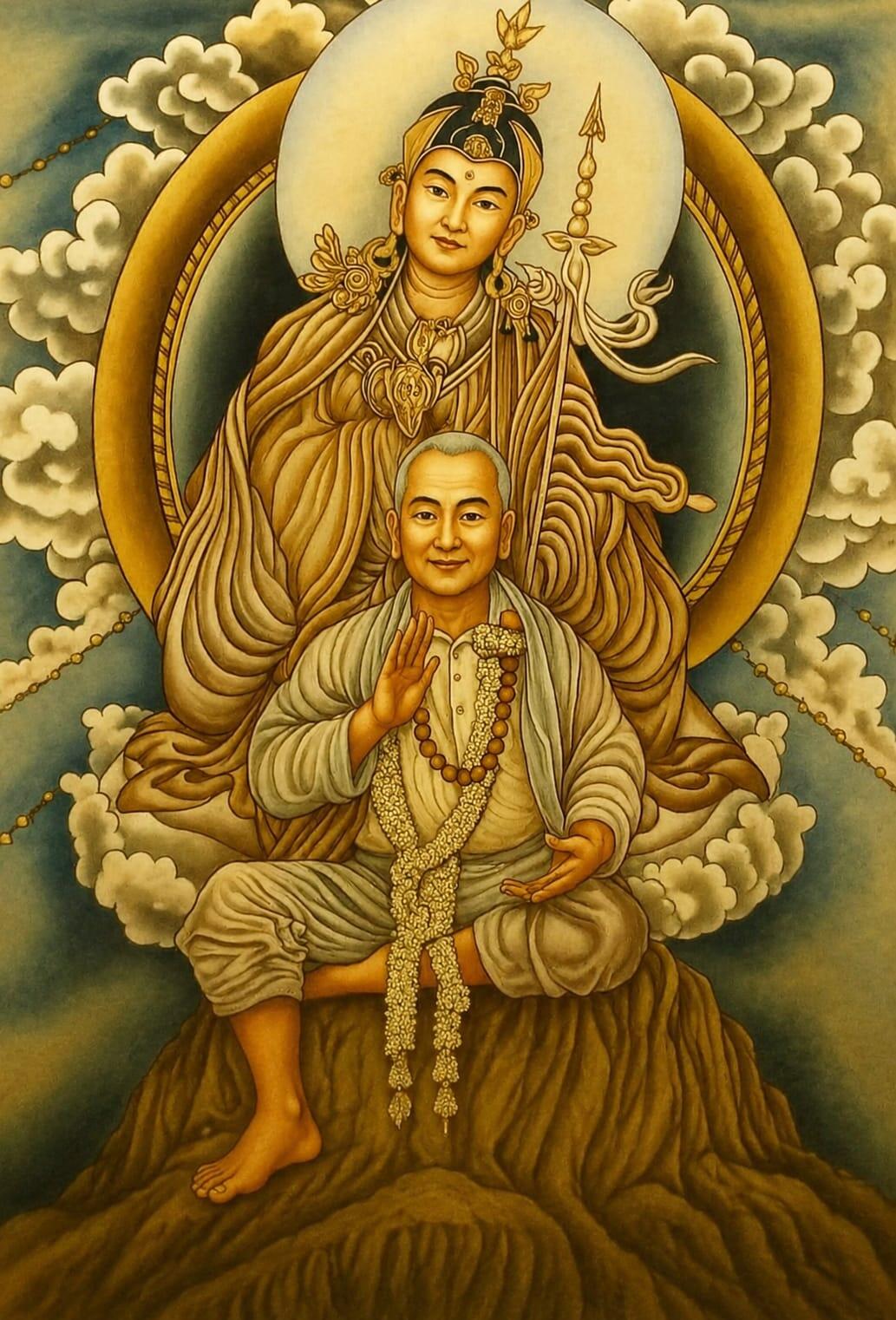

Padmasambhava sent his disciples by horse from Nalanda University, who took 3 months to reach. While he flew & reached the destination in 3 days, teleporting himself- the first public evidence of his application of the laws of quantum laws. He came to Tibet during the reign of Trisong Detsen. His mission was not simply to preach. He had to establish a spiritual foundation upon which Buddhism could survive. Traditional Tibetan accounts describe him confronting and subduing powerful local forces and converting them into protectors of the Dharma. He had already mastered & tamed the 5 elements of existence, water, earth, fire, air & sky/ space when they offered resistance. This is one of the great symbolic themes of his life. He did not simply destroy the indigenous spiritual world. Instead, forces that had previously obstructed the Dharma were transformed into guardians of it. He tamed each one with different technique. This became a characteristic feature of Tibetan Vajrayana.
Padmasambhava’s Tibetan mission became closely associated with Samye, traditionally regarded as Tibet’s first Buddhist monastery. Shantarakshita provided the scholastic and monastic foundation. Padmasambhava provided the tantric dimension. King Trisong Detsen provided royal patronage. Together they created an extraordinary Indian-Tibetan Buddhist transmission. Early Tibetan sources associate Padmasambhava with the construction and establishment of Samye. This became one of the most important turning points in the history of Tibetan Buddhism.
He gave enormous teachings to disciples in Tibet. The most dedicated Tibetan disciple of Padmasambhava was Yeshe Tsogyal. She became one of the most important female masters in Tibetan Buddhism. Yeshe Tsogyal is far more than a secondary character in Padmasambhava’s story. Tradition regards her as a great realised practitioner in her own right. Padmasambhava transmitted profound teachings to her.
She became one of his principal disciples and is associated with the preservation and concealment of many teachings. The Tibetan tradition later regarded her as a Dakini (Yogini) of extraordinary spiritual accomplishment.


She scripted all his teachings and concealed teachings in rocks, caves, lakes, temples, sacred landscapes and even within the mind-streams of future practitioners. This is one of Padmasambhava’s most extraordinary legacies known as the Terma tradition. These teachings were to be discovered when the appropriate time arrived. The individuals who discovered them were called Tertöns, or treasure revealers. This created a remarkable mechanism through which Padmasambhava’s teachings could continue appearing centuries after his physical lifetime. The distinction between the Kama, or transmitted oral/scriptural lineage, and Terma, the revealed treasure tradition, remains fundamental to the Nyingma tradition.
Indian scholars and Tibetan translators worked together to translate Buddhist scriptures, commentaries and tantric texts.
Padmasambhava always said, Wisdom is my father and Emptiness as his mother. Why “Mother”? Because the feminine principle represents the womb of potentiality. From Śūnyatā (Emptiness) ultimate nature of reality from which awakened wisdom arises. When the mind empties itself from “I,” “me,” “mine,” “success,” “failure,” the mind becomes spacious. Then Emptiness the spiritual womb from the awakened consciousness (wisdom) emerges from which something extraordinary becomes possible. Awakened activity with Active intelligence is the life of that realization.
Princess Mandarava of Zahor was an important disciple in Padmasambhava’s life. She became not merely his companion but a highly accomplished tantric practitioner. Padmasambhava gave her profound tantric teachings. According to the traditional account, the local king became furious when he discovered their relationship and attempted to punish Padmasambhava. A great fire was prepared. Yet when the flames disappeared, Padmasambhava and Mandarava were found alive, seated in meditation amid a miraculous lake. This sacred place is identified with Rewalsar in Himachal Pradesh, known in Tibetan as Tso Pema, the Lotus Lake.
If Tibet represents the great institutional transformation of Padmasambhava’s mission, Bhutan represents one of its most sacred landscapes. Bhutanese history traditionally places Guru Rinpoche’s arrival there around 747 CE. The Royal Bhutanese Embassy states that Padmasambhava visited Bhutan in 747 CE and introduced Buddhism there. Bhutan therefore regards him with extraordinary reverence. He is commonly called, Guru Rinpoche or the Precious Master and is one of the most important spiritual figures in Bhutanese history.

One of the most important Bhutanese chapters concerns Bumthang. According to Bhutanese tradition, Padmasambhava was invited by King Sindha Gyab, who was seriously ill. Padmasambhava came to Bumthang and healed the king. He subsequently subdued the local deity Shelging Karpo, who became associated with the protection of the Dharma. The Bhutanese tradition associates Guru Rinpoche with numerous sacred sites around Bumthang, including Kurjey, Kunzang Drak and Mebar Tsho.
Kurjey is one of Bhutan’s most sacred Guru Rinpoche sites. The name is associated with the imprint of Guru Rinpoche’s body. According to Bhutanese tradition, Padmasambhava meditated here and left his body imprint upon the rock. The site became Kurjey Lhakhang.
Another extraordinary sacred place is Mebar Tsho, the Burning Lake. It is particularly associated with the great treasure revealer Pema Lingpa, who later discovered sacred treasures connected with Guru Rinpoche’s tradition. His teachings were believed to remain embedded within the landscape and to reappear through enlightened treasure revealers.
And then comes perhaps the most famous Guru Rinpoche site in the world, Paro Taktsang, the Tiger’s Nest. Guru Rinpoche travelled to the site on the back of a tigress, traditionally understood to be an emanation of Yeshe Tsogyal. He meditated in a cave there and subdued the local forces. The site eventually became Taktsang Monastery. The Bhutanese heritage authority holds that he meditated there for three months, 3 weeks 3 days.

Padmasambhava is also represented through Eight Manifestations, each expressing a different aspect of his enlightened activity. Guru Rinpoche – the Precious Master, Guru Pema Gyalpo – Lotus King, Guru Shakya Sengé – Lion of the Shakyas, Guru Nyima Özer- Ray of the Sun, Guru Padmasambhava – Lotus Born, Guru Senge Dradrog – Lion’s Roar, Guru Dorje Drolö – Vajra Wrath & Guru Dewa Chenpo – Great Bliss. These are not simply eight different historical personalities. They symbolise different dimensions of enlightened activity.
One of his most enduring practices is Guru Yoga. The practitioner visualises the Guru above or before oneself, receives the blessing of wisdom, and ultimately recognises the inseparability of, Guru, Buddha, Dharma & one’s own awakened nature. The guru is therefore not merely a teacher giving information. The guru represents the awakened state itself. One of the most famous mantras associated with Padmasambhava is OM AH HUM VAJRA GURU PADMA SIDDHI HUM. It is traditionally understood as invoking the enlightened body, speech and mind of the Vajra Guru and requesting the accomplishment of spiritual realisation.
Padmasambhava is not merely a miracle-buddha but his deeper message concerns transformation. He taught that, fear can become courage, anger can become wisdom, desire can become discriminating awareness, ignorance can become clarity, attachment can become compassion, and even the most difficult aspects of human experience can become part of the path when approached with wisdom and disciplined practice. This is the heart of tantric Buddhism.


The earliest records establish an important Indian tantric master associated with the introduction of Buddhism into Tibet in the 8th century. Later biographies, from around the 12th century onward, greatly expanded his life into an enormous sacred narrative filled with miracles, manifestations, battles with spirits and hidden treasures. Therefore, there are effectively two layers of Padmasambhava & the historical Indian Vajrayana master and the sacred Guru Rinpoche of Tibetan and Himalayan Buddhism. The historical figure provides the human transmission.
After establishing Buddhism and giving extensive teachings, Padmasambhava eventually prepared to leave Tibet. He is said to have travelled toward the southwest, ultimately disappearing into the land of Cham or the Copper Mountain, where he is still prevails.
Disclaimer
Views expressed above are the author’s own.


