
Why Gurugram turns into Plato’s Atlantis every monsoon

Hello and welcome to the 104th edition of the Vine. First off, if you have been living under a rock or consumed by a black hole from which no information can escape, TOI has launched two excellent new LinkedIn newsletters that demand your immediate attention.
The first is From the Editor’s Desk by Indrajeet Rai (Editor, TOI Online), which casts an academic’s eye on what’s happening in India and the world and also compiles some of TOI’s best coverage.
Second, we will have Second Helpings by Prasad Sanyal, Times Internet’s Group Business Head, who loves food almost as much as the bottom line and, in his own words, has a “girth that speaks for itself” and is the “most comprehensive body of evidence that he has ever assembled on any subject”.
Now back to the Vine.
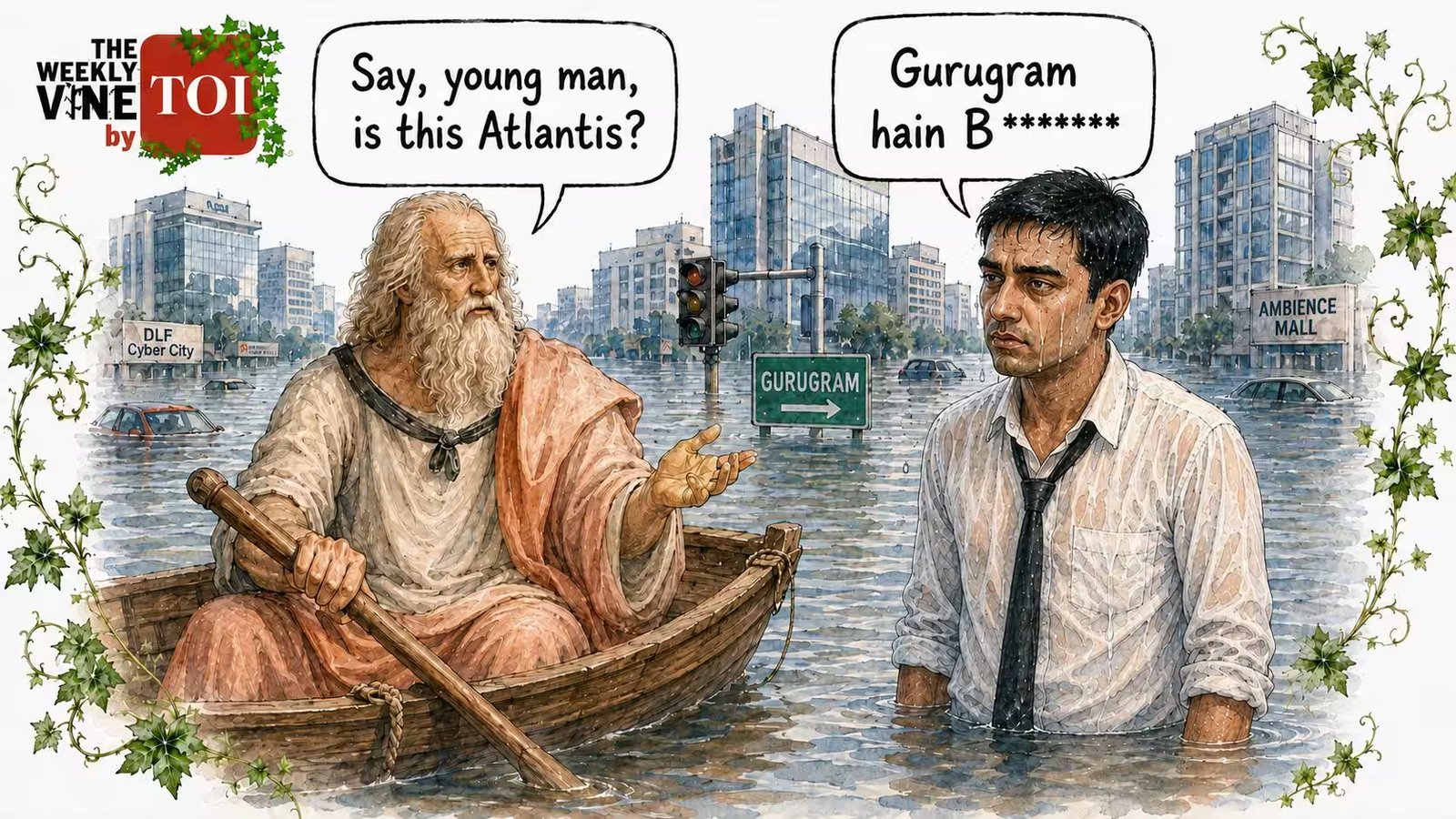
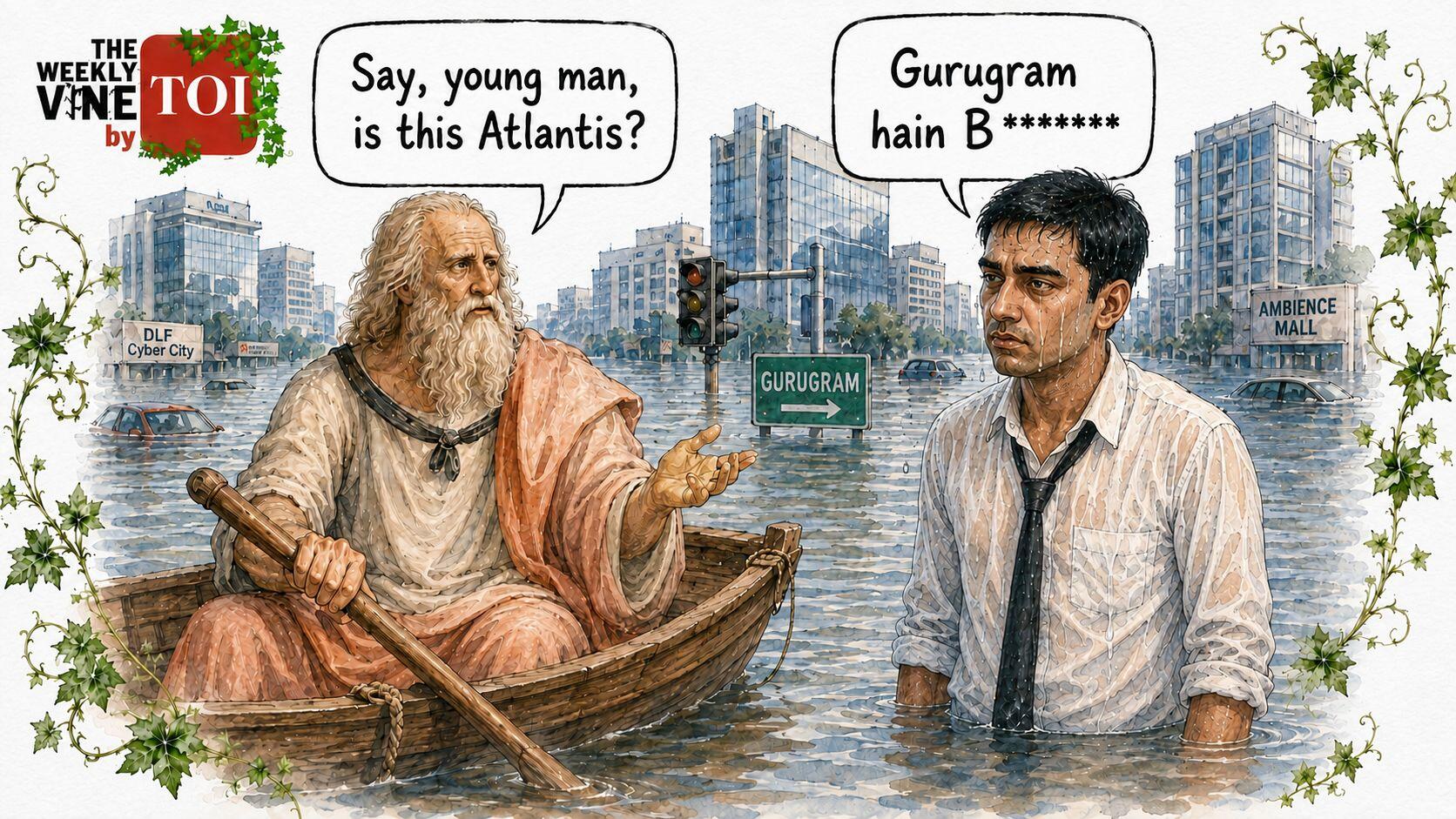
This week’s topic is again about water, but instead of Vining about its scarcity, we are going to take a deep dive, pun intended, into why the Millennium City starts to resemble Atlantis every monsoon. And if you think there’s a bit of déjà vu, you are not wrong: the Vine lamented that exact issue last year in Edition 57, which just shows that nothing changes over the years.
Gurugram = Atlantis 2.0
The Roman poet Juvenal rightly surmised that one could keep a populace suitably distracted with bread and circuses. And if you ever switch on a TV channel, you will realise he was bang on. We seem to have an infinite capacity for loquacious nonsense in this democracy that has no bearing on our everyday lives.
How many stanzas of a song ought to be sung?
What are the exact sartorial requirements for celebrating a patriarchal festival that celebrates fraternal-sororal relations?
How does one smash the patriarchy based on a book that almost no one follows and barely anyone has read outside sociology departments in left-liberal institutions? I swear, there are more Manchester United fans than Manusmriti followers in India in 2026.
It is honestly very tiring when we have so many literal life-and-death issues.
Potholes that swallow us whole.
Cities that require Bane masks to survive.
Bridges that lead to nowhere.
Streets that start to look like a Platonic prophecy the moment it starts to rain.
Which brings us to the modern iteration of Plato’s parable of Atlantis: Gurugram.
Now, most younger readers might be forgiven for thinking that Atlantis is the kingdom of Jason Momoa, but it’s a symbol for something much older.
Around 360 BC, Plato, the unfortunate philosopher whose name has become a curse word for incels, described a powerful and technologically advanced civilisation beyond the Pillars of Heracles at what we now call the Strait of Gibraltar. In Plato’s telling, the civilisation collapsed under the weight of its own hubris and societal decay.
If that sounds familiar, that’s exactly what happens to the post-capitalist dystopia masquerading as the utopia we call Gurugram.
The city attracts spiritual visits from nearby areas because it has liquor marts the way other cities have SBI branches, and it boasts glass towers, multinational offices and homes expensive enough to tank your cab-based start-up. And yet 75mm of rain can strand schoolchildren for hours, submerge its main roads and persuade the administration to ask the corporate capital of India to work from home.
There are various reasons for this, including greed, geography and politics. So let’s take a deep dive, pun intended.

The city sits at the foothills of the Aravallis, where rain falling on the hills rushes through Gurugram on its natural journey towards the Yamuna. This requires the city to handle both the water falling directly on it and the run-off arriving from a much larger uphill catchment.
The second problem is that greed overcame logic and the city destroyed much of its capacity to siphon off the water. A study cited by TOI showed that Gurugram had 519 water bodies in 1976, and four decades later, only 251 remained. These water bodies were connected to smaller ponds by nullahs, but many of those catchments and channels have since been encroached upon or severed. A few of the ponds, like government employees seeking pensions, exist only on paper. Instead, they are actually housing plots, construction waste, religious structures and even a former councillor’s office.
The result is that only around 20% of the city’s rainwater percolates into the ground, while roughly 80% flows into stormwater drains. Those drains were neither designed nor maintained to receive so much water so quickly.
All this run-off is forced into a limited drainage system with too few effective outlets.
The bottleneck helped create the 2016 “Gurujam”, when 52mm of rain paralysed the expressway. Once the main drains fill, smaller drains cannot empty into them. Water backs up, roads flood and pumps become useless because there is nowhere left to pump.
Gurugram is the perfect encapsulation in every way of a post-capitalist utopia, even more than Kerala. It was imagined as a collection of private colonies, office parks and gated complexes, each designed as an island of efficiency much like the Anglo-Saxon kingdoms that were brought together under King Aethelstan to counter the Vikings.
Inside the gates, there is power backup, private security and enough housekeeping staff to run a minor European principality. Outside, civilisation looks like it’s waiting for the Treaty of Westphalia.
This arrangement works until rainwater enters the group chat. Like Marxists, water doesn’t care for property relations, property lines or premium club memberships.
A colony can pump water out, but it cannot make the water disappear. It simply sends the problem next door, where another pump returns the favour. The city begins bailing water from one pocket into another like passengers on the Titanic arguing who gets to ride a boat or a door.
The central contradiction of Gurugram would make Plato chuckle: private enterprise created extraordinary wealth that would make Mammon jealous, but a functioning city required shared systems that no individual can purchase alone.
The construction economy also shaped what Gurugram chose to value.
Towers and malls produce jobs, investment and revenue that can be counted immediately. Open land and drainage channels look unproductive because their value becomes visible only when they are gone. One can sell a penthouse with an infinity pool; it is harder to sell buyers an empty patch of earth that prevents their SUV from becoming a submarine.
So construction raced ahead while civic infrastructure followed at the speed of a government file. By the time anyone asked where the water would go, the answer was usually beneath something too expensive to demolish.
In India, almost every political argument follows the same template: blame the government before you. That’s becoming a tad difficult with the same party in power for the last 12 years and even the same MP in Gurugram’s case. Admitting there was a problem, BJP MP Rao Inderjit Singh said that the current measures were a “Band-Aid” solution and blamed Congress-era development for the ills. Except that he is a six-time MP who spent his first two terms representing Mahendragarh as a Congress MP and his third, after delimitation, representing Gurugram.
Gurugram isn’t alone in the water-based chaos: both Delhi and Noida flood, but not in the apocalyptic way the Millennium City does. Delhi grew around an older drainage network, while Noida grew more systematically, extension by extension. Gurugram did the opposite: it built the profitable parts first and tried to stitch together the public city afterwards.
Its geography, vanished water bodies, concrete surfaces, fragmented construction and divided administration therefore combine with unusual precision. Heavy rain is merely the trigger. The flooding is the accumulated bill for decades of pretending that ecology is an obstacle to development rather than the ground on which development depends.
The cure does not require consulting the Oracle of Delphi. Gurugram must protect its natural channels and water bodies, maintain its drains and make one institution accountable for rainwater across the city. Most importantly, it must accept that open land is infrastructure too, even when nobody can put a sales office on it.
Plato’s Atlantis was destroyed after power and prosperity convinced its people that they had transcended natural limits. Gurugram expresses the same confidence in glass, steel and absurdly priced square footage. Every monsoon, the water arrives to conduct an audit.
Then the rain stops, the roads reopen and the city returns to selling aspiration by the square foot. The warnings are forgotten until the clouds gather again and the ancient paths, erased from official maps, reappear across highways and basements.
Perhaps we are living through Plato’s curse. Gurugram spent decades trying to forget where its water once flowed. Every monsoon, the water remembers. And hopefully, the Vine won’t be repeating the same lament next year.

Disclaimer
Views expressed above are the author’s own.