
Breathing – The health intervention most of us overlook

This post (#77) is inspired by a conversation with my friend Rohit Gaikwad, an engineer and technology leader with a PhD, who is also a certified yoga teacher and advanced practitioner. What made this conversation with Rohit really interesting is not just what he knows, but how he thinks. He is a first-principles thinker who wants to understand why something works, gets his own hands into the details, and only then talks about it. That curiosity pulled us into a long conversation about something we all do roughly 20,000 times a day without a second thought: breathing. So it wasn’t a surprise that this podcast clearly resonated, and had the highest attendance of my 59 podcasts to-date.
Automatic does not mean optimal
We assume that because breathing happens on its own, we must be doing it well. We make the same mistake with walking, sitting, and sleeping. The body can run these functions automatically, but automatic is not the same as optimal.
Rohit came to this the long way around. Back pain in his 30s pushed him into strength training. Years later, nagging stiffness pushed him into yoga, and the deeper he went, the more he saw how much breathing shaped both body and mind. Which raises a simple question. If breathing matters this much, why do so few of us ever learn to do it well?
The real reason we breathe
Ask most people why we breathe and the answer seems obvious: to get oxygen. That is true, but it is only half the story. The surprising part is that the main signal telling you to take a breath is not a shortage of oxygen. It is the build-up of carbon dioxide. We tend to treat carbon dioxide as pure waste, yet it does far more than that.
Think of your body as a city. Oxygen is the fleet of delivery trucks bringing supplies to every neighborhood. Carbon dioxide is the fleet of garbage trucks carrying waste away. Most of us obsess over the delivery trucks. But if the garbage trucks stop moving, the city grinds to a halt. Your body is no different.
Why carbon dioxide is not just waste
Here is where it gets counterintuitive. Many endurance athletes deliberately train their tolerance to carbon dioxide. Why would anyone want more of a so-called waste gas?
The answer lies in how oxygen reaches your cells. Picture a red blood cell as a taxi, and hemoglobin, the protein that ferries oxygen, as the driver. Oxygen is the passenger. The taxi picks up oxygen in the lungs and drives it out to your muscles and organs. But the passenger does not step out on its own. Carbon dioxide is what unlocks the door. When enough of it is present, hemoglobin lets go of its oxygen and releases it into the tissues that need it. This is a real and long-established effect, named the Bohr effect after the scientist who first described it in 1904.
This is part of why runners, cyclists, swimmers, and even soccer players can sustain effort for so long. Endurance depends on many things, from a strong heart to well-trained muscles, but a higher tolerance for carbon dioxide is one piece of it. It lets them breathe efficiently instead of over-breathing, and it helps working muscles pull oxygen from the blood right where it is needed. There is even a simple way to gauge your own tolerance, sometimes called the BOLT test. After a normal exhale, you hold your breath and time how long you last before the first natural urge to breathe. This is not a maximum breath-hold test, and you should stop well before you are gasping for air. Under ten seconds is poor. Forty seconds or more is elite. Follow the breathing exercises at the end of this post to help increase your score.
A powerful reset for stress
The athletic angle is interesting, but the part that I found especially intriguing was the role breathing plays in stress management.
Imagine you are stuck in traffic on the way to the airport and your flight boards in twenty minutes. Your heart races, your blood pressure climbs, your breathing turns shallow. Your body behaves as if it is under physical attack. Now picture yourself on a quiet beach at sunset. Same body, completely different state.
The difference is your nervous system, which runs in two modes. One is fight-or-flight, the alarm state your ancestors needed to escape a predator. The other is rest-and-digest, the recovery state where the body calms down and repairs. Modern life keeps many of us stuck in the alarm state, because the body treats emails, deadlines, and money worries as if they were lions.
Here is the practical part, and it is genuinely empowering. Almost everything in that alarm response runs automatically and is beyond your direct control. You cannot simply decide to lower your heart rate or your blood pressure. But you can change your breathing. And because breathing is wired into the same control system, slowing it down sends a signal that flips your body from the alarm state toward the calm one. Your breath is one of the levers that lets you reach in and reset. So the next time your chest tightens before a meeting or in traffic, that is the move: slow the breath down, lengthen the exhale, and the body follows.
The exhale is the more important half
Most people think deep breathing means a big breath in. The bigger lever is actually the breath out.
To see why, it helps to know about the vagus nerve. It is the longest nerve of the calming, rest-and-digest system, running from the base of the brain down through the neck and chest to the heart, lungs, and gut. Think of it as the main cable connecting your brain to your internal organs, and the master dial for slowing things down. As you breathe out slowly, the pressure inside your chest changes. Tiny sensors in your lungs, heart, and major blood vessels detect these changes and send messages to your brain. The brain responds by sending calming signals back through the vagus nerve. In response, it releases a messenger chemical called acetylcholine that acts like a brake, slowing the heart and easing blood pressure. This is not just a feeling of calm in your head. It is a measurable shift in the body, and you can often notice it within a minute. Several of the techniques at the end of this post are built on exactly this principle, the long, unhurried exhale.
Breathe through your nose
One of the clearest takeaways was to breathe through your nose. Many of us drift into mouth breathing, especially when stressed, exercising, or asleep.
Your nose does far more than let air in. It filters, warms, and humidifies it. It also produces nitric oxide, a gas your body uses to widen blood vessels and improve blood flow, and which has germ-fighting properties too. Athletes and supplement companies spend a fortune trying to raise their nitric oxide. One of the simplest ways to boost it is free: breathe through your nose, and add a little humming. In a study from Sweden’s Karolinska Institute, humming raised the nitric oxide measured in the nose roughly fifteenfold compared with quiet breathing.
This is where ancient practice turns out to have been ahead of science. The yogic humming breath, called Bhramari, is built entirely on that low, buzzing hum. So, in a quieter way, is the chant of OM. The drawn-out “mmm” at the end of OM is a hum, and the vibration it creates appears to stimulate the vagus nerve through a small branch that runs near the ear. In one brain-imaging study, chanting OM quieted the brain’s emotional centers in much the same pattern seen with medical vagus nerve stimulation. Thousands of years before anyone could measure nitric oxide or scan a brain, these traditions had already organized themselves around humming and slow, nasal breathing. Whether by observation, experience, or careful practice, these traditions emphasized techniques that modern science is now beginning to investigate.
What this means for longevity
I have written before about the main longevity levers, including strength and muscle mass, VO2 max, nutrition, and sleep. Breathwork does not replace any of them. But it may quietly support all of them.
The potential benefits read like a longevity checklist: a lower resting heart rate, higher heart rate variability (the small, healthy beat-to-beat variation in your pulse that tends to rise as you grow fitter and calmer), lower blood pressure, less stress, better recovery, and possibly lower chronic inflammation by way of that same vagus nerve. These are the very markers many of us already track with wearables and blood tests. The difference is that breathwork needs no equipment, no membership, and no prescription. Just practice.
A practical guide to the different breathing techniques
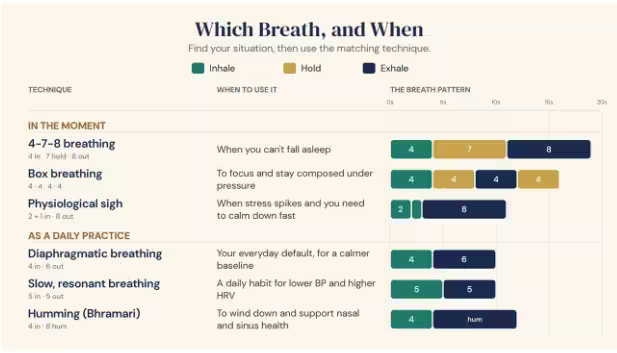
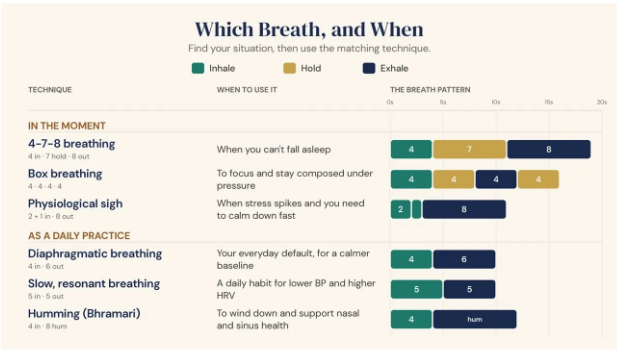
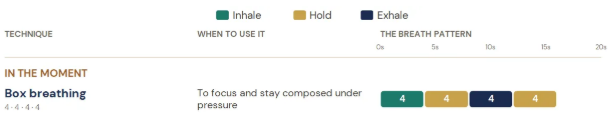
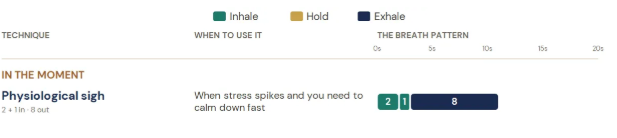
If you want to put this to use, try and do this for five to ten minutes a day consistently. Here are the most popular practices, with slightly different areas of application. The first three are what you can choose from to incorporate as a daily practice while the next three are ones you can use on an as-needed basis, depending on what situation you are in.
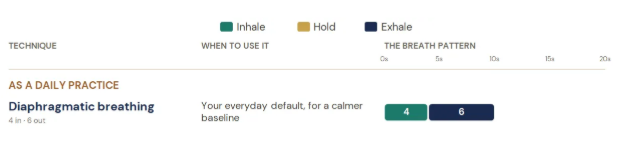
Diaphragmatic, or belly, breathing. This is the foundation for everything else. The diaphragm is the dome-shaped muscle just below your lungs. When you use it well, your belly gently rises as you inhale and falls as you exhale, rather than your shoulders lifting in a shallow chest breath. Breathing this way draws air into the lower lungs, where the exchange of oxygen and carbon dioxide is richest. As a bonus, the diaphragm’s movement acts as a pump for the lymphatic system, the body’s waste-clearance network, helping it move fluid and clear waste. How to do it: breathe in slowly through your nose for about four seconds, feeling the belly expand, then out gently for about six. The benefit is a calmer baseline and fuller, more efficient breaths.

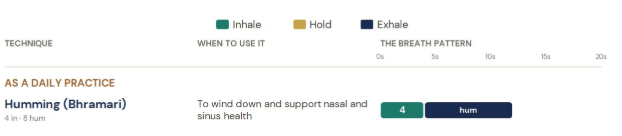
Humming breath (Bhramari). Breathe in through the nose, then hum on a long, slow exhale, feeling the buzz in your face and head. This is the nitric oxide booster. Best for calming down and supporting nasal and sinus health.

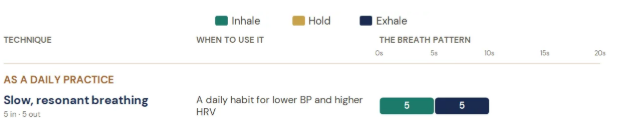
Slow, resonant breathing. Settle into roughly five to six breaths a minute, about five seconds in and five seconds out, for a few minutes. In his book Breath, James Nestor calls this unhurried pace the perfect breath, and it is the pattern behind the blood pressure and heart rate variability benefits. Pooled analyses of randomized trials show slow breathing can lower blood pressure by a few points, with breath-driven methods such as pranayama working at least as well as the commercial gadgets sold to do the same thing. It will not replace medication, but it is a free, low-risk daily practice.

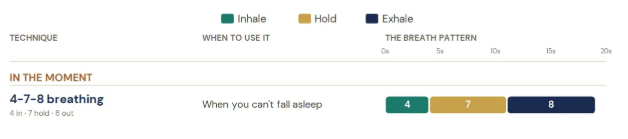
4-7-8 breathing. Inhale through the nose for four counts, hold for seven, and exhale through the mouth for eight. The long exhale and short hold tip you toward the calm state. Best used before sleep or to settle nerves.



Summary
Breathing practices have endured across so many cultures for thousands of years. You do not need to become a yogi or meditate for an hour. You only need to pay attention to something you already do thousands of times a day. And unlike almost everything else competing for your attention, your breath is always happening right now, in the present moment.
As always, I would love to hear your thoughts and experiences in the comments.
Nickhil Jakatdar is the CEO of GenePath Diagnostics and the founder of PreventiveHealth.ai, working to make advanced diagnostics and credible health guidance more accessible, affordable, and actionable. A PhD in EECS from UC Berkeley and the youngest recipient of the UC Berkeley Distinguished Alumnus Award, he has founded and led multiple tech companies. He holds 60 patents, and serves on several academic, healthcare, and innovation boards. To follow his thinking on preventive health, technology, and systems that scale expertise, join his private WhatsApp community and subscribe to his Substack.
Disclaimer
Views expressed above are the author’s own.