
Einstein’s equation that changed how we see the universe
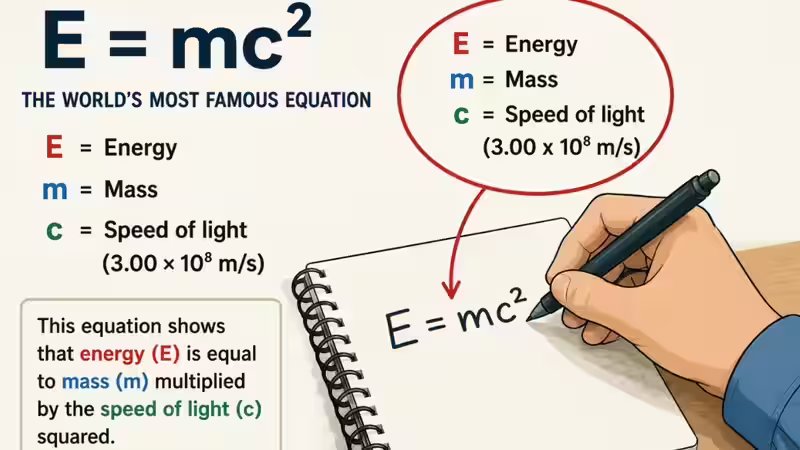
The language of modern physics is math, which makes its appreciation difficult outside the club of physicists and mathematicians. People are not interested and sometimes intimidated in reading physics written in mathematical formulae, which makes no sense to them. However, one formula of physics has captured public imagination more than anything else, i.e., E = mc2. Given by Einstein, it is arguably one of the most famous equations in the world of physics. Its popularity and public acknowledgement are so high that Stephen Hawkins, while accepting that each equation included in the book would halve the sales, has included this equation in his hugely popular book, “A Brief History of Time.”
There could be several reasons for the huge popularity of this formula. It symbolizes the triumph of simplicity in expressing fundamental working of the universe. Its appeal comes from the long-held philosophical view that the workings of the cosmos ought to be elegant. Einstein himself believed that the math describing nature should be simple and elegant. The popularity of the author (Einstein) of this formula has also contributed to its popularity. It appears, nevertheless, that the public popularity of this formula mainly stems from its profound implications and the possibility of attaching esoteric meanings to it.
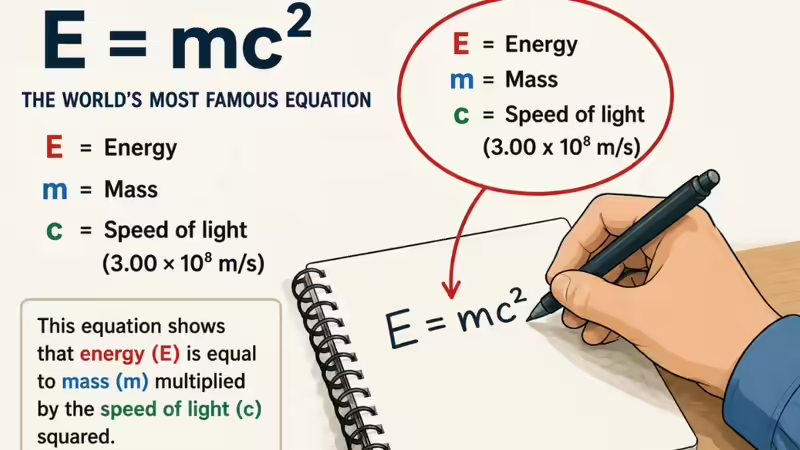

E = mc2 is the simplest but most powerful equation ever written. There are only three parts to it: E or energy; m or mass; and c or the speed of light. As ‘c’ is constant which works as the conversion factor only, it can be ignored for the meaning of this equation. Accordingly, the equation then simply comes out as the equivalence of mass and energy or E=m. This meaning is so profound and revolutionary that Einstein himself put it: “It followed from the special theory of relativity that mass and energy are both but different manifestations of the same thing — a somewhat unfamiliar conception for the average mind.” In other words, this equation linked two quantities (mass and energy) which, as per earlier thoughts, had nothing to do with each other.
This linking of mass and energy expressed by this formula has attracted a lot of interpretation, misinterpretations, esoteric meanings, pseudo-science and philosophical imagination around it. Many have taken a leap of imagination to describe it as matter turning into energy and vice versa; or saying that energy and matter are same things. There are many science books and websites equating matter with energy while explaining this formula. They generally consider matter as concentrated energy. On the other hand, there are many religious and pseudo-science interpretations of this formula ranging from connecting material and non-material to attaching soul and body/ God and world, etc.
These viewpoints, however, have elementary flaws. In E = mc2, the letter ‘m’ stands for mass and not for matter. The source of this confusion goes back to Newton itself. In Newtonian physics, the mass of an object is the “quantity of matter” inside it. The more matter an object is made from, the more massive it will be. If one accepts this view, then it requires only a small step to infer that E = mc2 is basically indicating matter-energy equivalence. In modern physics, however, energy and matter are different conceptual categories. Both mass and energy are properties of matter while matter is a substance that objects are made from. One cannot make an object purely out of properties like mass or energy as one cannot make an house purely out of properties like length and volume.
Pre-Einstein physics, particularly Newtonian, treated mass and energy as separate quantities. Mass was considered as the quantity of matter inside an object that remained constant, while energy was something that an object possessed due to its motion (kinetic energy) or position (potential energy) and therefore remained variable. Einstein refined Newton’s view by explaining that mass and energy both come in many flavors (rest mass, gravitational mass, relativistic mass, intrinsic energy, relativistic energy, etc.) and separating rest mass from other types of mass. Rest mass is mass of an object measured by an observer, with respect to whom the object is stationary. Whereas the relativistic mass is mass measured by an observer, with respect to whom the object is at motion. As speed of motion is observer dependent and being stationary is observer independent, an object’s rest mass is invariant and intrinsic to the object. In contrast to pre-Einstein physics, one of the implications of E = mc2 is that even rest mass has an energy inherent to it. This also indicates how pre-Einstein definitions of mass go wrong. Instead of the quantity of matter inside, an object’s rest mass is the quantity of energy inside. In other words, the rest mass of an object arises from the energy stored within it.
Here we come at the edge of the current scientific knowledge about matter, mass and energy and philosophy starts getting primacy over science. Some of main philosophical questions concerning the interpretation of E = mc2 are whether mass and energy are the same or different properties? And does mass-energy conversion actually happen?
There are mainly three philosophical/ scientific answers given to it. One view says that mass and energy are the same property and, therefore, talking of their conversion into each other is meaningless. Mass and energy are just two ways of measuring the same thing, like parallax and distance of a star are two ways of expressing its location. Mass and energy while being the same property appear as different properties because they are measured in different units. Physical processes (in which the emission of energy by an object is correlated with the decrease in the object’s mass) also indicates that mass and energy are not different but same property of any physical system.
Another view considers mass and energy as different properties which, therefore, cannot convert into each other. As “=” sign in m = ρV (where m is mass, V is volume, and ρ is density) doesn’t make mass and volume equivalent, similarly “=” sign in E = mc2 doesn’t make mass and energy equivalent. Objects including atoms and nucleons are made of constituents, and the purported conversion of mass and energy is merely a transformation of energy among the constituents of objects during the reaction.
Yet another more pragmatic and evidence-based view says that while mass and energy are different properties, mass-energy conversion actually happens. This view accepts that structureless particles (like electron) exist. If such particles exist, then the energy liberated in their reaction (for example, in electron-positron annihilation) cannot be explained as transformation of the energy originally possessed by the constituents of the reacting particles. One has to pragmatically accept that E = mc2 means that some or all of the mass of such particles “disappears” and an equivalent amount of energy “appears” within the relevant physical system through actual conversions of mass into energy.
All these views have their own merits and demerits. These questions are currently at the edge of our knowledge and understanding and may be better answered in future. For example, different property but actual conversion view fails to explain how magically one property is converted into other property or how energy gets converted into rest mass of an object? Similarly, different property but no conversion view fails to address reactions of indivisible structureless particles in which the energy liberated cannot be explained as transformation of the energy originally possessed by the constituents of the reacting particles. However, one can always hope that in future, physics will answer these questions and reveal such mechanisms.
Disclaimer
Views expressed above are the author’s own.