How India became the new powerhouse of global chess

From Chaturanga to world champions, India’s enduring love affair with the 64 squares is inspiring a new generation.
July 20 is World Chess Day. It commemorates the founding of the International Chess Federation (FIDE) in 1924. More than just a celebration of a board game, the day honors one of humanity’s oldest intellectual pursuits—a game that transcends language, culture, age, and geography.
For India, however, World Chess Day carries a deeper significance. Chess is not merely a sport imported from elsewhere; it is widely believed to have originated in ancient India as Chaturanga, a strategic game played over 1,500 years ago. Today, after centuries of evolution, India has returned to its roots. The country that gave the world chess is now producing some of its brightest stars.


From school classrooms and community clubs to international tournaments, chess has become one of India’s fastest-growing sports. Teenage grandmasters are defeating seasoned champions, and Indian players are dominating global rankings, leading to a chess renaissance in the country.
A game born in India
Most historians trace the origins of modern chess to Chaturanga, a strategy game played in the Gupta Empire around the sixth century CE. The game eventually traveled through Persia, where it became Shatranj, before spreading across Europe and evolving into modern chess.
Although historians continue to debate certain aspects of chess’s early evolution, India’s role in its development Historians widely acknowledge India’s significant role in the early evolution of chess, despite ongoing debates about certain aspects. This historical connection gives World Chess Day special resonance for Indians, reminding us that one of the world’s greatest intellectual games has roots in our civilization.
The Viswanathan Anand revolution
No discussion about Indian chess is complete without Viswanathan Anand.
Before Anand emerged on the international stage in the late 1980s, chess occupied only a niche place in Indian sports. Cricket dominated headlines, while chess remained largely confined to enthusiasts.
Anand changed everything.
Known for his lightning-quick calculations and calm demeanor, Anand became India’s first Grandmaster in 1988. Over the next three decades, he won the World Chess Championship multiple times, inspiring millions of Indians to take up the game.
His achievements transformed public perception. Parents began encouraging children to learn chess not only as a competitive sport but also as an activity that sharpened concentration, patience, and analytical thinking.
Anand’s legacy extends far beyond trophies. He built the foundation upon which today’s remarkable generation of Indian chess talent now stands.
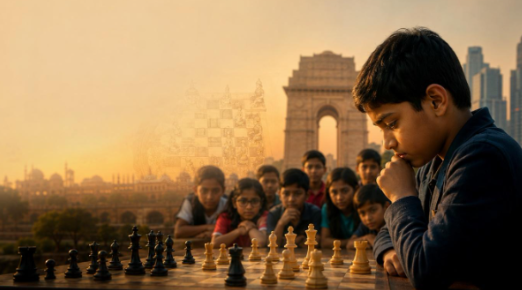

The most exciting chapter in Indian chess may well be unfolding today.
Young Indian grandmasters are consistently challenging—and defeating—the world’s strongest players. What makes this rise extraordinary is not merely the number of talented players but their age.
Teenagers such as D. Gukesh, R. Praggnanandhaa, Arjun Erigaisi, Nihal Sarin, and Aravindh Chithambaram have emerged as global contenders.
India has also produced exceptional women players, including Koneru Humpy and Harika Dronavalli, as well as rising stars such as Vaishali Rameshbabu, proving that Indian chess talent spans both genders.
Their fearless style and remarkable maturity have earned admiration across the chess world. Today, international commentators increasingly describe India as the future center of global chess.
Why Indian children are excelling
Several factors have contributed to India’s chess boom.
The first is accessibility. Unlike many sports, chess requires minimal infrastructure. A chessboard, an internet connection, and a willingness to learn are often enough to begin.
Secondly, online platforms have democratized training. Children from small towns can now play against opponents from every continent, analyze games with powerful computer engines, and learn directly from grandmasters through online lessons.
The COVID-19 pandemic accelerated this digital transformation. As families searched for meaningful indoor activities, chess experienced an unprecedented surge in popularity.
Schools, too, have embraced chess. Many educational institutions now include the game in extracurricular programs, recognizing its ability to improve memory, concentration, planning, and problem-solving skills.
More than just a sport
Chess is frequently described as the “gymnasium of the mind.”
Scientific studies suggest that regular chess practice can strengthen cognitive skills such as logical reasoning, pattern recognition, decision-making, and strategic planning. While playing chess alone does not guarantee academic success, it encourages disciplined thinking that benefits students throughout life.
The game also teaches valuable life lessons.
Every move has consequences.
Success requires patience rather than impulsiveness.
Mistakes cannot always be undone, but they can become learning opportunities.
These lessons resonate far beyond the chessboard.
India’s expanding chess ecosystem
India’s chess ecosystem has matured dramatically over the past decade.
State associations, private academies, schools, and corporate sponsors now organize tournaments across the country.
International competitions hosted in India have brought the world’s best players closer to Indian audiences.
The growth of livestreaming and social media has further transformed the sport. Grandmaster matches attract millions of online viewers, while chess creators explain strategies in simple language that appeals to beginners.
Artificial intelligence has also revolutionized preparation. Powerful chess engines help players analyze positions with astonishing precision, enabling even young competitors to reach world-class standards much faster than previous generations.
Chess in the digital age
Technology has changed not only how chess is played but also how it is consumed.
Fans can watch live tournaments from anywhere, follow computer evaluations in real time, and learn opening theory through interactive platforms.
Indian content creators have contributed significantly to this movement by producing tutorials in English and regional languages, making chess accessible to a much broader audience.
The digital revolution has ensured that geography is no longer a barrier to excellence.
Lessons beyond the board
Perhaps the greatest gift of chess is its relevance to everyday life.
Business leaders value strategic thinking.
Doctors rely on careful diagnosis.
Engineers solve complex problems.
Students prepare for competitive examinations.
In every field, success often depends upon anticipating consequences, evaluating alternatives, and remaining calm under pressure—the very qualities that chess nurtures.
For children especially, the game teaches resilience. Losing a match becomes less about failure and more about understanding what went wrong and improving next time.
Celebrating World Chess Day
World Chess Day offers an opportunity for everyone—not only professionals—to reconnect with this timeless game.
Schools can organize friendly tournaments.
Families can spend an evening around a chessboard instead of in front of a television.
Libraries and community centers can introduce beginners to the basics.
Even a single game can ignite a lifelong curiosity.
For India, the celebration is also a tribute to a remarkable journey. From the ancient invention of Chaturanga to producing world champions and teenage prodigies, the country has reaffirmed its place at the heart of global chess.
As India’s young grandmasters continue to challenge the world’s best, they remind us that chess is more than a game of kings and queens. It is a celebration of intellect, imagination, discipline, and perseverance.
This World Chess Day, perhaps the best move is also the simplest: set up a chessboard, make the first move, and discover why this ancient Indian legacy continues to captivate billions worldwide.
Disclaimer
Views expressed above are the author’s own.