
Upholding Darwin’s theory of evolution: Baya weavers’ ‘genius’ nests may be nature’s most brilliant snake-deterrent
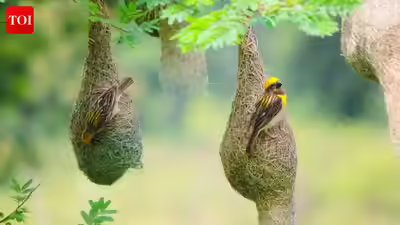
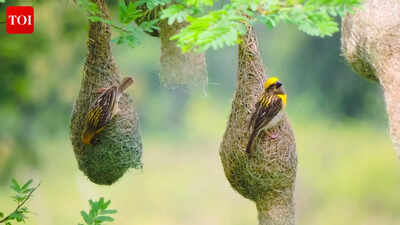
If Charles Darwin could scroll through today’s wildlife videos, we bet he’d pause at footage of the baya weaver and say, “Now that’s natural selection at its finest.”Over 150 years ago, Darwin introduced us to evolution by natural selection, primarily in his 1859 book ‘On the Origin of Species’, which states that organisms with traits that fit their environment best have a better shot at surviving and passing on those traits.A century and a half later, a tiny weaver bird is proving his theory right!
Baya weaver: The bird following the Darwinian theory
So, let’s talk about this little bird here — the baya weaver. It’s a sparrow-sized bird, yellow-crowned, found all over India and much of South and Southeast Asia. At first glance, it looks pretty plain — nothing extraordinary. But wait till you see the work of art and functionality it manages to build!During breeding season, look up at a palm, and there’s something wild hanging from the branches: these nests that look like lanterns or upside-down bottles, or, as one internet user put it, “nature’s most overengineered apartment complex.”
The science behind the work of art
Now, here’s the thing: scientists think these nests are one of evolution’s smartest answers to a problem that’s as old as nests themselves — snakes on the hunt for eggs.Lately, researchers and bird lovers have been discussing the weaver’s nest, especially its long entrance tunnel that points downwards. It really does look like something built specifically to drive snakes crazy. Instead of a standard nest, the male weaver weaves a hanging basket out of grass and leaves, suspends it from the thinnest branches, often over water, and tops it off with this narrow, downward-facing entry tube. Getting to the eggs means a predator has to grab onto a swinging, dangling thing, wiggle through a tight tunnel, then scramble face-up into the nest chamber. For a snake, that’s like trying to rob a bank while hanging upside down from a rope bridge, that too, during an earthquake.In fact, there’s actual data behind this. A major study in “Proceedings of the Royal Society B” showed birds with hanging nests and entrance tunnels lose fewer nestlings to predators, and their chicks live longer and develop for more days before leaving the nest. Simple math: safer homes, more baby birds make it.Scientists call it “convergent evolution” when unrelated bird families — like weaverbirds and icterids — both end up building similar elaborate hanging nests. Different birds, same problem (predators), and evolution invents pretty much the same solution.The really astounding part? Baya weavers don’t “know” anything about snakes or blueprints. Evolution works without conscious thought. The birds that just happened to build trickier nests raised more chicks, and, generation by generation, those nesting instincts won out.As one Reddit user put it: “It’s not understanding. It’s the form that survived.”Now Darwin would’ve loved that take!
Decoding baya weaver’s ‘brilliance’
But it’s not just about beating snakes. Baya weaver nests are also climate-control masterworks. Research out of Malaysia says these nests actually help steady temperature and airflow inside, making a comfortable nursery for the chicks. Depending on the local weather, weavers tweak the way they build, like contractors working to code.Then, as studies show, there’s the nest-building demarcation as well. Males do almost all the work: twisting grass and leaves into elaborate structures with nothing but their beaks and feet. They show off a half-finished “helmet” nest to attract a female. She inspects. Sometimes she approves, and he keeps building, but if not? He abandons it and starts from scratch. Turns out, nest quality is a dealbreaker; a ramshackle nest gets rejected, but a sturdy, safe one helps the male get the girl.Good architecture, it seems, is an impressive feat in the bird world!Put it all together: design, climate adaptation, snake defense, even romance—all woven into one swinging creation.However, snakes haven’t exactly quit, either — that’s how nature’s tug-of-war goes on. Predators and prey keep pushing each other to evolve trickier moves. But if you’re looking for a living example of how natural selection shapes behavior, look up at a baya weaver’s nest.But the brilliance of baya weaver’s nests is basically a reminder that genius solutions can come from a slow grind of trial, error, and survival — not from conscious thought or grand plans. The baya weaver’s nest hangs there in the monsoon wind, not understanding a thing about Darwin, evolution, or engineering, and yet, it beats all three at their own game.Now, that’s a real practical flex!