36 years later, what Sarla Bhat’s photo asks of us
For 36 years, Sarla Bhat existed in two different archives. In one, belonging to the state, she was just 56/1990, the number of the FIR filed after her body was found on a road in Srinagar on April 19, 1990. Alongside her name were a few cartridge cases and a formality of a post-mortem report. After three decades, a chargesheet has been added to that archive — filed by the police against those it believes abducted, tortured and murdered her.
From that April until now, she has existed in public memory only as a victim. In every conversation, the story of the young nurse was evoked, becoming a symbol of the terror that led to the Kashmiri Pandit exodus. But her face remained absent. In the post-truth world, somebody else’s photos became her face. But it was not her; history had remembered the event while forgetting the person.
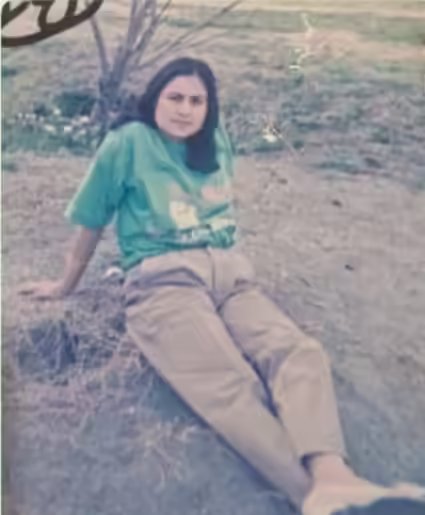
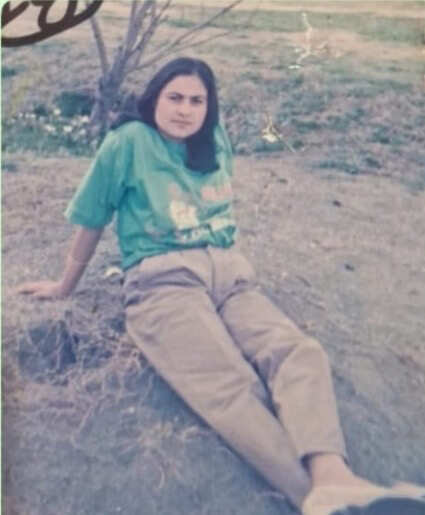
But there was another archive, the one belonging to her family. It contained her photograph: a young woman sits in a garden, on a patch of earth, leaning back on her hands. She wears an oversized green T-shirt and beige trousers with her legs stretched out before her. She looks at the camera without self-consciousness, without curiosity. It is an ordinary photograph, the kind that families once tucked into albums and forgot about until time itself made them precious. Nothing in the image announces history; nothing foretells violence; nothing suggests that her name would be known, but not her face. This gives the photo an extraordinary force. It does not return us to the moment of her death; it is a frame in which there is only life.

There is a Sebaldian quality to it. It appears almost unexpectedly, exposing the gaps in our remembering. There is also a police photo that shows her corpse from a little distance. She lies on the roadside, next to a wall, by an electric pole. In the background, half cut off from the frame, are what look like four policemen. Her body lies all alone in the wretchedness of the fantasy of “azaadi”. No one comes to cover her or to carry her home. She remains there through the night until morning, when the police finally remove her body. In that interval lies an entire moral catastrophe, a society in which a woman could be violated, killed, and left exposed to the night just because she is a Hindu. They did not care that till a few hours ago, as a nurse, she had been caring for their infants in Ward 7A of her hospital’s neonatology department.
Today, however, we must remember Sarla as the young woman you see in the photo. We must remember the hope of a woman in her early twenties, of her living the sentiment of the poet Dina Nath Nadim’s immortal lines: Mei chham aash paghe’cch, pagah sholi’e duniya (I have hope for tomorrow, tomorrow the world will be aglow).
French philosopher Roland Barthes recalled Baudelaire’s phrase about “the emphatic truth of gesture in the great circumstances of life.” The force of Sarla’s photograph lies precisely there. Here, she is not abstract yet; she is a young woman in a fashionable tee; here she is Sarla, not simply a Pandit.
Terror does not only mean death; it also means a recalibration of perception. In the Kashmir of 1990, it transformed ordinary acts into calculations of survival. The walk towards home could be disrupted; there could be a knock on the door; one’s name could appear on a hit list. Anthropologist Michael Taussig describes this as the making of a “nervous system,” in which terror shifts from violating acts of violence into the smallest heartbeats of everyday life. Fear thus ceases to arrive from outside, instead becoming internal. Seen through that lens, the photograph preserves not merely a person, but a way of inhabiting the world before fear entered its nervous system.
Today, when we look at Sarla Bhat, who was 23 when she was killed, we cannot not know what followed. We know that history is approaching from outside the frame. We know that this ordinary afternoon belongs to a future that will soon disappear.
That is why, from now on, we must celebrate her life. The Pandits observe a few eventful dates each year to commemorate those who fell in the madness of 1989-90 (and afterwards). Maybe it is time to live a full life on Sarla’s behalf because she could not. French writer Georges Perec speaks of the “infra-ordinary”, of discovering what usually escapes notice. We must do that for Sarla, we must imagine how she lived, in all the minute, repetitive and unrecorded details that constitute a human life.
Perhaps, on April 18, wherever we are, we should go to a garden or a park, wear whatever makes us feel beautiful, have our ice cream, or coffee, or panini, read a poem on a bench, simply inhabit, deliberately and gratefully, the life that Sarla was denied. We must make the world aglow for her.
Pandita is the author of ‘Our Moon Has Blood Clots: A Memoir Of A Lost Home In Kashmir’
Disclaimer
Views expressed above are the author’s own.