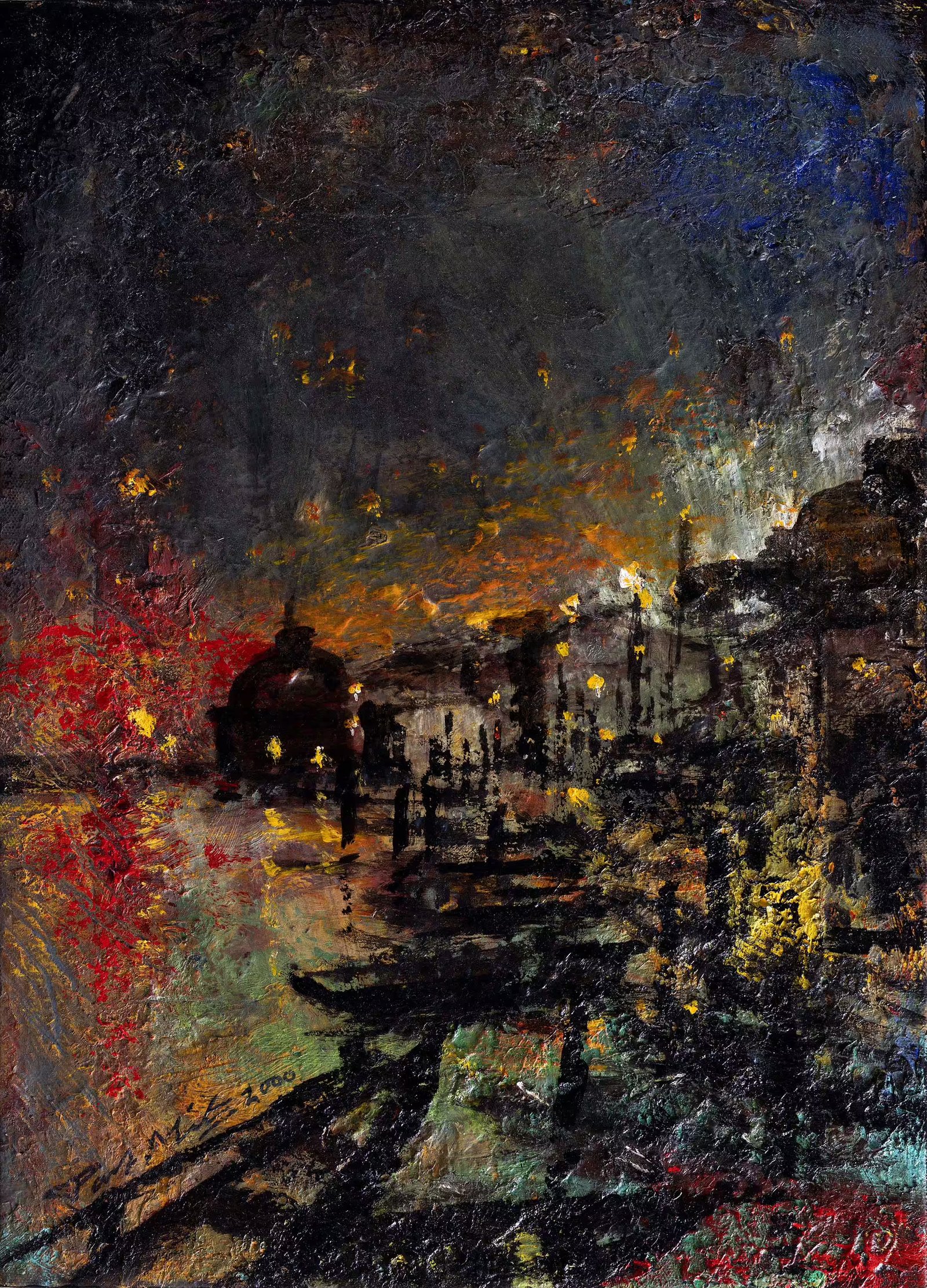
When worshipped and worshipper are one

The state of enlightenment that sages attain is that of ultimate tranquillity. But as many accounts attest, the ascent to the transcendence called Moksh, or Satori, or best of all that which remains without name or definition, can be an earth-shattering experience, as electrifying as a thunderbolt striking not from the blue but from within.
One of the most harrowing of such narrations is that of Ramkrishna Paramhans, a mystic whose polestar of guidance in his quest for liberation was the Goddess Kali, although he was a disciple of Adi Shankaracharya’s Advaita, the teaching that the individual atman is non-different (a-dvaita) from the cosmic reality symbolised by Brahmn.
The liberation from the labyrinthine illusion of separateness lies in the path of jnan, knowledge, which embodies all routes of spiritual realisation without the barriers or boundaries of distinction and discrimination.
The Introduction to The Gospel of Shri Ramakrishna, translated from Bengali into English in 1943 by Swami Nikhilananda, describes the sage’s release from the bondage of sensory limitation in devastating detail:
“I had no difficulty in taking my mind from all the objects of the world. But the radiant, and all too familiar figure of the Blissful Mother…appeared before me as a living reality…prevented me from passing into the Great Beyond. Again and again I tried, but She stood in my way every time…
“…I again sat to meditate. As soon as the Divine Mother appeared before me, I used my discrimination as a sword, and with it clove Her in two. The last barrier fell… I lost myself in samadhi.”
By what Nietzsche called dancing at the perilous edge of the abyss of self-negation, Ramakrishna cut the bonds of attachment, however sublime, that create the illusion of discrimination, of separateness, from the inescapable unity of all being.
In doing this he went beyond even the core of Advaita as summed up in the Upanishadic Great Saying, ‘Tat Twam Asi’, That Thou Art, Tat being Brahmn, Twam the individual soul, and Asi establishing correlation between the two. The phrase is a mnemonic connecting the individual with Brahmn.
The verbal linkage between the two, like Ramakrishna’s vision of Kali, creates the snare of the sensory world to act as go-between, an interloper in the inseparable.
The Tao Te Ching, credited to the fabled Chinese philosopher Lao Tze, begins with an admonition that would strike a chord with Ramakrishna: “The tao that can be named is not the eternal Tao. The name can be named is the eternal Name.”
Tao, the ultimate reality, or what the 14th century German mystic Meister Eckhart called the Godhead, cannot be contained in any verbal representation, any imagined concept or destination, be it Kali or any other manifestation whatsoever.
The true devotee must sunder from the devoted by annihilating the separation between worshipper and worshipped in all-embracing Brahmn.
As the poet put it: “They reckon ill who leave me out/When me they fly, I am the wings,/I am the doubter and the doubt/And I the hymn the Brahmin sings/Find me…and turn thy back on Heaven.”
Beyond the sacred there are no destinations. Not even that mofussil way-station called Heaven.


Disclaimer
Views expressed above are the author’s own.
END OF ARTICLE