Scientists just discovered a ‘molten planet’ that’s one giant lava ocean and it smells like rotten eggs |
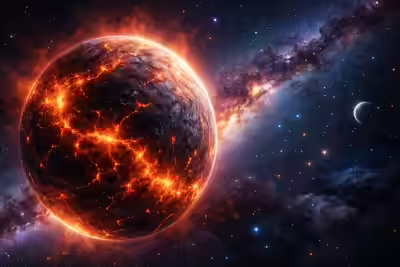
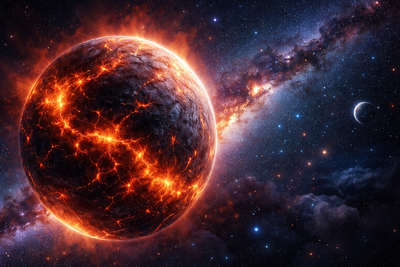
Deep in the cold darkness beyond our Solar System, Oxford-led astronomers have discovered a world that defies easy categorisation: a small, rocky world with a mantle of molten rock thousands of kilometers beneath its surface. The world, named L 98-59 d, orbits a small star 35 light-years from Earth as part of a small, closely clustered system, but in terms of what’s going on beneath its surface, this world is in a category all its own. Using complex computer modeling tied into telescope observations, Oxford-led astronomers via a study published in Nature Astronomy have determined that this world is dominated by a long-lived magma ocean, loaded with sulphur, which has helped to lock in place a thick atmosphere composed primarily of hydrogen gas. The world itself is just one part of a new class of “magma ocean” worlds, which may be more common than astronomers have long thought.
L 98-59: A rocky exoplanet covered in a global magma ocean
L 98-59 d, a rocky exoplanet slightly larger than Earth, has conditions more akin to a permanent lava world than the familiar, cool, crusty land we know. Inside, the mantle is composed of primarily molten silicate, as seen in the volcanoes of Earth, forming a global “magma ocean” that reaches almost as far as the core. Surface temperatures can reach as high as 1,900 °C, keeping the rock in a “mushy” state, rather than solid or liquid.Unlike Earth, which cooled down over billions of years to form a stable crust and tectonic plates, L 98-59 d appears to have maintained a molten state for a great part of its lifetime. Its molten state means that the planet is able to retain huge amounts of sulphur in its interior. It is from here that the sulphur slowly rises to the surface in the form of hydrogen sulphide gas. The “sulphur rich lava world” is a unique combination that we do not see anywhere in our Solar System.
How Oxford scientists figured out the planet is molten
Scientists didn’t literally look inside the planet. Instead, they employed sophisticated computer models that correlate observations from telescopes with models of planets’ interiors and atmospheres. From a period just a little later than when the planet was initially formed, almost five billion years ago, they were able to trace what influences its interior over time. By comparing these predictions with data from observatories such as the James Webb Space Telescope, they were able to determine that a magma ocean is present.physics.Lead author Dr Harrison Nicholls, of Oxford’s Department of Physics, explained in Volatile-rich evolution of molten super-Earth L 98-59 d, that the discovery “suggests that the categories astronomers currently use to describe small planets may be too simple.” Co‑author Professor Raymond Pierrehumbert added that the work shows how “computer models can uncover the hidden interior of a planet we will never visit,” turning remote data into a picture of oceans of molten rock and strange chemistry.
Why this changes our view of exoplanets
The composition of L 98-59 d also makes astronomers consider the possibility of reconsidering the way they classify “rocky” or “super-earth” planets. A planet may resemble the Earth in terms of mass and size, but it could be permanently molten beneath a thick atmosphere, rendering it less habitable than it might seem. The sulphur-based gases, including the well-known smell of rotten eggs from hydrogen sulphide, might be indicative of other planets of the molten variety.As planetary physicist Dr. Richard Chatterjee, of the University of Leeds and Oxford, explained, “We need to make more observations to determine just how common these ‘pungent planets’ really are, but the initial findings suggest they could be surprisingly common.” What does this mean for the search for habitable planets? The lesson here is one of caution. A rocky planet, seemingly habitable, could, in fact, be a scorching molten sulphur world, not a water-based world suitable for life.
What this means for the future of space science
The research, published in Nature Astronomy, is indicative of a change in terminology from basic descriptors such as “rocky” and “ocean” to more detailed and physics-based nomenclature for exoplanets, including “magma ocean worlds” and “sulphur lava planets.” This is significant because it allows scientists to better understand observations made by powerful telescopes and plan follow-up observations that are appropriately targeted. It also serves to remind us that our universe is home to planetary types that do not exist in our world, including those dominated by scorching lava and those we can only dream of.For the public, the idea of a world with a surface that is really a continent-scale ocean of glowing rock, and a thick, pungent atmosphere, gives a sense of just how alien and yet familiar exoplanets can be. The detection of L 98-59 d is not just a scientific achievement; it is a step toward having a more honest conversation about what another Earth really means.