
Political Economy of oil, gas wars amid civilisational rivalries in emerging solar era
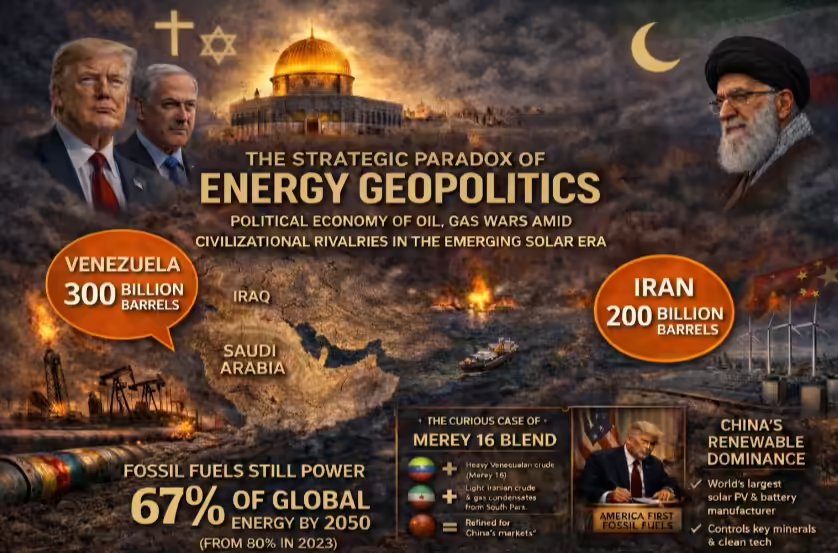

Oil and gas will continue to be dominant energy sources amid renewable surge in coming decades. So after securing Venezuela, Iran was next on US radar to hold over the oil-based order rooted in controlling fossils, and the curious case of Merey 16 blend for China
World’s most important energy flashpoint lies today around Strait of Hormuz, from where 20 per cent of global oil flows. It has been choked by Iran after attack on it by US and Israel over alleged attempts by Tehran to acquire nukes. Iran, a nation with a massive oil reserve of over 200 billion barrels, also an ally of China and Russia, was reportedly ready to give up enrichment of its uranium but was attacked unprovoked, throwing diplomacy to tatters. Amid stated goals of eliminating Tehran’s nuclear weapons and civilizational conflict among Christianity, Islam and Judaism, also lies a geopolitical reality to control or deny control (to China and other BRICS economies) of the remaining pillars of the global oil systems, after securing Venezuelan resources, and their supply chains running through the deep seas and oceans. Though, paradoxically the global community chases goals for reducing use of fossil fuels and achieving net zero emissions by 2070.
Desperate attack to control oil-rich Iran after success in Venezuela?
With the overthrow of President Nicholas Maduro, a pro-China leader, the US is in full control of Venezuela, with the largest oil reserve in the world at over 300 billion barrels. Simultaneously, the global energy landscape is reshaped by the rise of China as the dominant manufacturing power in renewable technologies, as it controls significant global supply chains for solar panels, batteries and critical minerals. For the US, this shift has triggered growing strategic concern. As the world moves toward renewable energy, Washington faces the prospect that the new technologies powering that transition may be dominated by Chinese supply chains.
The result is a striking contradiction in global energy politics. Even as governments promote renewable energy and decarbonisation, geopolitical competition around oil resources continues to intensify. OPEC’s World Oil Outlook 2025 estimates that fossils will be at 67% by 2050 from 79.8% in 2024. As per IEA, fossil fuels met 80% of global energy demand in 2023.
Broader strategic paradox: Is the US attempting to break Iran-Venezuela-China oil-linkage and the curious case of Merey 16?
The US confrontations involving Iran and Venezuela therefore reveal a broader strategic paradox: the world is racing towards a renewable future while still competing for control over fossils. The truth may be that the global economy as of now remains deeply dependent on petroleum and will remain so in coming decades. Transportation, aviation, petrochemicals, and large segments of industrial production still rely heavily on fossil fuels. As long as this infrastructure remains in place, oil-producing regions will retain strategic importance.
Energy experts also note that at times heavier Venezuelan crudes (mined in Venezuela’s Orinoco Oil Belt) and lighter Iranian crudes are mixed (3:1 ratio) for quality refining efficiency. Shale 24, which focusses on Argentina energy sector, argues that the “The Merey 16 (Venezuelan dense crude) value chain would collapse without Iran’s technology and inputs.” It must be “liquefied” by injecting natural gas condensates from Iran’s South Pars field gas reservoir, which was in news over attacks by Israel. China was one of the key markets for this oil.
The data behind the transition paradox
Global energy data by OPEC explains the scale of the contradiction over energy resources. Oil made up 30.6% of global demand in 2024. Its share is expected to edge down to 29.8% by 2050, but it will remain the world’s dominant fuel.
China and the emerging renewable order
China has emerged as the dominant manufacturing hub for solar photovoltaic components, controlling large portions of global production from polysilicon to solar modules supply chains. It is also a leading producer of lithium-ion batteries used in EVs and energy storage systems. Technologies driving the global energy transition are increasingly tied to Chinese capacity. For West, particularly the US, this creates a new form of strategic dependence, even as they attempt to reduce reliance on fossils.
A world between two energy systems; President Trump’s pro-fossil approach
The current energy landscape amid these geopolitical conflicts reflects a world caught between the two systems. The first is the fossil fuel order, built over the past century around oil fields, refineries and pipelines, while the emerging renewable system based on solar panels, PVs, battery storage and wind turbines. A global shift from oil, gas and coal to renewable would be gradual. The fossil order is controlled by the US, which will try its best to retain, as has been explicit by the policy of President Donald Trump, who just after his inauguration in January, 2025, signed many orders to promote fossils and to withdraw support for renewable energy.
The New York Times underscoring how President Trump views the world, writes that “…oil and gas are symbols of strength and power, and plentiful fossil fuels will ensure that the US is able to dominate allies and rivals alike.” It further, quotes President Trump: “We have something that no other manufacturing nation will ever have – the largest amount of oil and gas of any country on earth, and we are going to use it. We will bring prices down, fill our strategic reserve up again…and export American energy all over the world.”
Energy control as political economy tool
Therefore, access and control over multiple sources of crude, including that in Iran, which as per Kpler analytics exported 80% crude to China in 2025, and Venezuela, carries significant strategic value. Trump told FT that he would prefer to “take the oil in Iran”. These are also efforts to preserve a dollar-centred oil trading system, which underpins US financial power. Secondly, crippling the economy of civilizational adversaries by controlling their energy too are strategic political economy tool.
https://www.visualcapitalist.com/global-energy-demand-by-fuel-type-2024-2050p/
https://www.csis.org/analysis/chinas-solar-industry-upheaval-effects-will-be-global?
https://www.opec.org/assets/assetdb/woo-2025.pdf
Disclaimer
Views expressed above are the author’s own.
END OF ARTICLE