
Patrick Winston: Meet Patrick Winston: MIT professor whose one-hour lecture stayed packed for 40 years and it wasn’t about STEM |
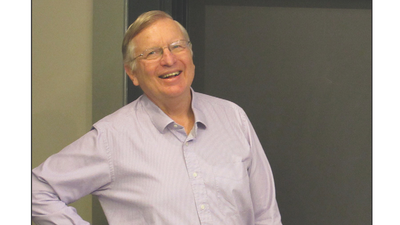
For decades at the Massachusetts Institute of Technology, one lecture stood out not for equations or algorithms, but for a skill that quietly shapes success across every field. Delivered by Patrick Winston, the session drew packed rooms year after year, with students, researchers, and professionals turning up in large numbers to hear a talk on something rarely prioritised in technical education: communication. Known as “How to Speak,” the lecture became one of the most widely viewed non-technical lectures on MIT OpenCourseWare, continuing to reach global audiences long after Winston’s death in 2019.
Patrick Winston’s MIT lecture that filled rooms
Patrick Winston’s lecture developed a reputation at MIT that few academic sessions could match. It was not uncommon for attendees to arrive early to secure a seat, and even then, many found themselves standing through the hour-long talk. The consistency of its popularity over several decades reflects how deeply the subject resonated with audiences in a highly technical environment.At an institution known for pushing the boundaries of science and engineering, this lecture addressed a different kind of gap. Students who were trained to solve complex problems often found themselves needing to present those solutions clearly, whether in classrooms, research settings, or later in professional life. Winston’s lecture offered a structured approach to doing exactly that, making it as relevant to first-year students as it was to experienced researchers.
What ‘How to Speak’ actually teaches
The lecture is built around the idea that having strong ideas is not enough if they cannot be communicated effectively. Winston approached communication as a skill that can be learned, refined, and applied systematically. Rather than relying on charisma or natural speaking ability, he focused on practical techniques that improve clarity and engagement.He emphasised the importance of structure in any presentation. According to his approach, a talk should be designed with the audience in mind, ensuring that each idea follows logically from the previous one. This method reduces confusion and helps listeners stay engaged, particularly when dealing with complex or unfamiliar topics. The lecture also highlights the importance of pacing, tone, and emphasis, showing how delivery can influence how information is received.
The idea of the “empowerment promise”
One of the defining features of Winston’s teaching is the emphasis on how a talk begins. He argued that the opening moments of any presentation determine whether the audience remains attentive. To address this, he introduced the concept of the “empowerment promise,” which involves clearly stating what the audience will gain from the talk within the first minute.This approach shifts the focus from the speaker to the listener. By making the value of the talk immediately clear, the speaker establishes relevance and purpose. In an environment where audiences are often exposed to large amounts of information, this clarity becomes essential in capturing and maintaining attention.
Making ideas memorable
A significant portion of the lecture is devoted to understanding why some ideas are remembered while others are quickly forgotten. Winston explained that memorable communication often combines clarity with elements that reinforce understanding. These elements can include strong visual associations, concise phrasing, and the use of examples that illustrate key points.He also highlighted the role of storytelling in communication. By placing ideas within a narrative, speakers can make abstract concepts more relatable and easier to follow. This approach not only improves comprehension but also increases the likelihood that the audience will retain the information.
Learning through contrast
Winston introduced a teaching method based on comparison, often referred to as the “near miss” technique. Instead of presenting only correct examples, he demonstrated the value of showing examples that are almost correct alongside those that are fully accurate. This contrast allows the audience to identify subtle differences and better understand what makes an idea effective.The technique reflects a broader principle in learning, where understanding is strengthened through comparison and analysis. By seeing both effective and ineffective approaches, audiences gain a clearer sense of how to apply the concepts themselves.
Ending with impact
Another key aspect of Winston’s framework is how a talk concludes. Rather than summarising what has already been said, he encouraged speakers to focus on what the audience has gained. This approach reinforces the value of the presentation and leaves a lasting impression.Ending with a clear contribution ensures that the audience walks away with a sense of what they have learned or acquired. It shifts the conclusion from repetition to impact, aligning with the overall goal of effective communication.
A lecture that no longer runs but still reaches millions
The lecture was traditionally delivered during MIT’s Independent Activities Period each January for decades, becoming a long-standing academic tradition. However, it is no longer conducted as a live annual session following Winston’s passing in 2019.Despite this, the lecture continues to exist in recorded form and remains widely accessible through MIT OpenCourseWare. The final recorded version, released in 2018, has been viewed by millions and continues to be shared across platforms, ensuring that its lessons remain relevant to new audiences.
A legacy beyond the lecture hall
Although the lecture was delivered within the academic setting of MIT, its reach has extended far beyond the campus. Through MIT OpenCourseWare, it has become accessible to a global audience, attracting viewers from a wide range of backgrounds and professions.Patrick Winston’s work continues to influence how people approach communication, particularly in fields where technical expertise is often prioritised over presentation skills. His lecture remains a reminder that the ability to clearly express ideas is not secondary to knowledge, but an essential part of making that knowledge meaningful and impactful.