Oil not well, ‘warmonger’ Trump, and menu cards as works of fiction
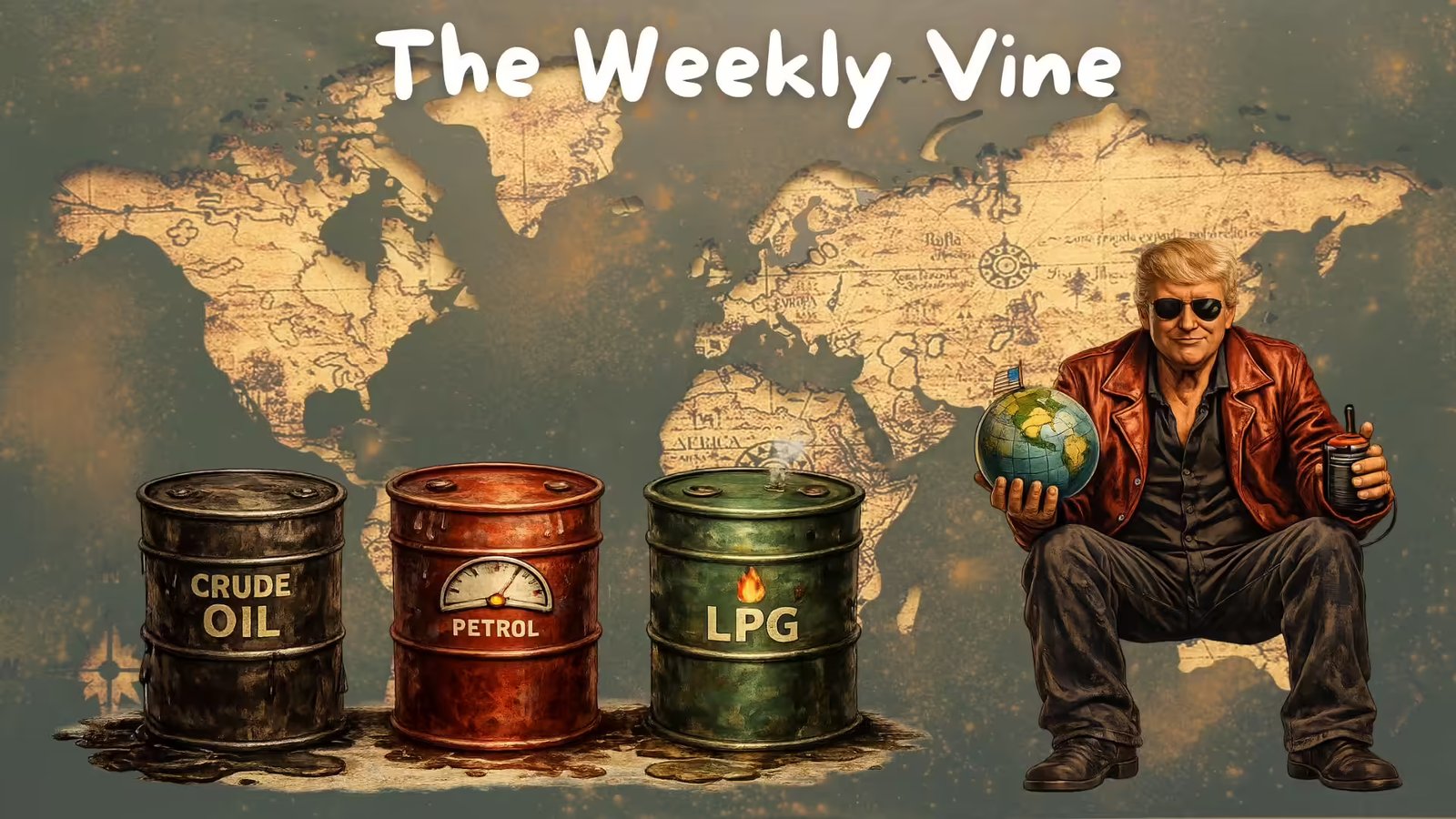

Hello and welcome to another edition of the Weekly Vine. This week we explain why ‘oil’ is not well, decode why Trump is the Jungian composite of other US presidents, and finally discuss the tyranny of choice at 35,000 feet.
Oil not well
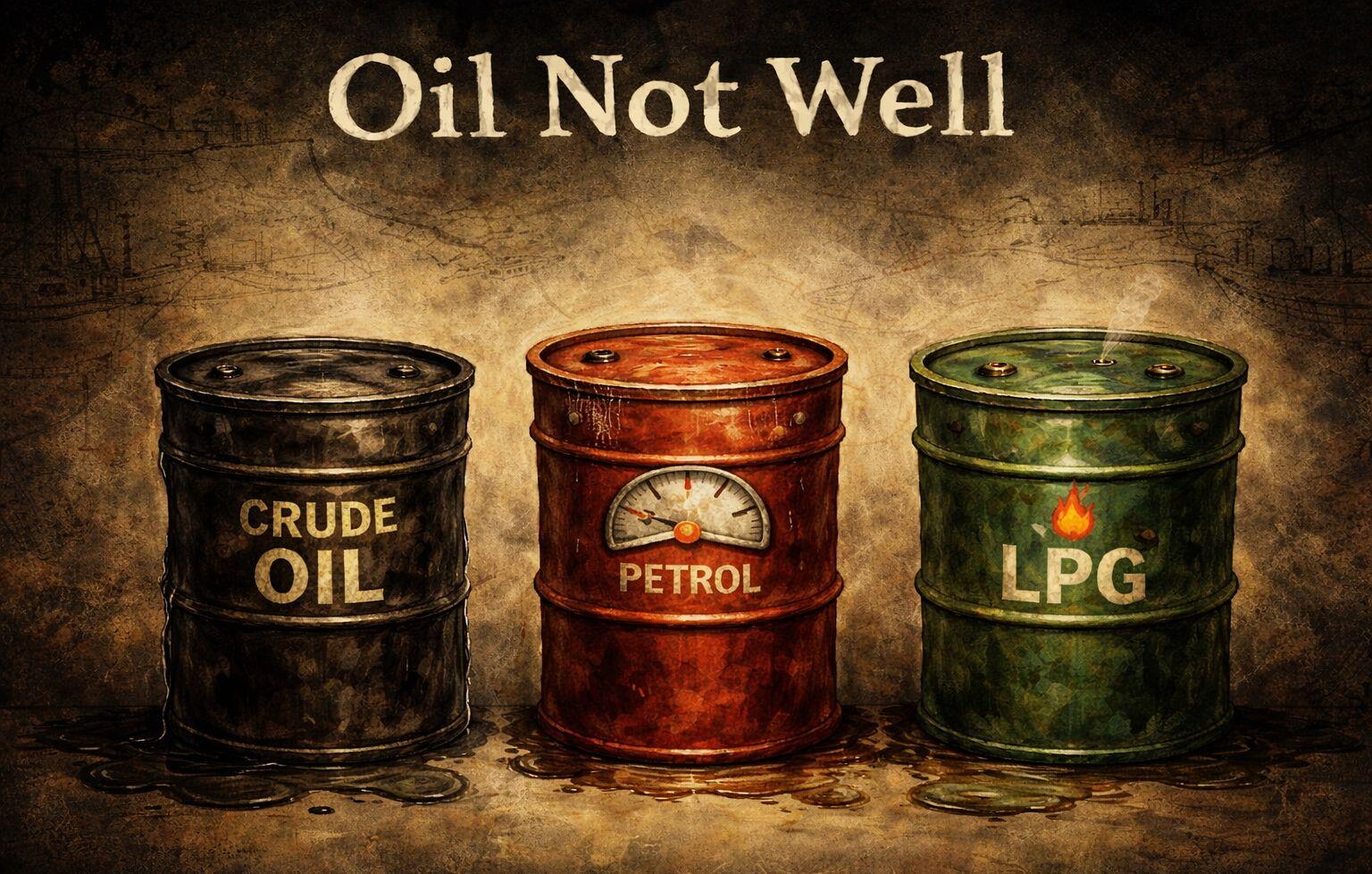

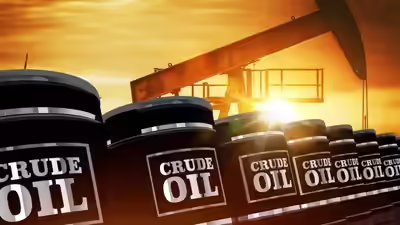
The modern world runs on three liquids: water, coffee and crude oil. Water sustains life, coffee powers journalists, and crude oil everything else. Without water there is no civilisation, without coffee there is no journalism, and if oil disappeared civilisation and journalism would collapse while arguing about geopolitics.
For years, clever analysts have tried to identify the “new oil”. Data, lithium, artificial intelligence, attention spans. But the answer remains stubbornly old-fashioned. Oil is still the new oil and the old oil. For now, whenever oil becomes unstable, the world remembers just how much modern life depends on it.
To understand why a crisis involving Iran suddenly produces anxiety about LPG cylinders, tanker routes and refinery supply chains in India, one must begin with a small but important energy primer.
The words oil, petrol, diesel and gas are often used interchangeably in everyday conversation, but they describe very different things.
Crude oil is the raw liquid that comes out of the ground after drilling. It is thick, dark enough to get Democrats to care, but largely useless like rednecks who think they would run Silicon Valley if Indians stopped getting H-1B visas.
That crude oil is transported to refineries, where it is transformed into different fuels.
The lightest fraction becomes petrol for cars and motorcycles. A heavier fraction becomes diesel that powers trucks and buses. Another becomes aviation turbine fuel for aircraft.
One portion becomes LPG, the propane-butane mixture that fills cooking cylinders and helps produce worthwhile things like butter chicken. LPG is produced both during crude oil refining and during the processing of natural gas.
Natural gas, meanwhile, is different altogether. Mostly methane, it powers electricity plants, fertiliser factories and industrial heating. When cooled to extremely low temperatures it becomes LNG, which can be transported across oceans.
Now the problem is this: India, with its vast population, consumes enormous amounts of energy but produces very little crude oil of its own. Nearly nine out of ten barrels of oil used in India arrive from overseas. To put that in context, imagine having an IPL team where ten players are foreigners and there is only one Indian.
Most of this oil arrives not through pipelines running across continents but through ships crossing oceans. India’s energy system depends less on geology and more on geography.
Most of those ships come from the Persian Gulf.
Countries such as Iraq, Saudi Arabia, the United Arab Emirates and Kuwait pump enormous volumes of crude oil every day and export them to Asian markets. Tankers load the oil at Gulf ports and sail east toward India, China, Japan and South Korea.
But before those tankers can reach the Indian Ocean, they must pass through one narrow stretch of water that has quietly become one of the most important choke points in the global economy.
The Strait of Hormuz, a narrow maritime corridor between Iran and Oman, functions as the exit gate for the Gulf’s oil. Nearly 20 million barrels a day, roughly one-fifth of global consumption, pass through it. When everything is calm, tanker traffic moves through it continuously like buses leaving a crowded station.
In late February 2026, the United States and Israel launched a series of strikes on Iranian military and nuclear facilities. Iran responded the way countries with a strategic chokepoint often do: it turned geography into a weapon.
Iran sits on the northern edge of the Strait of Hormuz. If the Persian Gulf were a giant bottle of oil, Hormuz would be the narrow neck through which everything must pour out.
Following the strikes, Iran began threatening commercial shipping and launched drone and missile attacks near shipping lanes and Gulf ports. Several tankers were damaged, insurance premiums surged and shipping companies started avoiding the route.
Shipping companies are not particularly brave organisations. They are in the business of moving cargo, not participating in naval warfare. When missiles and naval mines enter the equation, captains suddenly begin searching for alternative routes.
So even though the oil itself still exists underground in Saudi Arabia, Iraq or the UAE, it becomes much harder to transport it to the rest of the world.
Oil markets operate on expectations as much as physical supply. If traders believe that millions of barrels might not reach global markets, prices move immediately. Within days of the escalation, crude prices surged sharply and analysts warned they could approach or cross $100 a barrel if disruptions continued.
India is the world’s third-largest oil consumer but produces very little crude domestically. Roughly 90% of its oil needs are imported, along with large portions of LPG and LNG supplies.
A significant share of those imports originates in the Persian Gulf.
That means tankers carrying crude oil from Iraq, Saudi Arabia, Kuwait and the UAE must sail through the Strait of Hormuz before heading toward coastal refineries such as Jamnagar.
If Hormuz slows down, India feels it almost immediately.
Refineries worry about delayed shipments. LPG import terminals worry about supply gaps. Shipping costs rise, insurance premiums climb and the global price of crude pushes up petrol, diesel and aviation fuel.
Even sectors that have nothing to do with petrol pumps begin to feel the ripple effects.
Fertiliser plants depend on natural gas that travels through the same shipping routes. Manufacturers face higher logistics costs because diesel powers freight networks. Airlines watch jet fuel prices rise. Restaurants and hotels worry about commercial LPG supply.
In other words, a missile fired in West Asia eventually shows up as a bill at an Indian petrol pump.
India has tried to soften the blow.
Refiners have increased purchases of Russian crude and tapped strategic reserves wherever possible. Russian oil imports help cushion the shock because those shipments travel through different routes and do not pass through the Strait of Hormuz.
But such adjustments can only cushion the shock, not eliminate the vulnerability.
India’s energy system ultimately depends on ships crossing oceans and narrow straits remaining open thousands of kilometres away.
Which is why when missiles fly in West Asia, dosa batter in Bengaluru and LPG cylinders in Mumbai begin to feel nervous.
When crude stops flowing smoothly, even the small comforts of modern life suddenly become harder to take for granted.
Trump – The Jungian Composite


If one listens to commentary about Donald Trump – and there’s so much of it that banning the word ‘Trump’ would bankrupt WENA outlets – you would assume he was an anomaly in the system, the sum total of all unbalanced equations, antithetical to the American way of life. In recent times, his actions — expansionist tendencies, warmongering, using government agencies to target his opponents, justifying his actions, and snatching basic liberties — have been held up as something as un-American as socialism.
But Trump isn’t an aberration from past American presidents, but their Jungian composite sketch: the Expansionist, the Warmonger, and the Freedom Crusher.
What makes Trump a more evolved version is that he refuses to participate in the diplomatic pageantry of pretending that America’s actions are for some great good instead of self-aggrandisement. Trump isn’t here, to borrow a phrase from Morpheus’ epic speech in Zion in The Matrix Reloaded, because of the path that lies before him, but because of the path that lay behind him in American history. The only difference from former premiers is that he performs these old imperial instincts as pure, unembarrassed id — an unrestrained force not seen in reel or real life since Tyler Durden.
Menu cards and works of fiction


Air travel is one of those modern experiences that sits delicately between aspiration and mild disappointment. Somewhere between the optimism of the boarding gate and the philosophical resignation of the baggage carousel lies a curious little theatre called in-flight dining. Tuesday, I was flying into Kolkata when a small miracle occurred. The airline’s upgrade algorithm, normally as warm and generous as an income tax notice, decided that I was worthy of an upgrade that’d make me feel like a Maharaja.
Upgrades have a strange psychological effect. Your posture improves, your tone becomes calmer, your boarding pass suddenly feels less like a ticket and more like a visiting card to a minor princely state.
And then the ritual begins. The friendly air hostess hands you a menu card.
Now, a menu card on an aircraft is a fascinating cultural document. It suggests civilisation, implies abundance and, above all, it quietly tells you that you are not merely travelling across India but dining elegantly above it.
Disclaimer
Views expressed above are the author’s own.
END OF ARTICLE