My team got better when I learned to leave the room
Trust is a behaviour, not a statement.
I walked into the team’s daily standup like I always had. Sat down. Listened. Asked a few questions.
Nothing unusual. Except everything about it was wrong.
I’d recently been elevated to a new higher leadership position, overseeing people across multiple functions. But I was still showing up to the same meetings I’d attended before the promotion. In my head, I was being the hands-on leader who stays close to the work.
What I didn’t see was what my presence was doing. Team members were looking to me for direction instead of to their actual team lead. I was sending a message I never intended: that the person running this team wasn’t enough. That the real decision-maker was here now.
I wasn’t supporting the team. I was undermining them.
The pattern I couldn’t see
It wasn’t just one meeting. The same dynamic played out everywhere. Planning sessions. Design reviews. Weekly syncs. I was in every room, and in every room, I was accidentally shrinking the people who were supposed to be leading.
The worst part? I thought I was doing a great job. I was working harder than ever. Every instinct that had made me successful as an individual performer was telling me to stay close to the work.
Those instincts were the problem.
Stepping back
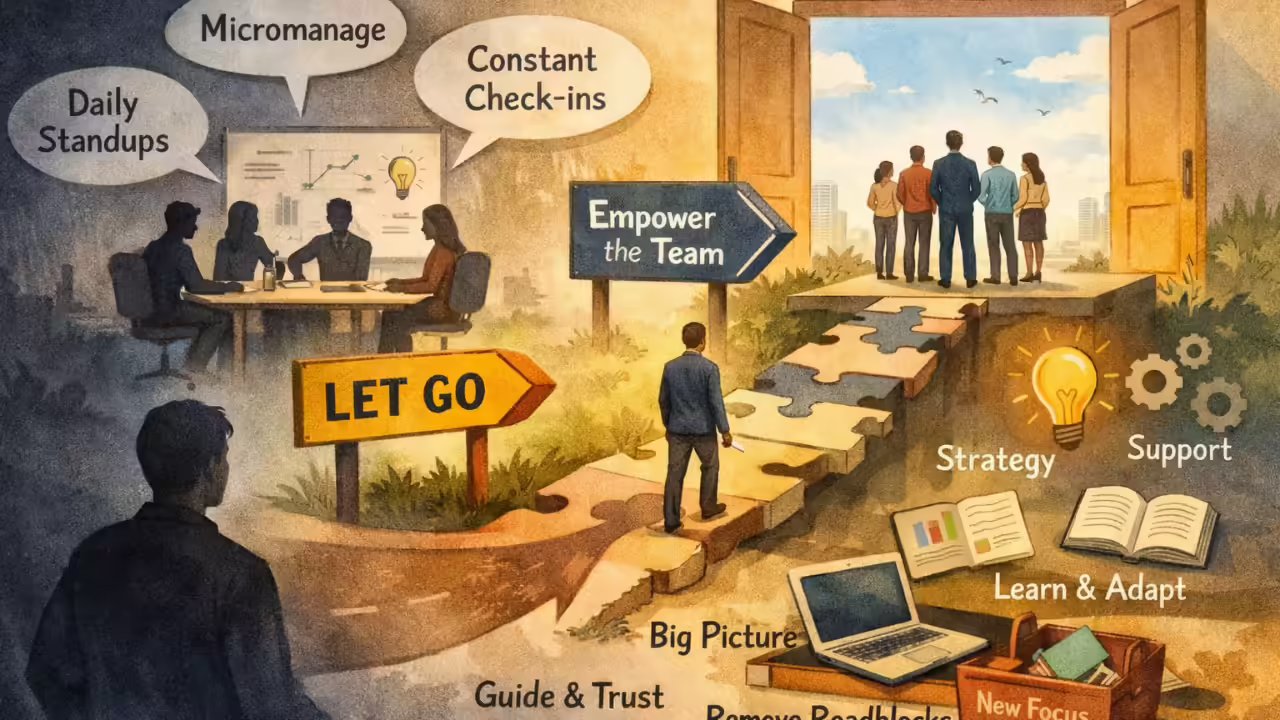
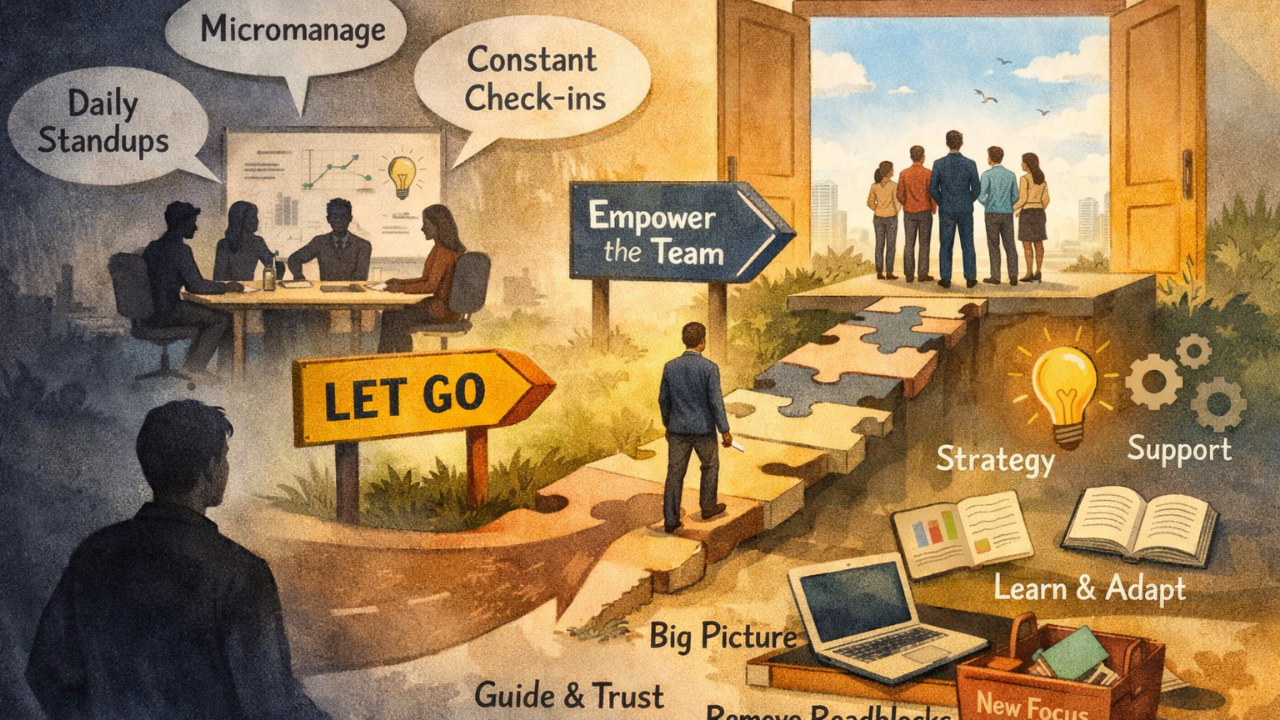
I stopped going to the daily standups. That sounds small. It felt enormous.
Instead of sitting in on execution meetings, I started having separate conversations with team leads about what we were building and why. The how was theirs to figure out.
And then came the part nobody warns you about: when you stop attending all those meetings, your calendar goes quiet. When your entire career has been built on being busy and being across things, a quiet calendar feels like failure. I genuinely thought I was derelicting my duties.

My first instinct was to overcompensate. More check-ins. More one-on-ones. More “just seeing how things are going” messages. Then I caught myself again. You can’t tell your team “I trust you” and then show up every day asking for updates. Trust that needs constant verification isn’t trust.
So I forced myself to sit with the discomfort.
The right kind of work
With the freed-up time, I started doing things I’d never had bandwidth for. I dug into our website analytics to understand technical issues. I looked at content performance data, trying to spot patterns the teams might not have visibility into. I experimented with tools and workflows I could share with the design team. I read more.
The work changed. Instead of doing the team’s work, I was finding ways to help the team do their work better. Clearing blockers. Spotting opportunities. Bringing context from other parts of the business.
Then something told me this was working: people started coming to me with their problems. Not because I was sitting in their meetings and they had no choice. Because they chose to. They trusted I could help.
The honest conversation
Around this time, I read The Ride of a Lifetime by Bob Iger. One story stuck with me. When Iger ran ABC Entertainment, he was overseeing television programming, but he’d never been a creative. Instead of faking expertise, he told the producers honestly that he didn’t know how to pick scripts. He wanted to learn and support them. That vulnerability became the foundation of partnerships that lasted his entire career.
I was in a similar spot. I’d been given responsibility for functions I hadn’t worked in before. SEO. Design. Operations. I could have faked it. Instead, I had a one-on-one with each of my direct reports and told them the truth: I don’t know the details of your work, but I’m going to learn. I want you to be successful, because that’s the only way I can be successful. We figure this out together.
There’s a voice in your head that says leaders should have answers, not questions. But I’d rather have my team trust me for being honest than respect me for a facade that would eventually crack.
The stuff nobody writes about
Every leadership post talks about managing the people above you and below you. Almost nobody talks about the hardest part: peers.
When you’re elevated, you inherit peer relationships where someone might push unreasonable priorities onto your team, or where two teams create friction for each other and suddenly you’re the one mediating. You can’t escalate every disagreement to your boss. But nobody has the final say either.
I got formal leadership coaching during this period, arranged by my manager. It didn’t give me a magic framework. It helped me see my own blind spots. How I was showing up in difficult conversations. What I was triggering in others. Where I had room to handle things differently.
A year, not an epiphany
The initial shift happened within a couple of months. I left the wrong meetings. I changed how I spent my time. I had the honest conversations.
But the full transition took about a year. Slow and gradual. Every month a little less anxiety about not being in the room. A little more confidence that the team could handle it. A little more clarity about what my job actually was.
My job wasn’t to be the best person in the room. It was to make the room better. Clear the path, provide context, build trust, and get out of the way.
If you’re in the middle of this transition and it feels uncomfortable, that’s not a sign you’re doing it wrong. The discomfort of letting go is the price of learning a completely different kind of work.
Disclaimer
Views expressed above are the author’s own.
END OF ARTICLE