
Mojtaba Khamenei: How Mojtaba Khamenei’s greenlight defused Trump’s ‘wipe out civilization’ ultimatum and led to a US-Iran truce
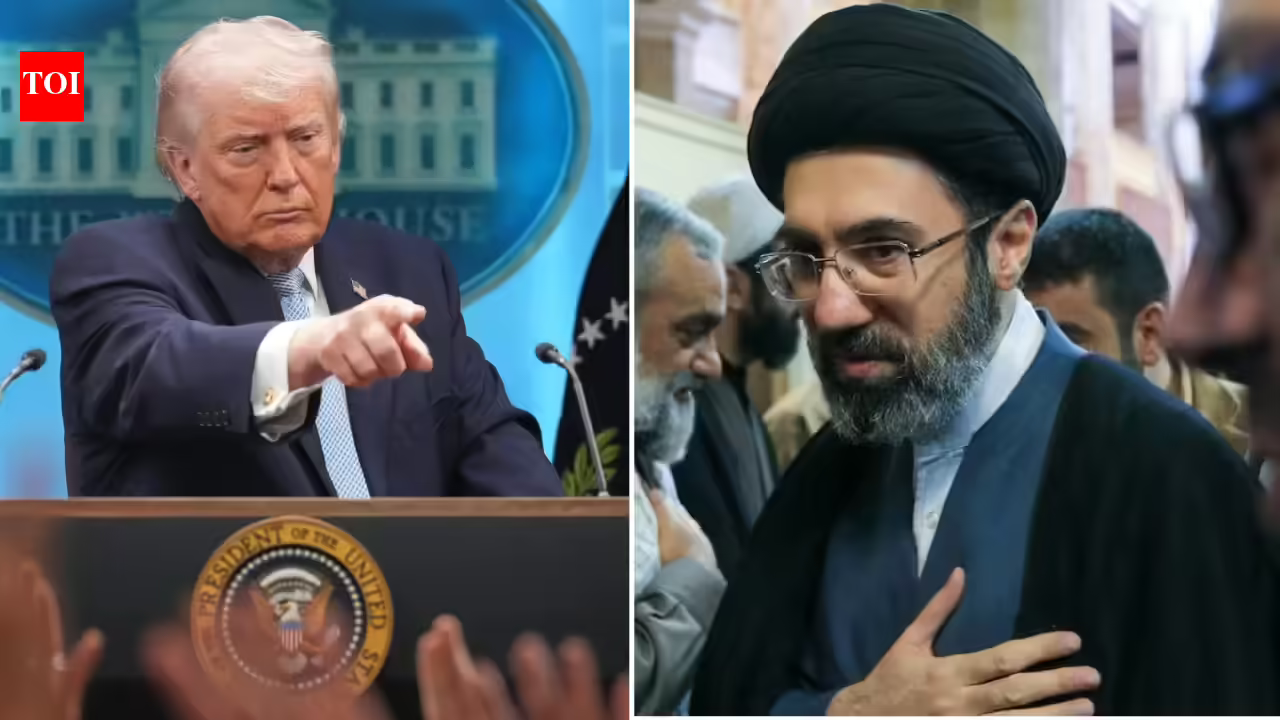
Donald Trump and Mojtaba Khamenei (R)
Thirty-eight days into the war, a ceasefire was declared. Early on Wednesday, Donald Trump reached terms with Iran, agreeing to halt military actions for two weeks. What began as an American-Israeli campaign aimed at regime change in Tehran saw Ayatollah Ali Khamenei eliminated on the first day of Trump’s Operation Epic Fury.The ceasefire came a day after Trump issued a weighty admonishment, warning that he would destroy the “whole civilization” of Iran if it did not reopen the Strait of Hormuz, a vital global oil and energy artery.
As soon as the deal was finalized between Washington and Tehran, both sides raced to claim victory. Israel, the United States’ ally and partner in the war, also backed the truce.
Khamenei signals negotiators to explore deal
According to an Axios report, officials in the US and Israel learned of a striking development on Monday, just as President Trump’s ultimatum loomed: supreme leader Mojtaba Khamenei had, for the first time since the war began, instructed his negotiators to move toward a deal, according to an Israeli official, a regional source, and another source familiar with the talks.While Trump was publicly threatening total annihilation, behind the scenes there were signs of diplomatic momentum, though even those close to Trump didn’t know which way the situation would turn until the ceasefire was announced. US forces in the Middle East and Pentagon officials were preparing for a massive bombing campaign on Iranian infrastructure, while trying to gauge Trump’s intentions. “We had no idea what was going to happen. It was wild,” a defence official said.Allies across the region braced for potential Iranian retaliation on an unprecedented scale, while some civilians in Iran were fleeing their homes to escape the worst of the strikes. Axios based its account on conversations with eleven sources familiar with the negotiations.
Negotiations intensify amid chaos
On Monday morning, as Trump mingled with the crowd at a White House Easter celebration, a “very angry” Steve Witkoff was working the phones. The US envoy called the 10-point counter-proposal just received from Iran “a disaster, a catastrophe,” according to a source with direct knowledge.What followed was a chaotic day of revisions. Pakistani mediators shuttled drafts between Witkoff and Iranian foreign minister Abbas Araghchi, while the foreign ministers of Egypt and Turkey tried to bridge gaps. By Monday night, the US had approved an updated proposal for a two-week ceasefire, leaving the decision to Khamenei, who was reportedly very active in the process on Monday and Tuesday.
Khamenei’s approval a ‘breakthrough’
The new supreme leader’s involvement was necessarily clandestine. Facing an active Israeli assassination threat, Khamenei communicated primarily via runners passing notes. Two sources described his approval for negotiators to cut a deal as a “breakthrough.” Araghchi also played a central role in persuading Revolutionary Guard commanders to accept the deal, while China advised Iran to seek an off-ramp. By the end of the day, all major decisions went through Khamenei. “Without his green light, there wouldn’t have been a deal,” a regional source told Axios .
‘Whole civilisation will die’: Trump’s stark warning
Despite progress by Tuesday morning, Trump issued one of his most extreme threats: “A whole civilization will die tonight.” Some US media outlets reported Iran had walked away from talks in response, but sources said momentum was actually building. US vice president Vance coordinated from Hungary, mainly with the Pakistanis, while Israeli Prime Minister Benjamin Netanyahu stayed in frequent contact with Trump and his team, though concerns grew that Israel had lost control of the process.“The President of the United States has told me, and he’s told the entire negotiating team, secretary of state, the special envoy Steve Witkoff, he said, go and work in good faith to come to an agreement,” Vance said“He’s impatient. He’s impatient to make progress. He has told us to negotiate in good faith, and I think if they negotiate in good faith, we will be able to find a deal. But that’s a big if, and ultimately, it’s up to the Iranians how they negotiate. I hope they make the right decision,” he addedBy around noon ET on Tuesday, the parties were converging on a two-week ceasefire. Three hours later, Pakistani Prime Minister Shehbaz Sharif posted the terms on X, urging both sides to accept. Trump then fielded calls and texts from hawkish allies urging him to reject the deal, adding to the uncertainty. Multiple people who had spoken with Trump just an hour or two earlier believed he would spurn the offer, right up until he approved it.
Ceasefire finalized
Before posting his response, Trump consulted Netanyahu to secure his commitment to adhere to the ceasefire, then spoke to Pakistan army chief and de-facto head Asim Munir to finalize the deal. US forces received stand-down orders 15 minutes after Trump’s post. Araghchi followed up, confirming Iran would adhere to the ceasefire and open the Strait of Hormuz to vessels “in coordination with Iran’s armed forces.”
Questions remain
The key questions now: How fully will Iran allow shipping to resume, and how steadfast will Netanyahu remain in honouring the ceasefire? A senior Israeli official told Axios that Netanyahu received assurances the US would insist in peace talks that Iran abandon nuclear enrichment and its ballistic missile program. Vance is expected to lead the US delegation in Pakistan on Friday, a high-stakes assignment in his career.Gaps remain between the US and Iranian visions for a deal, leaving the possibility of renewed conflict. Defense secretary Pete Hegseth and press secretary Karoline Leavitt are expected to hold press conferences on Wednesday defending Trump’s threats, arguing they made the deal possible. Meanwhile, the Iranian regime may still question whether Trump’s threats are truly over.