From learning to hold a pencil to cracking UPSC: 24-yr-old IIT graduate with cerebral palsy bags AIR 112 in first attempt | Meerut News

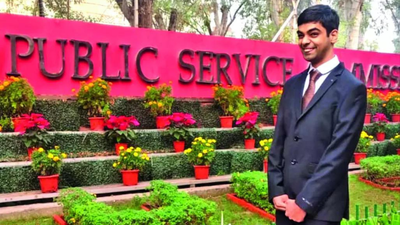
Against all odds: From learning how to hold a pencil to mastering academic challenges, his journey has been full of hurdles, Manvendra’s mom said.
MEERUT: When the Union Public Service Commission declared the Engineering Services Examination (ESE) 2025 results on Dec 17, Manvendra Singh’s name appeared with an All India Rank of 112, securing his selection to the Indian Engineering Services in his very first attempt. For the 24-year-old IIT graduate from Bulandshahr, the achievement marked the end of a journey that began not with competitive exams or coaching classrooms, but with learning how to perform the most ordinary actions in a body that resisted them.What matters for the family is not just the rank or the designation, but the long arc behind it — from a child gripping a pencil in his fist to a young engineer learning, patiently and repeatedly, how to make space for ambition within the limits of his own body.Manvendra, a resident of Awas Vikas in Bulandshahr district, lives with cerebral palsy, a neurological condition that affects movement and muscle control. He was diagnosed at six months. By the time he was two, he was unable to hold his neck properly, and as he grew, stiffness gradually developed on the right side of his body. Everyday tasks demanded deliberate effort, and adaptation became instinctive.His mother, Renu Singh, a principal at a private school in Bulandshahr, recalls the journey as one shaped by persistence rather than milestones. “Clearing UPSC is a long and difficult process with several stages. From learning how to hold a pencil to mastering complex academic challenges, his journey has been full of physical and societal hurdles since childhood,” she said.One of her earliest memories is of placing a pencil in her son’s hand. Manvendra could not hold it between his fingers. He gripped it tightly in his fist, and for years, that was how he wrote. Progress was slow, but it was steady. Over time, through repetition rather than accommodation, he trained his left hand to do what his right could not, turning effort into routine.Doctors had told the family early on that cerebral palsy would likely affect his coordination and gait throughout his life. Medical care became a constant. Renu Singh said she took him to more than 50 hospitals and doctors across the country before sustained treatment at a hospital in New Delhi helped stabilise his condition. “Along with medical care, his willpower mattered the most,” she said.The household was dealt another blow when Manvendra was 17. His father died after a prolonged illness, a loss that altered the family’s emotional centre. “He was sensitive and emotional, and the loss affected him deeply,” his mother said. With time, she added, he recovered enough to support the family, quietly assuming responsibility as the eldest child.Academically, Manvendra remained focused. A consistently bright student, he completed school with strong results. After Class 12, his family suggested that he appear for the Uttar Pradesh Technical Entrance Examination, a safer and more conventional option. He declined. “He was determined to aim for IIT,” Renu Singh said.He went on to clear the Graduate Aptitude Test in Engineering with an All India Rank of 63 and completed his BTech in Electronics and Electrical Engineering from IIT Patna in 2024. After graduation, he moved to Delhi and joined a coaching institute to prepare for the Engineering Services Examination, a three-stage process involving prelims, mains and an interview, demanding sustained concentration and physical endurance.In his first attempt, he cleared all stages and secured AIR 112, earning selection to the Indian Engineering Services, which recruits engineers for Group A and B technical posts across central govt departments such as Railways, Telecom and Power.For Renu, the result closed a chapter defined less by expectation than by endurance. “There were moments when everything felt overwhelming,” she said. “But he never stopped believing he could do this.” The rank, she says, is important. But it is the years behind it — the slow rewriting of limits, the discipline of persistence, and the quiet refusal to lower ambition — that define Manvendra Singh’s journey far more clearly than any number beside his name.