
Scientists create smartwatch-like plant wearables that let farmers monitor crops in real time, detecting drought, disease and nutrient problems days before plants show visible signs of stress

The leaf sensor is more of an early warning system showing how the plant is responding in the moment, before visible signs appear,” said Nafize Hossain. (Credit: Nafize Hossain) British farmers may soon manage crop conditions using real-time data from advanced plant wearables, similar to how people use smartwatches to monitor sleep, blood oxygen and…
Read More

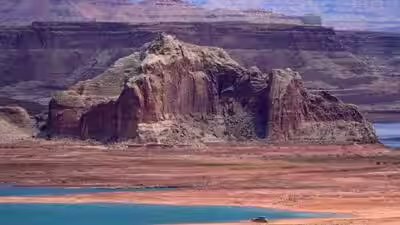
Lake Powell and Lake Mead are both running dangerously low, and scientists now say one radical idea could help: drain most of Lake Powell and store the water in Lake Mead instead

Scientists say Lake Powell should be drained to help save Lake Mead as Colorado River crisis deepens (Associated Press file photo) Scientists have suggested that instead of continuing to keep large amounts of water in Lake Powell, the reservoir should gradually be drained and the water stored in Lake Mead instead.The proposal comes as both…

Read More

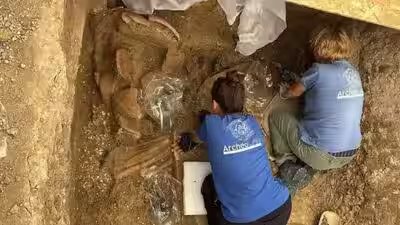
A 2,500-year-old warrior prince tomb found in Italy had a chariot, helmet and weapons still inside

A 2,500-year-old warrior prince tomb found in Italy had a chariot, helmet and weapons still inside Archaeologists in Italy have uncovered the 2,500-year-old tomb of a pre-Roman warrior prince along the country’s Adriatic coast, shedding new light on the Piceni, an ancient civilisation that left behind very few written records.The royal burial was found in…

Read More

Scientists have filmed a rare 125-million-year-old goblin shark alive in its natural deep-sea habitat for the first time, revealing a new depth record and a wider Pacific range

Goblin shark near Tonga Trench (2024). Credit: Minderoo-University of Western Australia Deep-Sea Research Center and Inkfish For the first time, scientists have filmed live goblin sharks swimming freely in their natural deep-sea habitat, giving researchers a glimpse of one of the world’s rarest and most mysterious sharks without removing it from the ocean. The discovery…

Read More

Quote of the day by Isaac Newton: “I can calculate the motion of heavenly bodies but not the madness of people” – why human behaviour is harder to predict than the stars |

Isaac Newton (Image: Wikipedia) Isaac Newton spent his entire career proving that the universe follows precise, predictable laws. Then he lost a fortune betting on people, and admitted the difference out loud. “I can calculate the motion of heavenly bodies but not the madness of people,” he is reported to have said, after watching his…

Read More

Gagnayaan: Isro clears another parachute milestone; IMAT-5 Done, but details on 4th test elusive | India News

BENGALURU: Isro has completed the fifth Integrated Main Parachute Airdrop Test (IMAT-05), clearing another milestone towards the first uncrewed Gaganyaan mission by qualifying the crew module’s main parachute system to withstand the maximum expected loads during descent.“The test, conducted on July 7 at the Aerial Delivery Research and Development Establishment (ADRDE) drop zone in Sheopur…

Read More

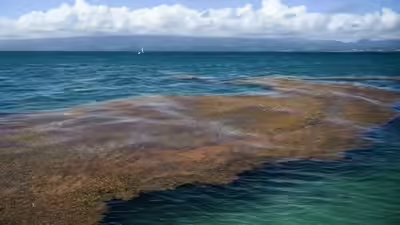
Space images have found a 5,000-mile seaweed belt across the Atlantic: Scientists say it can clog beaches and create public health problems |

Seaweed is no longer just an aquatic flora, it has now transformed into a nuisance, especially for scientists. Sargassum, a genus of brown macroalgae that was once largely confined to the Sargasso Sea has evolved into the Great Atlantic Sargassum Belt that stretches across 5,000 miles. In May alone, scientists detected 37.5 million tons of…

Read More

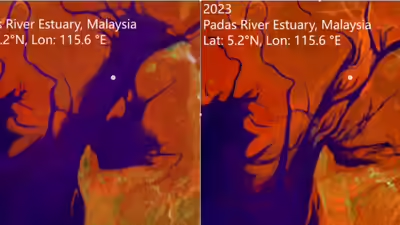
Satellite images reveal global mangrove recovery: Nasa study shows forests springing back, but rising seas could still drown them |

Mangrove forests rank among the world’s most valuable coastal ecosystems, shielding communities from storms, storing vast amounts of carbon and providing nurseries for countless marine species. For decades, scientists warned that these unique forests were disappearing faster than many tropical rainforests because of coastal development, aquaculture and pollution. Now, new satellite observations from Nasa present…

Read More

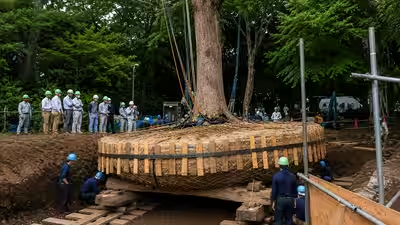
Japan does not cut down centuries-old trees for development. Instead, experts spend months preparing their roots and relocating them |

When roads, railways or new buildings are planned, centuries-old trees are often among the first casualties of development. In Japan, however, some of the country’s most valuable trees are given a second chance. Rather than cutting them down, arborists and horticultural experts sometimes relocate them using a painstaking process that can take months or even…

Read More