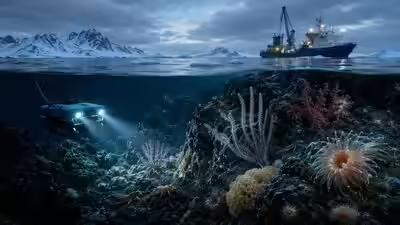
Norway opened parts of its Arctic seabed for future mining, but scientists have now discovered rare deep-sea life living there |

Far below the Arctic Ocean surface, beyond the reach of sunlight and largely untouched by human observation, a month-long expedition has been documenting a world that few people have ever seen. Scientists working aboard a Greenpeace research mission used remotely operated vehicles to explore seamounts, hydrothermal vents and deep seabed habitats off Norway’s coast, recording…

Read More

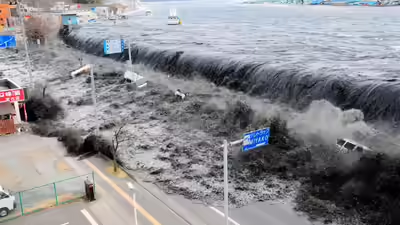
Japan’s 2011 megaquake sent a seismic wave nearly 2,900 km to Earth’s core, which returned 13 minutes later and shifted the entire country eastward |

A seismic wave generated by Japan’s devastating 2011 magnitude 9.0 Tohoku-Oki earthquake travelled nearly 2,900 kilometres to the boundary of Earth’s core, reflected back about 13 minutes later and shifted the entire country eastward by roughly six millimetres, according to a study published in the journal Science. The movement was far too small for anyone…

Read More

Meet the magnetic liquid metal robot that can split, merge and squeeze through tiny gaps like a living cell |

Scientists have developed a remarkable liquid robot that blurs the line between machines and living organisms. Created by researchers from Seoul National University and Gachon University, the robot is made from liquid metal coated with a dense armour of microscopic particles and embedded with magnetic particles that allow it to be controlled remotely. Unlike conventional…

Read More

Alaska: Scientists find that humans and dogs have such a friendly relationship because early ancestors fed salmon to canines 12,000 years ago

Humans Fed Salmon to Canines 12,000 Years Ago, Study Suggests, Hinting at the Origin of Our Relationship With Dogs Early humans in Alaska were sharing their salmon catches with ancient canines 12,000 years ago. This shows that close relationships between humans and dog ancestors developed 2,000 years earlier than anyone previously thought in the Americas.The…

Read More

Quote of the day by Marie Curie: “Life is not easy for any of us. But what of that? We must have perseverance and…” – understand what confidence and perseverance can achieve that talent alone never will |

Quote of the day by Marie Curie (AI-generated image) Marie Curie wrote this to her brother Joseph on the eighteenth of March, 1894, years before radium, before either of her Nobel Prizes, while she was still a struggling student in Paris. “Life is not easy for any of us,” she wrote. “But what of that?…

Read More

Buried for 5,300 years beneath a Stone Age tomb, a skull discovered in Spain has revealed the world’s earliest known ear surgery |

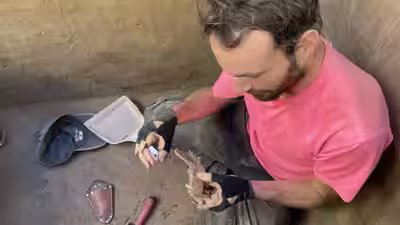
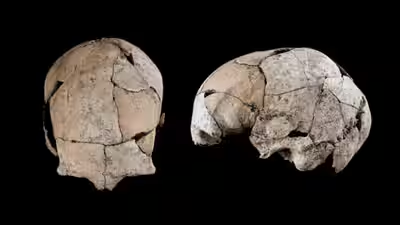
For more than 5,300 years, it lay undisturbed beneath a Stone Age tomb in northern Spain, hidden among the remains of nearly 100 people. When archaeologists finally uncovered the ancient skull, they expected another glimpse into prehistoric life. Instead, they found evidence of something far more extraordinary. Careful examination revealed that the woman had undergone…

Read More

Archaeologists uncover 3,000-year-old tomb near Egypt’s Luxor; inscriptions suggest it belonged to a man named Paser from the Ramesside period

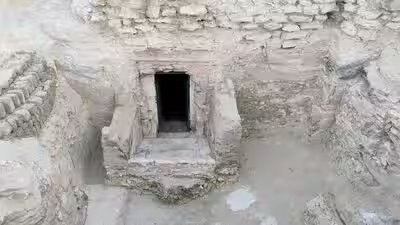
Image Credit: Facebook/ @Egypt’s State Information Service Archaeologists have uncovered a 3,000-year-old tomb near Luxor, Egypt revealing fresh insights into the country’s ancient past. The tomb, discovered in the Sheikh Abd el-Qurna necropolis on Luxor’s West Bank is believed to have belonged to a senior official named Paser, who lived during the Ramesside period. The…

Read More

This supersonic jet needed a radiation meter to monitor cosmic storms because it flew twice as high as commercial aircraft at a speed of 2,470 km/h, near the edge of space

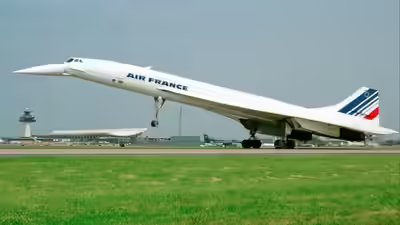
Concorde flew so high that it was forced to carry a radiation meter to track dangerous cosmic storms British-French supersonic jet Concorde flew so close to the edge of space that it had to carry a special radiation meter to monitor dangerous cosmic storms. If the cockpit instrument sounded an alarm, the only way pilots…

Read More

Scientists say crushing deep-ocean pressure squeezes hidden nutrients out of sinking marine snow, feeding microbes and changing what we know about Earth’s carbon cycle

Scientists say crushing deep-ocean pressure squeezes hidden nutrients out of sinking marine snow, feeding microbes and changing what we know about Earth’s carbon cycle (Representational AI image) Life in the deepest parts of the ocean may have access to more food than scientists once believed. A new study has found that the huge pressure found…

Read More

A supernova lit up Earth’s sky in 1054 and was visible in daylight. Hubble now shows its glowing remains are still expanding nearly 1,000 years later

NASA’s Hubble Space Telescope images of the Crab Nebula Nearly 1,000 years after people first saw a bright new star appear in the sky, scientists have measured how the remains of that explosion are still expanding today.In July 1054, court astronomers in China recorded a bright “guest star” near Tianguan, now known as Zeta Tauri….

Read More