
Florida is planting 15,000 milkweeds along highways to help monarch butterflies; the unused roadsides could become a 10,200-acre wildlife corridor

Officials in Florida have planted 15,000 milkweed plants along roadsides to help monarch butterflies survive. If you have driven through rural roads in northern Florida recently, you may have noticed new wildflower signs and patches of orange flowers growing along the roadside. These are not just for decoration. They are part of a large conservation…


Read More

Scientists studied how animals survive winter and found fruit flies rebuild their biological clock into a separate seasonal mode

Seasonal gene switch locks fruit flies in winter mode Scientists studying how animals survive the winter have discovered that fruit flies completely rebuild their internal biological clocks to switch into a separate seasonal mode. For context, a fruit fly is a tiny insect that feeds on ripe, rotting, or fermenting fruits and vegetables. They are…

Read More

Residents kept reporting dolphins in two Japanese bays. Underwater microphones revealed how frequently they visit

Scientists monitored dolphins in two bays along Sea of Japan coast. (Representational photo) People living along Japan’s Sea of Japan coast had been saying for years that they occasionally spotted dolphins close to shore. Local fishers also reported seeing them from time to time. These sightings were interesting, but scientists did not have enough information…

Read More

DNA from 457 koalas suggests the species nearly went extinct 100,000 years ago, before humans reached Australia

Koalas nearly went extinct before humans arrived, DNA study reveals A major genetic study has found that koalas almost became extinct about 100,000 years ago because of major climate changes, long before the first humans reached Australia.By studying the DNA of hundreds of koalas, an international team of researchers found that every koala alive today…

Read More

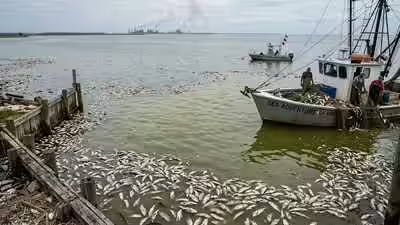
The Gulf of Mexico grows a vast ‘dead zone’ every summer, but what happens beneath the water threatens far more than marine life |

Every summer, a vast stretch of the Gulf of Mexico transforms into what scientists call a “dead zone,” an area where oxygen levels in the water become so low that most marine life cannot survive. Fish flee if they can, while shrimp, crabs and bottom-dwelling organisms are often trapped in what researchers describe as “hell…

Read More

Archaeologists in Iraq unearthed a rare 2,600-year-old Assyrian stele of King Ashurbanipal at Nineveh’s Shamash Gate, nearly a decade after ISIS damaged the ancient city

A fragment of an ancient stele dating to the reign of the Assyrian King Ashurbanipal found in Iraq’s Nineveh province, July 17, 2026 A rare 2,600-year-old Assyrian monument has been found at the ancient city of Nineveh in Iraq. The discovery is a major success for an area where Islamic State militants (ISIS) deliberately destroyed…

Read More

Scientists gave wild raccoons four-lock puzzle boxes to test their problem-solving skills, but the animals opened them using completely different techniques |

Imagine leaving a locked food box in your backyard and returning the next morning to find it open. Now imagine that every raccoon opened it differently. That is exactly what happened during an experiment in Laramie, Wyoming, where researchers installed specially designed puzzle boxes to test the problem-solving abilities of wild raccoons. Equipped with four…

Read More

The British Royal Navy brought nearly 27,000 Africans rescued from slave ships to a remote Atlantic island; their teeth are now revealing their lost childhood journeys

152 Africans were rescued from illegal slave ships and taken to Saint Helena nearly 200 years ago. (Representational photo) Nearly 200 years after thousands of Africans were rescued from illegal slave ships and taken to the remote island of Saint Helena by the British royal navy, scientists have uncovered new clues about where many of…

Read More

Earth: Earth has regulated its climate for 60 million years through a hidden ocean feedback; the key was sea level and one essential nutrient

Earth’s natural system keep its climate from being too hot or too cold. (Representational photo_ Earth has gone through many periods of warming and cooling over its long history. Despite these changes, the planet has remained capable of supporting life for hundreds of millions of years. Scientists have long believed that Earth has a natural…

Read More

Live demos at BHU science show inspire schoolkids | Varanasi News

Varanasi: Banaras Hindu University organised a science show at Swatantra Bhawan on Saturday, featuring live scientific experiments for students from various schools in the city. The programme aimed to promote scientific temper and spark curiosity among students through interactive demonstrations.Addressing the gathering, Vice-Chancellor Prof Ajit Kumar Chaturvedi said science should not remain limited to textbooks…

Read More