
Texas engineers are building fish-like nano-robots that could harvest lithium from seawater and transform the future of clean energy |

Image Credit: Getty Images Lithium is of utmost importance for modern technology. It is powering the smartphones and the huge fleet of electric vehicles. As the world is shifting towards clean energy, the demand for lithium is also increasing quickly, which is placing a huge pressure on land-based mining. However, researchers at Texas A&M University…
Read More

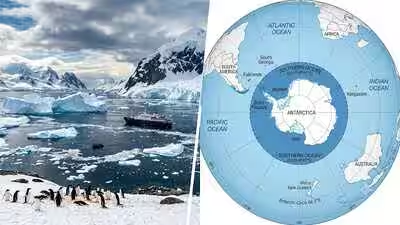
The Southern Ocean may be Earth’s safest place to remove carbon from the atmosphere, scientists find |

Left/Southern Ocean/Right/Southern Ocean on map/Image: AI Generated As the world searches for ways to remove carbon dioxide already accumulating in the atmosphere, ocean iron fertilisation (OIF) has emerged as one of the most debated climate intervention strategies. The idea is deceptively simple: adding tiny amounts of iron to iron-poor parts of the ocean stimulates the…

Read More

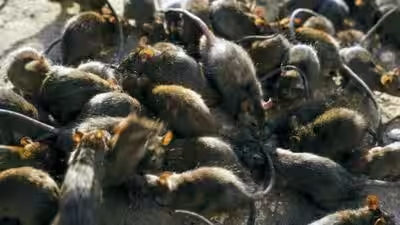
Tiny reef fish flourished beside islands filled with seabirds; where rats removed the birds, the entire underwater food chain took another route

Ecosystems work with each other no matter how far or disconnected they are. Animals and birds have impacts on each other’s lives and deaths. According to a new study, invasive rats on tropical islands are creating winners and losers among tiny underwater animals near the bottom of the food chain that inhabit surrounding coral reefs….

Read More

In 2008, MSU scientists discovered a tiny fungus hiding inside a rainforest tree that naturally produced diesel-like fuel |

Image(s): Left/MSU/Right/Canva For decades, scientists have searched for cleaner alternatives to fossil fuels, looking everywhere from algae and bacteria to agricultural waste. In 2008, one of the most unexpected discoveries came from deep inside the South American rainforest. Researchers identified a microscopic fungus living quietly within the tissues of a tree that produced a mixture…

Read More

Washington teenager Lakshmi Agrawal made a jute-waste sponge for salmon-killing tyre pollution; after it removed up to 80% in lab tests, she won $75,000

Lakshmi Agrawal (Image Credit: Society for Science) An 18-year-old student from Bellevue, Washington, has turned an agricultural waste product into a promising solution for one of the Pacific Northwest’s most pressing environmental challenges. According to the Society for Science, Lakshmi Agrawal won the $75,000 Regeneron Young Scientist Award at the 2026 Regeneron International Science and…

Read More

Why the dinosaurs disappeared: The asteroid that ended their reign struck Earth with a force of around 100 million megatons |

For more than 160 million years, dinosaurs dominated life on Earth. They survived shifting continents, volcanic eruptions, changing climates and countless evolutionary challenges, becoming the planet’s undisputed apex animals. Then, around 66 million years ago, their reign ended with astonishing speed in geological terms. Today, scientists overwhelmingly agree that the extinction was triggered by a…

Read More

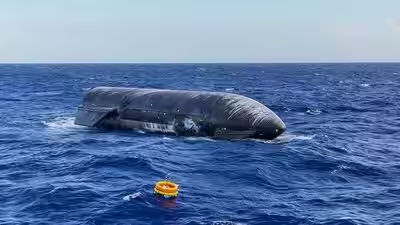
Elon Musk’s previous Starships exploded or broke apart after splashdown; Flight 13 landed so gently that the 171-foot spacecraft remained afloat in the Indian Ocean for five days

A rocket has been floating on the surface of the Indian Ocean for the past five days and its pictures are all over the internet. While one would assume it to be a scene from a sci-fi movie, the image is of SpaceX‘s most recent spacecraft that made a successful return from space.On Friday, SpaceX…

Read More

Humans may not be the only primates with geometric intuition as monkeys recognise shapes in remarkably similar ways, study finds |

For decades, one idea has shaped discussions about human intelligence: our ability to recognise geometric patterns was thought to set us apart from other primates. People naturally notice features such as symmetry, parallel sides and right angles, and many researchers have argued that this reflects a uniquely human way of thinking.A new study was published…

Read More

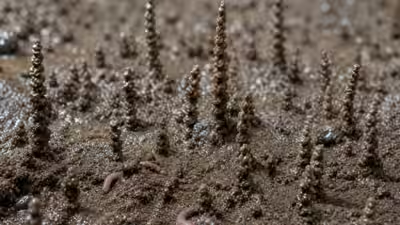
Physicists reveal why these tiny worms stack their poop into delicate towers that seem to defy gravity |

Most animals leave behind waste that quickly disappears into the landscape. But along Europe’s sandy tidal flats, one marine worm has adopted a remarkably different approach. Instead of scattering its droppings across the beach, it carefully stacks them into tall, coiled towers that seem to defy gravity. These delicate spirals have fascinated naturalists since the…

Read More

Arika: Minnesota student Arika Kundu, 13, designed a method that turns peanut-shell waste into a material for removing pesticide residues from fresh produce; she is now competing for a $25,000 science prize

Arika Kundu, 13, uses peanut shells to help remove pesticide residues from produce. A 13-year-old Indian-American student from Minnesota has invented a method to reduce pesticide residues on fresh fruits and vegetables by using peanut shells, something that is usually thrown away.Arika Kundu, a seventh-grade student at Minnetonka Middle School East in Shorewood, Minnesota, developed…

Read More