The asteroid that killed the dinosaurs nearly wiped out birds too, leaving only a few ground-dwelling survivors |

Representative Image of the Chicxulub asteroid striking Earth amid devastated prehistoric landscapes (AI-generated image) Sixty-six million years ago, an asteroid roughly 10 kilometres wide slammed into what is now Mexico’s Yucatan Peninsula, gouging out the Chicxulub crater and triggering the most devastating mass extinction event in the history of complex life on Earth. Non-avian dinosaurs,…
Read More

Thousands of zebra mussels were detected in Spain’s Ebro River in 2001; today they are collapsing structures and pipes with a population of 40,000 per square meter

In northeastern Spain, the spread of zebra mussels continues to baffle water management experts, keeping them on alert over the damage to water infrastructure caused by these invasive species. Their presence in reservoirs, irrigation canals and water distribution networks has begun to disrupt water supplies, especially in Catalonia’s Lleida province, as per a report by…

Read More

Researchers mapped more than 100 lakes across 1,000 kilometres of Brazil and Uruguay; the network could detect ecosystem stress before irreversible damage

Published in the journal One Ecosystem, the research provides the first systematic assessment of the Southern American Coastal Shallow Subtropical Lakes What if lakes could warn us about an environmental disaster? These freshwater systems may be giving off subtle biological signals long before the fish start dying off, the algae bloom on the water, or…

Read More

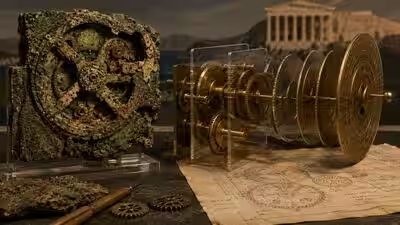
Scientists explain how the ancient Greek Antikythera Mechanism copied the Moon’s changing speed without modern technology |

The Moon does not travel across the sky at a constant pace. Its speed changes throughout each orbit, a detail ancient astronomers noticed long before they had the mathematics to explain it fully. More than two thousand years ago, the makers of the Antikythera Mechanism found a way to reproduce this unevenness using bronze gears…

Read More

Newton: Quote of the day by Isaac Newton: “If I have done the public any service, it is due to my patient thought” |

In a world that often celebrates quick answers, instant success and sudden flashes of brilliance, Isaac Newton’s words offer a very different view of achievement. “If I have done the public any service, it is due to my patient thought,” Newton wrote in a 1692 letter to the English theologian Richard Bentley. The remark reflects…

Read More

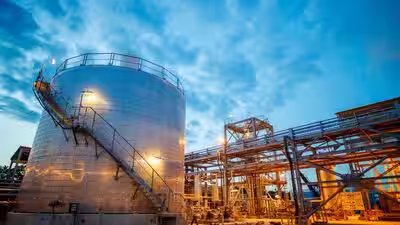
Texas A&M researchers built a 17-foot fire whirl over crude oil on water; it burned 40% faster, cut soot 40% and consumed up to 95% of the fuel

A giant, tornado-like flame may offer a cleaner and faster way to respond to oil spills at sea. In a large-scale experiment, researchersfrom Texas A&M University and the University of California, Berkeley created a nearly 17-foot-tall fire whirl over crude oil floating on water. The spinning flame burned the oil about 40% faster than a…

Read More

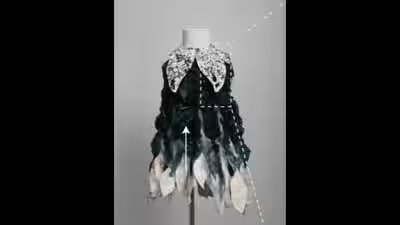
Scientists in China create a self-healing dress from living fungus that repairs its own tears and biodegrades naturally |

PC: Study: A programmable fungal platform for engineered living textiles Researchers in China have created a textile made from living fungal mycelium that can heal its own cuts, grow new surface layers on command, and biodegrade completely within weeks. The material, built from Cordyceps militaris fungus, keeps its cells alive throughout the manufacturing process, unlike…

Read More

Meet Millie Pradawong, the 14-year-old Virginia student using machine learning and CRISPR to make microalgae produce more biofuel

Millie Pradawong developed an AI and CRISPR tool to improve microalgae biofuel production. A fourteen-year-old teen in United States has developed a computational tool with the help of machine learning and CRISPR gene editing to improve biofuel production. Millie Pradawong is one of the ten finalists in the 3M Young Scientist Challenge this year.Her project…

Read More

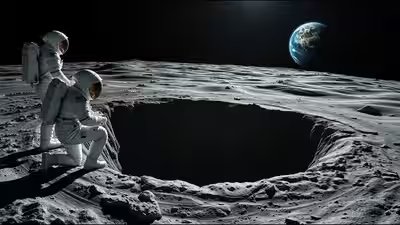
Moon: Scientists develop a new way to detect hidden water ice on the Moon using seismic waves |

Representative Image of astronauts investigating potential water ice reserves on the Moon (AI-generated image) Beneath the permanently shadowed craters near the Moon’s south pole, scientists believe significant deposits of water ice may be buried out of reach of the instruments currently used to search for it from orbit. A new study led by researchers at…

Read More

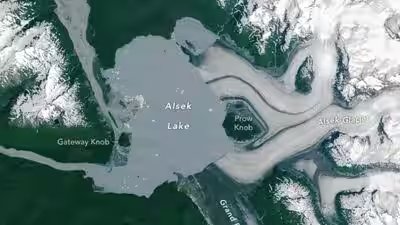
A new island has emerged in Alaska after a glacier melted away: Nasa images reveal a stark sign of climate change |

Alsek on July 5, 1984. Image Credit: NASA Earth Observatory images by Michala Garrison, using Landsat data from the US Geological Survey. The coastal plain of southeastern Alaska is currently witnessing a rapid transformation where water is replacing ice at an unprecedented rate. Glaciers in this region are melting, which leads to the formation of…

Read More