Lost Himalayan blueberry rediscovered in Arunachal Pradesh after 188 years: Rare Vaccinium piliferum found in dense forests |
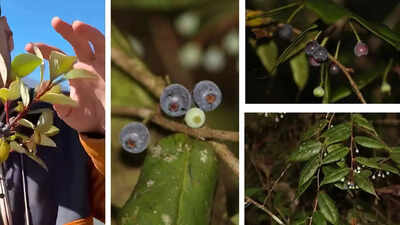
On the edge of Arunachal Pradesh, where the forest starts to tighten, and the river systems cut through steep green slopes, a small botanical record has reappeared in a way few expected. A plant tied to old herbarium sheets and colonial-era field notes has been seen again after slipping out of documented sight for generations. It was not found in any dramatic sense, no sudden announcement in the field, just a slow confirmation as samples and sightings were matched against scattered historical references. The species in question, a wild Himalayan relative of blueberry and cranberry plants, had last been reliably recorded in the mid-19th century. Each plant location was marked using GPS coordinates, a practical step for future monitoring.
The lost Himalayan blueberry Vaccinium piliferum resurfaces in Arunachal Pradesh
The plant is known as Vaccinium piliferum, a species tucked within a broader family that includes better-known berry shrubs found in colder regions. Its presence in historical literature comes from brief encounters by botanists working in the eastern Himalayan belt during the 1800s. One early record dates back to the 1830s, when it was noted in the Mishmi Hills. For well over a century, there was nothing new to add. No confirmed sightings, no preserved specimens arriving in herbaria, just a gap that gradually turned into an assumed absence.The recent encounter came from forest stretches near vijoynagar in Changlang district, where tributaries of the Noa-Dihing River move through dense, uneven terrain. It is the kind of landscape where fieldwork is slow, often interrupted by wet ground, tangled undergrowth, and long distances between clear markers.According to CSR Journal, within this setting, a small cluster of plants was recorded at mid-elevation slopes, sitting between roughly 1,150 and 1,280 metres above sea level. The population was not spread out in any obvious way. Instead, the individuals were scattered in a pattern that felt fragmented, almost hesitant, across a limited stretch of forest.Only a handful of mature plants were counted. Sixteen in total. That number, written down in field notes, stood out for its simplicity more than anything else.
What the plant looks like up close
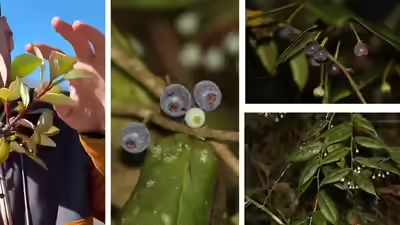
In appearance, Vaccinium piliferum does not stand apart strikingly at first glance. It grows as a climbing shrub, leaning on nearby trees rather than standing rigid on its own. In some cases, it reaches several metres in length, threading itself through the forest layers.The flowers are small and pale, shaped like hanging bells. The fruit, when it appears, resembles the familiar look of wild blueberries, though coated with a faint waxy layer that gives it a muted bluish sheen. Leaves carry subtle markings too, with edges sometimes showing a reddish tint that becomes clearer when examined closely rather than from a distance.
How a Himalayan plant faded from scientific documentation
The story of its absence is not unusual for Himalayan plant life, where documentation has often been uneven and dependent on scattered expeditions. The earliest botanical notes were made during periods when large parts of the region were still being mapped through limited field visits.After those early collections in the 19th century, references to this species faded out of published records. No consistent follow-up surveys managed to confirm its continued presence, and over time it slipped into the category of plants assumed to be either extremely rare or possibly lost from recorded observation.