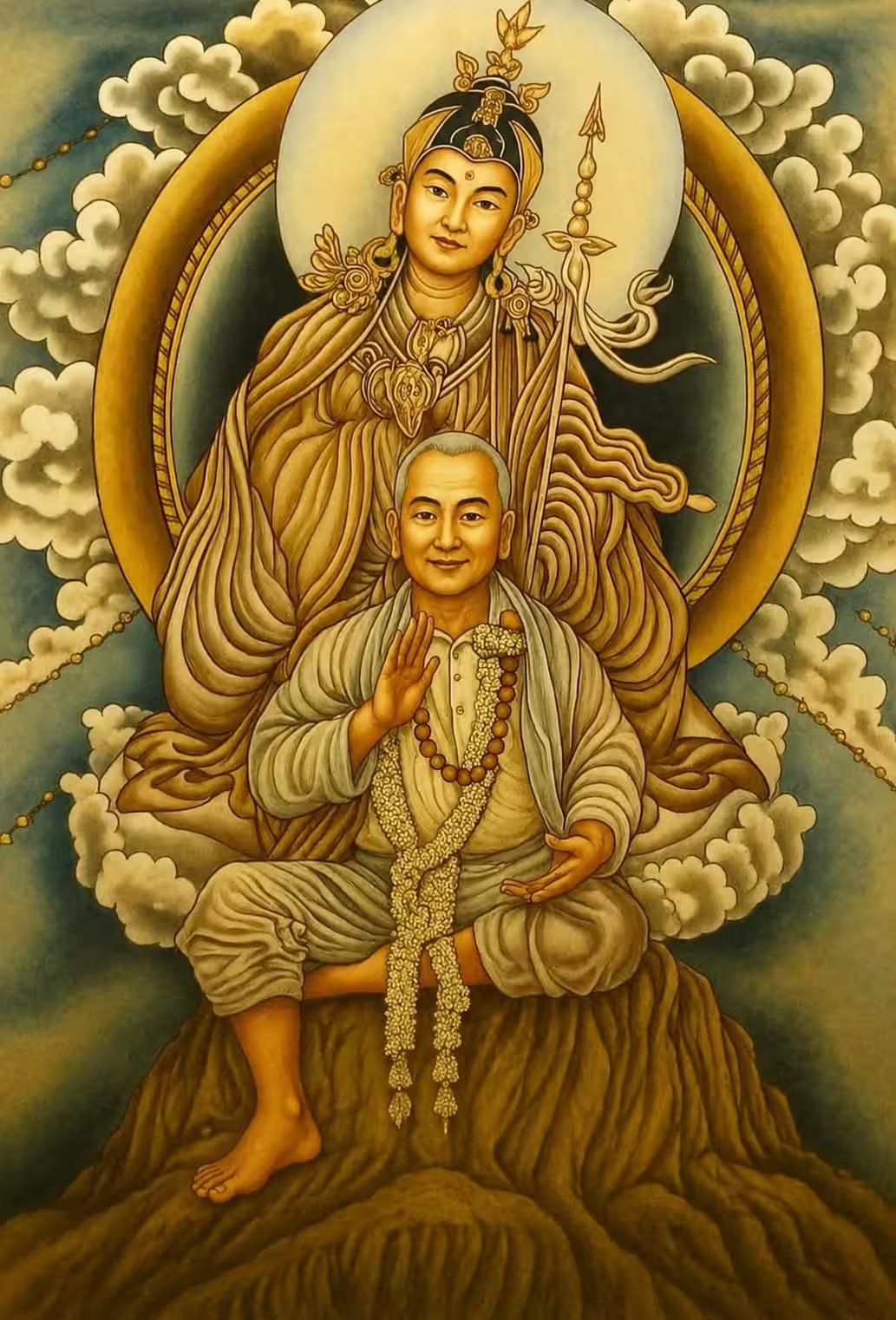
Spirituality’s “chicken or egg” dilemma

Some time ago, as I visited the history of world religions, it struck me that for all their fabulous diversity, structure, and dogma, religion has a fascinating general tendency to converge at a uniform peak: mysticism. Take Islam, for instance. Islam is characterised by its discrete and categorical tenets and prescriptions. Yet, from this highly structured paradigm blossomed Sufism—a profoundly fluid mystical tradition. At the core of Sufism, as with mysticism in general, lies the experiential union of the soul with the non-dual God and the realization of universal oneness. The mystic seeks the ultimate fusion of the proverbial soul and God—the drop slipping back into the boundless ocean from which it hatched.
Interestingly, such realisations almost invariably accompany a radical, all-encompassing, universal breed of love. But this begs a dizzying question: Does the knowledge, the realisation, of universal oneness naturally beget universal love? Or could it be the other way around? On the surface, the logic seems straightforward. If I deeply understand that you and I are of the same essence, woven from the exact same fabric, how could I not love you? It appeals perfectly to rationality that such a knowledge of oneness would act as the primary spur of universal love.
Yet, deeper reflection quickly betrays that the relationship is far more complex. Knowledge, no matter the mode that begets it, is by itself a neutral entity. The intellectual or experiential grasp of absolute unity is a double-edged sword. While, on the one hand, it can open one’s heart to the pains and joys of the world – on the other hand, the very same knowledge can spawn profound indifference. The mere understanding that all is one, that individual identities are just passing illusions in the cosmic play, can easily translate into spiritual apathy. It can just as easily lead a person to withdraw from the world as it can lead them to embrace it. If something is to inspire an unwavering, unconditional love for all of existence, it must look beyond mere knowledge.
Universal love and the knowledge of unity aren’t a simple and deterministic cause-and-effect equation. At the very least, they must walk hand in hand, each spurring and reinforcing the other. And while knowledge can elicit and deepen love, it is love, be it towards God or man, that seems equally capable of ushering man to the knowledge of universal oneness. It is no coincidence that both knowledge and love can knock down divisions. And the idea that knowledge of oneness must necessarily precede universal love seemingly fails to account for much of history.
By extension, there is a crucial corollary for the pragmatic mind faced with the unrelenting question of how to make man more moral and loving. More is needed to inculcate morality and fraternity than cliched sermons of universal oneness. The secret to making man more moral and loving is something else. And what is that? We’ll keep it for another day.
Disclaimer
Views expressed above are the author’s own.
END OF ARTICLE