How Cristiano Ronaldo became Real Madrid’s destiny child after football’s greatest act of kindness | Football News
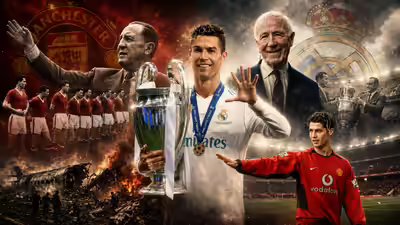
There is a version of this story that most people alive today have never heard, buried beneath decades of transfer headlines, rivalry narratives and the comfortable modern assumption that what exists now is all that ever existed. Unbeknownst to a generation of supporters who grew up watching these two clubs circle each other across the biggest stages in European football, the relationship between Manchester United and Real Madrid was never supposed to be what it became. One club built its identity on the working-class terraces of industrial England, the other spent decades as the favoured institution of a fascist dictator, and the two had raided each other’s academies and done enough damage to each other’s ambitions to sustain a perfectly respectable hatred. Sir Alex Ferguson, the most successful manager in Manchester United’s history, made the temperature of that feeling plain enough in 2008 when Real Madrid came for Cristiano Ronaldo, he called them a “mob” to whom he would not sell “a virus,” the language of a man who had long decided exactly where he stood on the matter.And yet Ronaldo had always wanted to go. He had admitted as much publicly as early as 2006, that playing for Real Madrid was a childhood dream he had carried from the streets of Funchal in Madeira, even as he gave everything he had to Ferguson and to Old Trafford, winning three Premier League titles, a Champions League, and a Ballon d’Or, becoming so indispensable to United’s identity that an entire generation of supporters across two continents had taken to following the club as much for the man wearing the number seven shirt as for the club itself When the move finally came in 2009, for a then world-record £80 million, most of the world read it as the biggest transaction in football history and left it there. What almost nobody mentioned was that it was also something closer to a repayment, a settling of a debt so old and so profound that most of the people celebrating it had no idea it existed. To understand what Ronaldo’s crossing from Manchester to Madrid actually meant, you have to go back more than half a century, to a spring evening in 1957, to a young English team that had no business being as good as they were, who would later endure the most devastating human loss in football history, and to a Spanish president who saw something in defeat that would change the course of both clubs forever.
Two empires meet: the semi-final of 1957
In April 1957, Manchester United travelled to Madrid for the first leg of a European Cup semi-final against the most dominant club side on the continent. Real Madrid, led by their visionary president Santiago Bernabeu, were European royalty, a multi-national squad of the finest footballers money and ambition could assemble, already holders of the European Cup and utterly accustomed to dispatching whoever stood in their way. Manchester United, managed by the quietly formidable Scottish coach Matt Busby, were something altogether different, a side so young and so distinctly his own creation that the English press had taken to calling them the ‘Busby Babes’, a squad with an average age of twenty-one, built almost entirely from players Busby had developed himself, quick and fearless and playing with an attacking verve that was unusual for English football of the era.
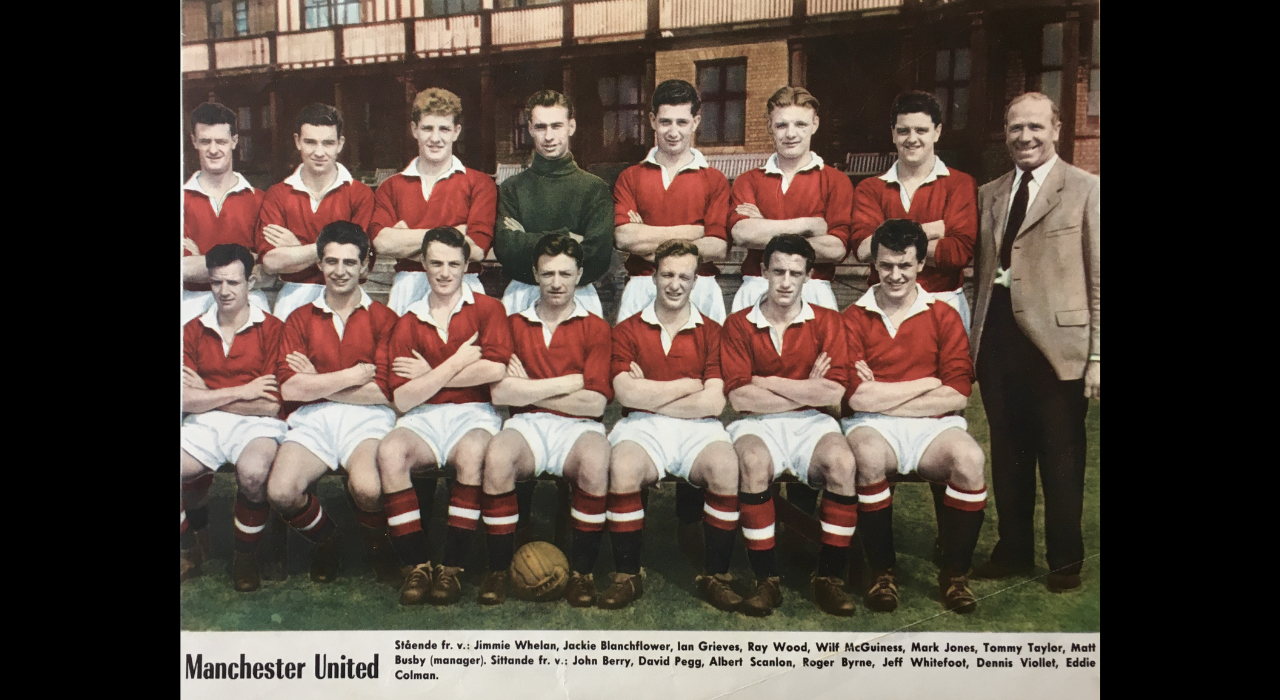
Matt Busby with the ‘Busby Babes’ of Manchester United, including eight players who died in the Munich air disaster/ Wikipedia
Real Madrid won the tie 5-3 on aggregate, which was the expected outcome, but the scoreline did not capture what Bernabeu had actually witnessed. In the second leg at Old Trafford, United held Madrid to a 2-2 draw, and across both matches the young English side had carried themselves with a spirit and a technical audacity that genuinely startled the Spaniards.
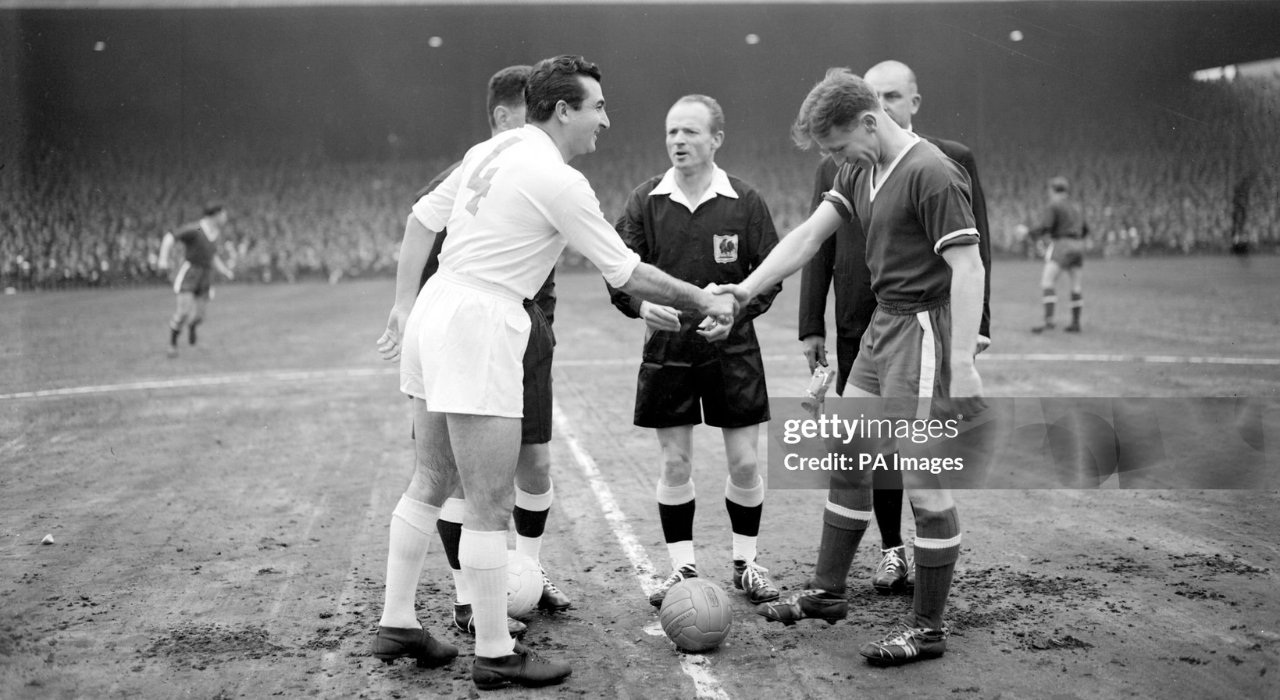
Rival captain Miguel Munoz (left) of Real Madrid and Roger Byrne of Manchester United shake hands before the Kick off of their European Cup Semi-Final second leg match at Manchester. Result was a 2 -2 draw giving Real Madrid a winning aggregate of 5 -3. (Photo by PA Images via Getty Images)
Bernabeu was so moved by what he saw that he approached Busby afterwards and offered him a job. Busby declined, because he had unfinished business of his own, he wanted to win the European Cup with Manchester United, not manage the team that kept stopping him. But something had been established between the two men in those exchanges, a mutual respect rooted in a shared belief in attacking football and the development of young players, that would prove to be one of the most consequential relationships in the sport’s history.
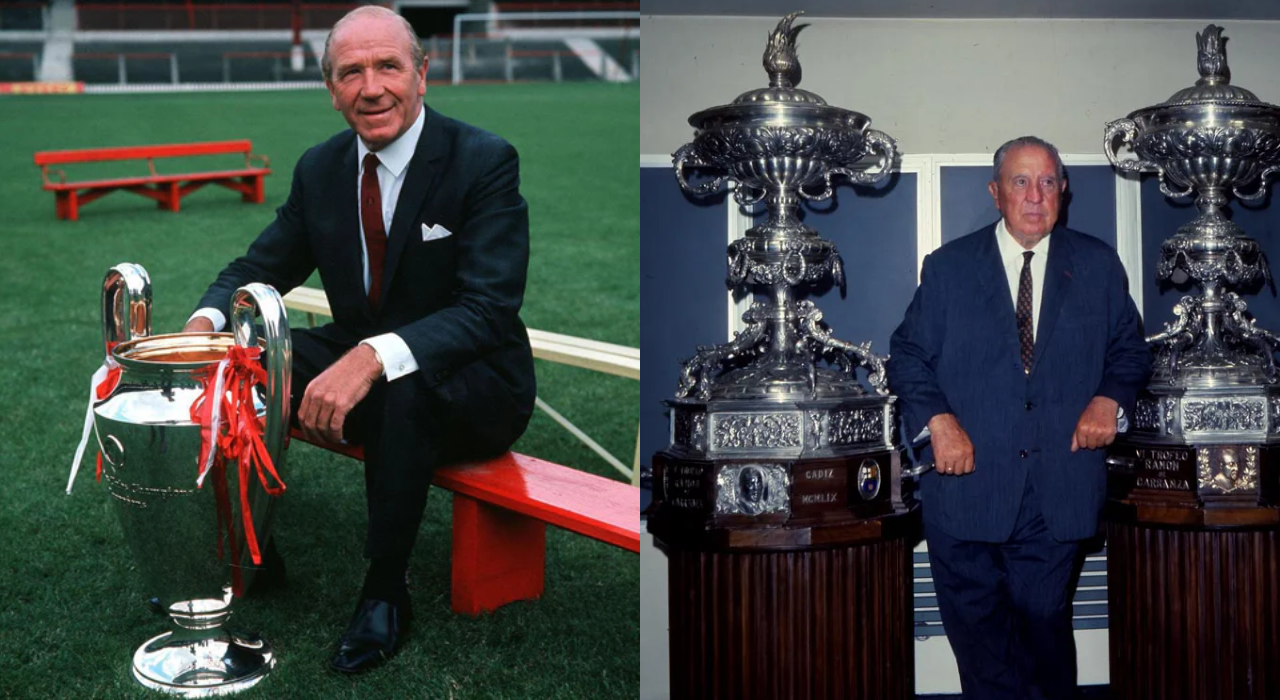
Matt Busby, the man behind Manchester United, and Santiago Bernabéu, the architect of Real Madrid
The sky fell over Munich
Ten months later, on the 6th of February 1958, a British European Airways flight carrying the Manchester United squad home from a European Cup quarter-final victory over Red Star Belgrade in Yugoslavia stopped to refuel at Munich airport in West Germany. The runway was covered in slush. The plane failed to gain sufficient speed on its third attempt at takeoff and crashed through the airport perimeter fence. Twenty-three people died, among them eight of Busby’s players, Geoff Bent, Roger Byrne, Eddie Colman, Duncan Edwards, Mark Jones, David Pegg, Tommy Taylor and Liam Whelan, as well as three members of the club’s staff. Busby himself survived but lay critically injured in a Munich hospital, twice receiving the last rites.
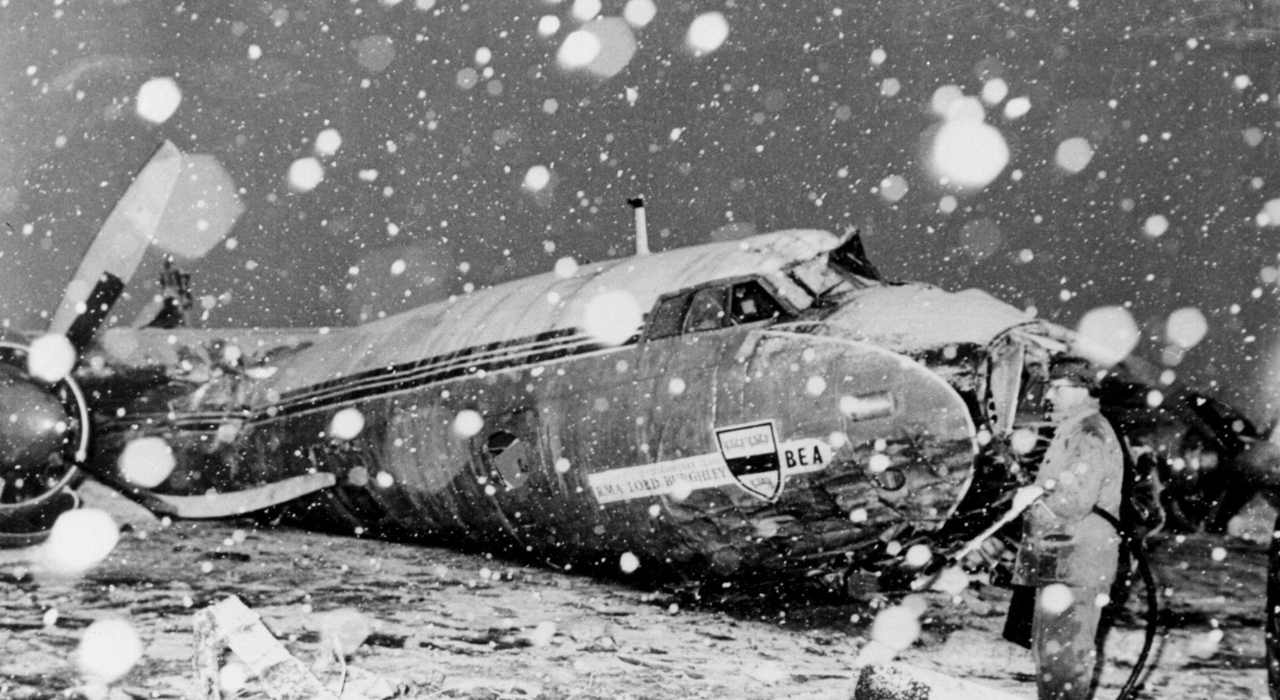
In the Munich air disaster of 1958, Manchester United’s plane crashed on takeoff in snowy conditions, killing 23 people including eight players and several staff members/ (Getty Images)
Alfredo di Stefano, Real Madrid’s Argentine-born centre-forward and the finest footballer in the world at that time, later described the moment he heard the news on the telephone at his home in Madrid. He said his heart was filled with sadness, that he felt he had lost many friends, and that he was most sorry for the game of football itself, because this Manchester United team, in his words, was magnificence itself. It contained, he said, some of the world’s greatest players. The football world grieved. But Santiago Bernabeu did not stop at grief.
What Real Madrid did next
Three months after Munich, Milan eliminated the depleted United side in the European Cup semi-final and went on to face Real Madrid in the final. Real won 3-2. Rather than simply celebrate, Bernabeu dedicated the victory to the fallen from Manchester and, in a gesture that was equal parts symbolic and deeply felt, offered United the trophy. United declined, but the offer said everything about the spirit in which it was made.What followed was more practical, and more remarkable. Real Madrid proposed loaning United the services of Di Stefano himself for the entire 1958-59 season, with both clubs splitting his wages, so that Busby could have the world’s best player at his disposal while he rebuilt. The Football Association blocked the move on the grounds that Di Stefano would be occupying a place that might otherwise go to a British player, a decision that, viewed across the distance of history, reads as one of the more spectacularly misguided interventions in English football administration. As John Ludden, author of A Tale of Two Cities: Manchester and Madrid 1957-1968, later revealed, Bernabeu had gone personally to Di Stefano to arrange it. “He was willing to go until the end of the season,” Ludden said, “United paying half his wages and Madrid the other half. But the Football Association blocked it as he would be taking the place of a potential British player.”Undeterred, Madrid found other ways. They produced and sold across Spain a memorial pennant bearing the names of the eight players who had died at Munich, under the title “Champions of Honour,” with all proceeds directed toward Manchester United. They invited the crash survivors and bereaved families to recuperate at Madrid’s facilities in Spain, at no cost. And when it became clear that Munich had damaged United not only in human terms but financially, the disaster had cost the club enormously in revenue, in lost players, in the sheer administrative chaos of rebuilding, Bernabeu organised a series of fundraising friendly matches between the two clubs.Real Madrid’s standard fee for a prestige friendly at that time was £12,000, a considerable sum. When Busby travelled to Madrid in 1959 to request the matches and explained what Munich had done to the club’s finances, Bernabeu’s response was immediate. “We must treat Matt and Manchester United generously,” he said. Pay what you can afford. In the end, he absorbed the costs himself.
Five friendlies and a resurrection
Between October 1959 and September 1962, Manchester United and Real Madrid played five friendly matches that were unlike any friendly matches before or since. They were not exhibitions. They were, for United’s young players, the closest thing available to a masterclass in what European football at its highest level actually demanded, and for Busby, they were a deliberate act of education, a way of keeping the idea of Europe alive for a squad that was nowhere near ready to compete there yet.
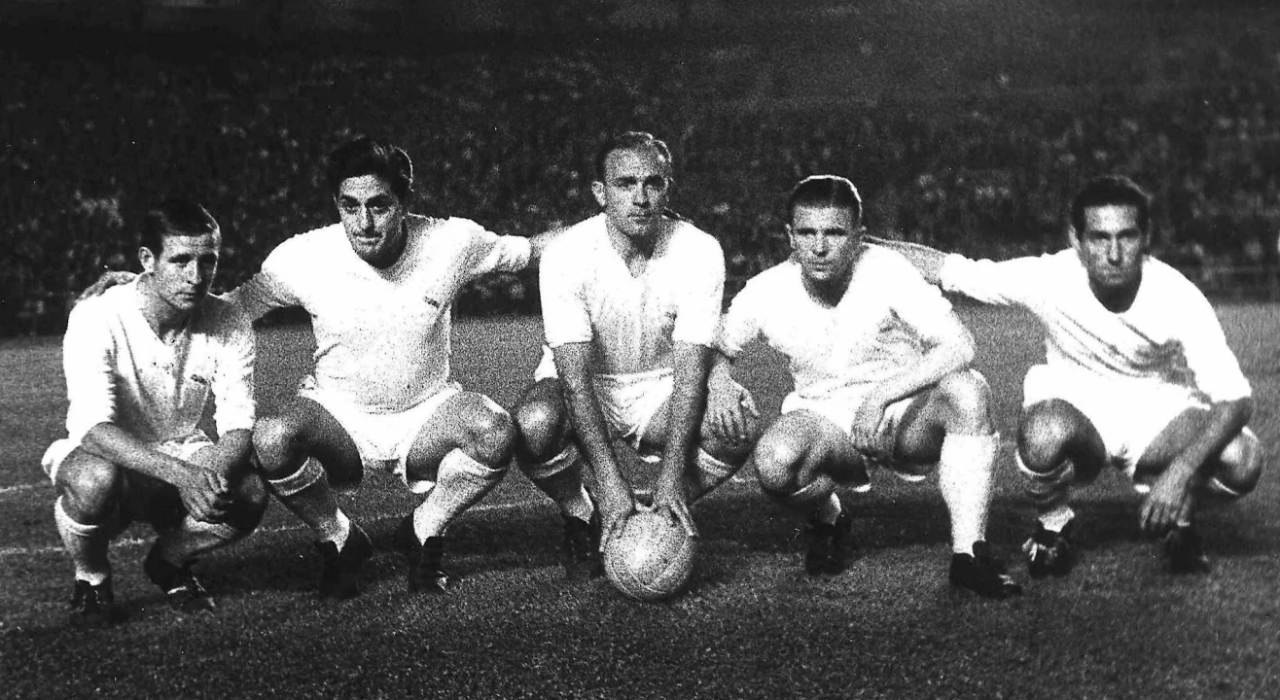
Real Madrid dominated European football during the 1950s by winning the competition five times in succession between 1955 and 1960. Hungarian star Ferenc Puskas joined the club in 1958 to link up with Di Stefano, Kopa, Gento and Rial to form one of the most exciting teams ever seen. AFP/Getty Images
The first match, played at Old Trafford in front of 63,000 supporters and broadcast live on television, ended 6-1 to Real Madrid. The scoreline looked like a humiliation but the United players formed a guard of honour for Real’s victorious team at the final whistle, and the crowd gave both sides a thunderous ovation. The real education came the following month, when Real returned expecting something similar and instead were given the fright of their lives, an eleven-goal thriller that United led for a full hour before Real eventually edged a 6-5 victory in front of 80,000 fans who applauded both teams from the pitch. Di Stefano, speaking afterwards, said that in many ways United had been the better team, and that with players like these and with Busby to inspire them, “Manchester United must be strong again before long.” That evening, Bernabeu hosted a fundraising banquet for the bereaved Munich families, at which he declared that Busby was “not only the bravest, but the greatest man I have ever met in football.”
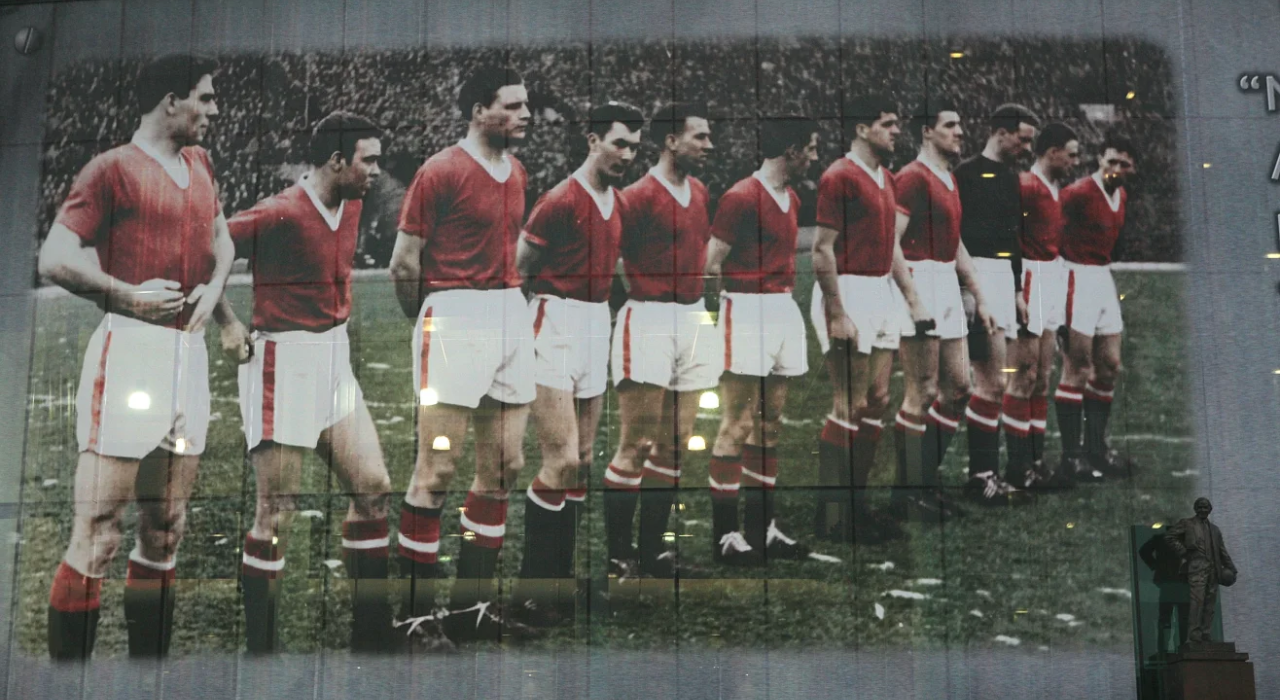
This giant mural outside Old Trafford next to the statue of Busby depicts the United team lining up at their European Cup game with Red Star Belgrade before the disaster at Munich airport on February 6, 1958. Their legacy will never be forgotten. Christopher Furlong/Getty Images
The third friendly, in October 1960, carried its own quiet story. Both Di Stefano and Puskas were carrying injuries and Bernabeu contacted Busby to offer a postponement. Busby declined, Madrid had become like family, he said, and both players, moved by that response, played through their injuries anyway. Madrid won 3-2, but the result was almost beside the point. By December 1961, the gap had closed so dramatically that United, despite sitting second from bottom in the league at the time, beat Real Madrid 3-1 at Old Trafford. And then, in September 1962, United won 2-0 at the Bernabeu itself, the first English club ever to do so, in front of 80,000 spectators, many of whom had turned on their own team in frustration before the remaining crowd rose at the final whistle to acclaim the visitors. Santiago Bernabeu clapped them off. He had watched United go from a broken, financially devastated club struggling to stay in the First Division, to a side capable of winning on his own ground. He had helped make that happen, and he knew it, and he was glad.
1968: the dream fulfilled, and the grace of a great man
United won the FA Cup in 1963, the first major trophy of the post-Munich era. The league title followed in 1965 and again in 1967. And in the spring of 1968, ten years after the snow and wreckage of Munich airport, Manchester United faced Real Madrid in the semi-final of the European Cup, the same competition, the same opponents, the same prize that had drawn them together in 1957 and set everything in motion.Before the match, the seventy-two-year-old Bernabeu addressed his club at a league title celebration and spoke about United with a warmth that went far beyond diplomatic courtesy: “I want Manchester United greeted and treated and respected as the greatest club in the world. As our friends for many years, nothing must go wrong. If we are beaten in the European Cup by Manchester United on Wednesday then we shall have lost to a great team. We have met them on many occasions and it’s about time their luck changed.”
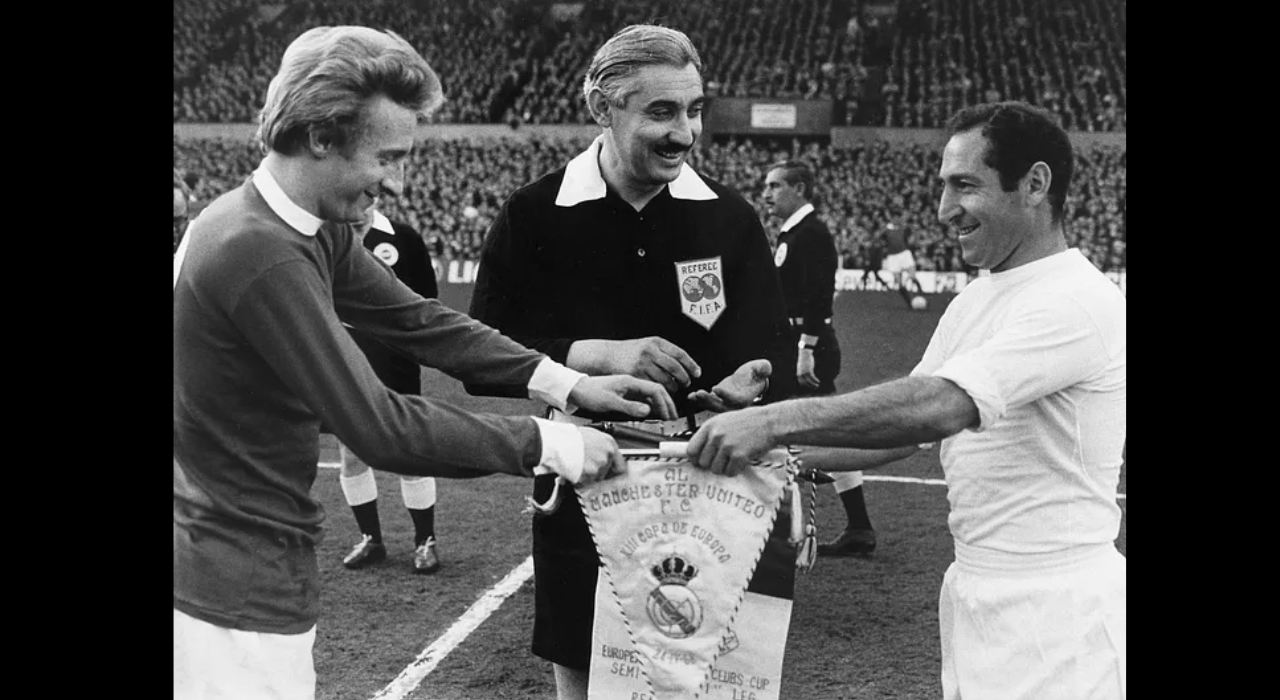
Manchester United captain Denis Law (left) and Real Madrid captain Paco Gento exchange pennants as referee Tofiq Bahramov watches before their European Cup semi-final at Old Trafford, April 24, 1968/ Image: X
United won the semi-final and went on to beat Benfica 4-1 at Wembley in the final, with Charlton scoring twice and George Best, the Northern Irish forward who had become the most mesmerising player in English football, adding a third. Sir Matt Busby’s dream, the one he had refused to abandon even when it cost him everything, was finally complete. When told that United had won, Bernabeu did not sulk or withdraw into defeat. He smiled, and he said: “If it had to be anyone, then I am glad it was them.” He had played his own part in their resurrection, and he knew it.
The debt repaid: Cristiano Ronaldo
For all the hostility that had accumulated between the two clubs by the time the twenty-first century arrived, the rival ambitions, the competing philosophies, the academy raids, Ferguson’s barely concealed contempt for the club he once called a mob, football has a way of settling its oldest accounts on its own terms and in its own time. The repayment, when it came, arrived in the form of a teenager from the Portuguese island of Madeira.
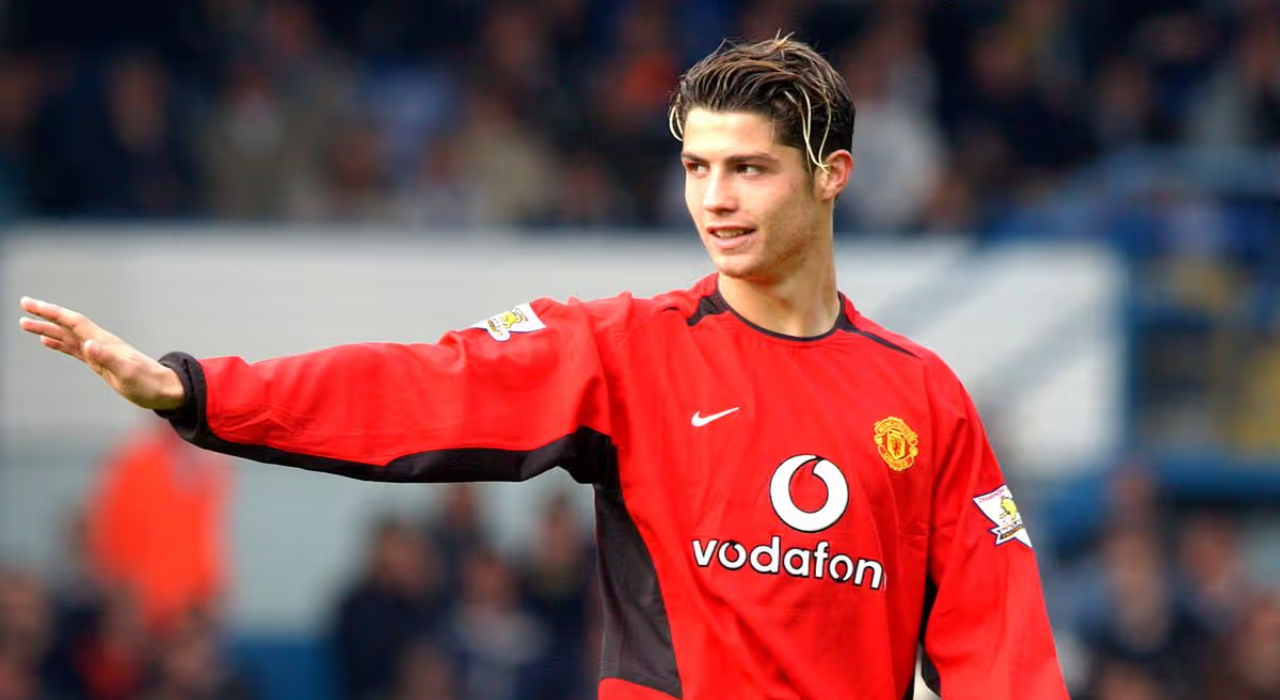
Cristiano Ronaldo at Elland Road in October 2003.(Image: Matthew Peters/Manchester United via Getty Images.)
In August 2003, a skinny eighteen-year-old signed for Manchester United after a pre-season friendly between the two clubs so thoroughly impressed Sir Alex Ferguson, the Aberdeen-born manager who had taken over from Busby’s successor and built United into the dominant force in English football, that he moved immediately to secure the player’s signature. Cristiano Ronaldo dos Santos Aveiro had grown up in poverty in Funchal, the son of a kit man and a cook, and had already shown enough at Sporting Lisbon to suggest he was something unusual. What nobody fully anticipated was the scale of what he would become.Over six years at Old Trafford, under Ferguson’s fierce and meticulous guidance, Ronaldo was transformed from a spectacular but inconsistent teenager into the most complete footballer on the planet. He won three consecutive Premier League titles, a Champions League, and the first of what would eventually become five Ballon d’Or awards, the prize given annually to the world’s best player. Ferguson, by Ronaldo’s own account, was the closest thing to a father figure he had encountered in football, the man who taught him that talent without discipline was merely decoration.In 2009, Real Madrid paid £80 million to bring him to the Bernabeu, the highest transfer fee ever paid at that point, though not without considerable resistance from Ferguson, who held on as long as he could before accepting that some destinations are written into a player’s story long before anyone has the power to stop them. Ronaldo had dreamed of Madrid since childhood, and Madrid, it turned out, had been waiting for someone exactly like him. What followed across the next nine years was the most prolific individual chapter in the history of either club. Ronaldo scored 450 goals in 438 appearances for Real Madrid, became their all-time leading scorer, won four Champions League titles and collected further individual honours that placed him, alongside Lionel Messi, in a category of achievement that the sport had not previously seen. The glory days that Real Madrid had known under Di Stefano and Puskas in the 1950s and 1960s, the era that Bernabeu had built with such fierce pride, were not just equalled in the Ronaldo years. In many respects they were surpassed.There is something in that which goes beyond coincidence. In the late 1950s and early 1960s, Real Madrid gave Manchester United the resources, the opposition, the education and the human generosity that allowed them to rebuild and eventually reach the summit of European football. They did it without obligation, without invoice, and without expectation of return. Decades later, Manchester United, albeit with considerable reluctance and no small amount of anguish, gave Real Madrid the player who defined their modern era, who filled the Bernabeu with a standard of performance that even Di Stefano and Puskas, watching from wherever great footballers go, might have recognised as something close to their own. Whether you call it karma or symmetry or simply the long arc of football’s most generous rivalry, the ledger between these two clubs has a strange and beautiful balance to it. Bernabeu spent years rebuilding United out of nothing but goodwill, and the game eventually sent his club the greatest player of his generation in return.The relationship between these two clubs was never really about transfers or trophies or the ordinary transactions of football at the top level. It was built in grief and generosity, sustained through five extraordinary Friday nights and one gracious Spanish president who understood that brotherhood, in football as in life, is measured not in what you take but in what you give when it costs you something to give it.