
NASA is chasing an asteroid that contains more gold than exists on Earth
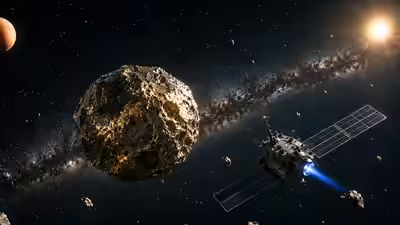
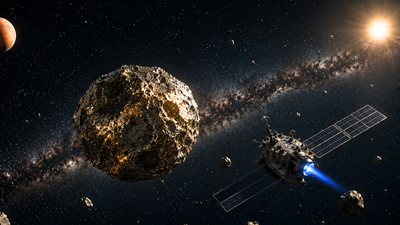
Somewhere between the orbits of Mars and Jupiter, a giant metallic world drifts silently through deep space. Unlike ordinary rocky asteroids, 16 Psyche has captured global attention because scientists believe it may contain enormous quantities of valuable metals, including iron, nickel, platinum, and possibly more gold than has ever been mined on Earth. The asteroid’s estimated theoretical value has triggered headlines describing it as a “trillion-dollar asteroid” or even a “space treasure chest”. But for NASA, the real fascination is not simply wealth. Scientists believe Psyche could be the exposed core of an ancient lost planet, offering a rare glimpse into how worlds like Earth were formed billions of years ago.
Inside the trillion-dollar asteroid chased by NASA
Discovered in 1852 by Italian astronomer Annibale de Gasparis, 16 Psyche is one of the largest objects in the asteroid belt. It measures roughly 220 kilometres across and appears very different from most asteroids in the Solar System.While many asteroids are made primarily of rock or ice, Psyche seems unusually rich in metal. Radar observations and density measurements suggest the object contains large amounts of iron and nickel, along with traces of other heavy metals.Scientists suspect Psyche may once have been part of a young protoplanet that was shattered during violent collisions early in Solar System history. If that theory is correct, the asteroid could actually be the exposed metallic core of a failed planet whose outer layers were stripped away billions of years ago.The asteroid became an internet sensation after reports claimed it could contain more gold than exists on Earth.These estimates are based on the asteroid’s enormous size and presumed metal content. If all of Psyche’s metals could somehow be mined and sold using current Earth market prices, the value would theoretically reach astronomical levels, sometimes estimated in the quintillions of dollars.The possibility of vast precious metal deposits has helped transform Psyche into one of the most talked-about objects in space science.
NASA has been chasing Psyche since 2023
NASA launched the Psyche mission in October 2023 aboard a SpaceX Falcon Heavy rocket.The spacecraft is currently travelling billions of kilometres through space toward the asteroid belt and is expected to arrive at Psyche in 2029.Instead of landing, the spacecraft will orbit the asteroid and gradually move closer in stages while studying its composition, magnetic field, gravity, surface geology, and internal structure.The mission uses advanced solar-electric propulsion powered by large solar panels and ion thrusters. This technology allows the spacecraft to travel efficiently over extremely long distances.NASA hopes the mission will answer one major question: is Psyche truly the exposed core of an ancient planet, or something even stranger?
Why Psyche matters more than its theoretical wealth
Although headlines often focus on the asteroid’s potential monetary value, planetary scientists are far more interested in what Psyche could reveal about the birth of planets.Earth and other rocky planets contain metallic cores buried thousands of kilometres beneath their surfaces. Humans have no way to directly study Earth’s core.But if Psyche is indeed an exposed planetary core, it may offer the first direct opportunity to examine the internal building blocks of a planet-like object.Scientists hope the asteroid could help explain how planets formed, how metallic cores developed, how magnetic fields emerged, and how ancient collisions shaped the early Solar System.In many ways, Psyche may function as a giant natural laboratory floating through space.
The asteroid may not be what scientists first expected
Recent telescope observations suggest Psyche could be more complicated than researchers originally believed.Some studies indicate parts of its surface may contain significant rocky material mixed with metal, while other regions appear highly reflective and metallic.This has produced multiple theories about the asteroid’s origin. It may be a partially exposed planetary core, a mixture of rock and metal, or an object heavily altered by billions of years of impacts.NASA’s spacecraft is expected to finally resolve many of these mysteries after it arrives later this decade.
Could humans ever mine an asteroid like Psyche?
The idea of asteroid mining has fascinated scientists, entrepreneurs, and science-fiction writers for decades. In theory, metal-rich asteroids could provide enormous quantities of industrial materials and rare metals for future space economies.But mining Psyche remains far beyond modern technological capabilities.The asteroid lies hundreds of millions of kilometres away, and transporting mined materials back to Earth would currently be enormously expensive and technically difficult.There are also major legal and economic questions surrounding ownership rights and the effect such massive metal supplies could have on global markets.For now, Psyche remains primarily a scientific mission rather than a commercial one.
Why the asteroid continues to fascinate the world
Part of Psyche’s appeal comes from the way it combines science, mystery, and imagination. It is simultaneously a possible planetary core, a relic from the birth of the Solar System, a symbol of futuristic space mining, and one of the richest-known objects humanity has ever identified.The asteroid’s reputation as a floating fortune has helped it dominate headlines, but scientists believe its greatest value may ultimately lie in the knowledge it can provide about the origins of planets including Earth itself.