
Those who pressure-cook Kosha Mangsho should not be trusted with civilisation
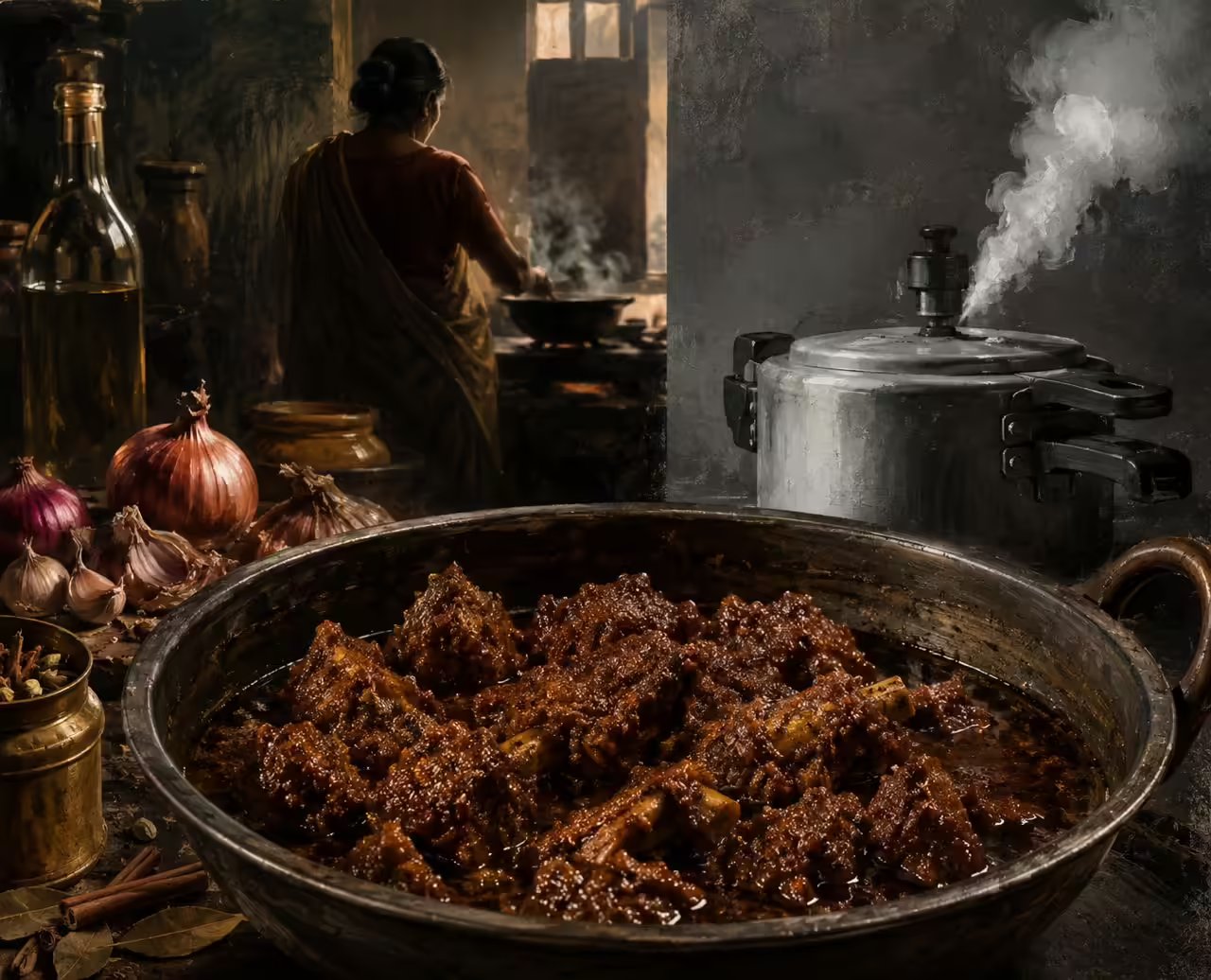
There is a particular kind of person one encounters increasingly in modern urban India. They wear smartwatches that congratulate them for standing up, use phrases like “life hack” without irony, and believe every problem can be solved faster with an app, an AI tool, a productivity framework or, in moments of culinary barbarism, a pressure cooker. These people must never be allowed near kosha mangsho.
And it’s not because cooking is sacred. We Bengalis are far too argumentative to keep anything sacred for long. The reason is that kosha mangsho represents one of the last surviving acts of resistance against acceleration itself. And acceleration, as it turns out, ruins mutton.
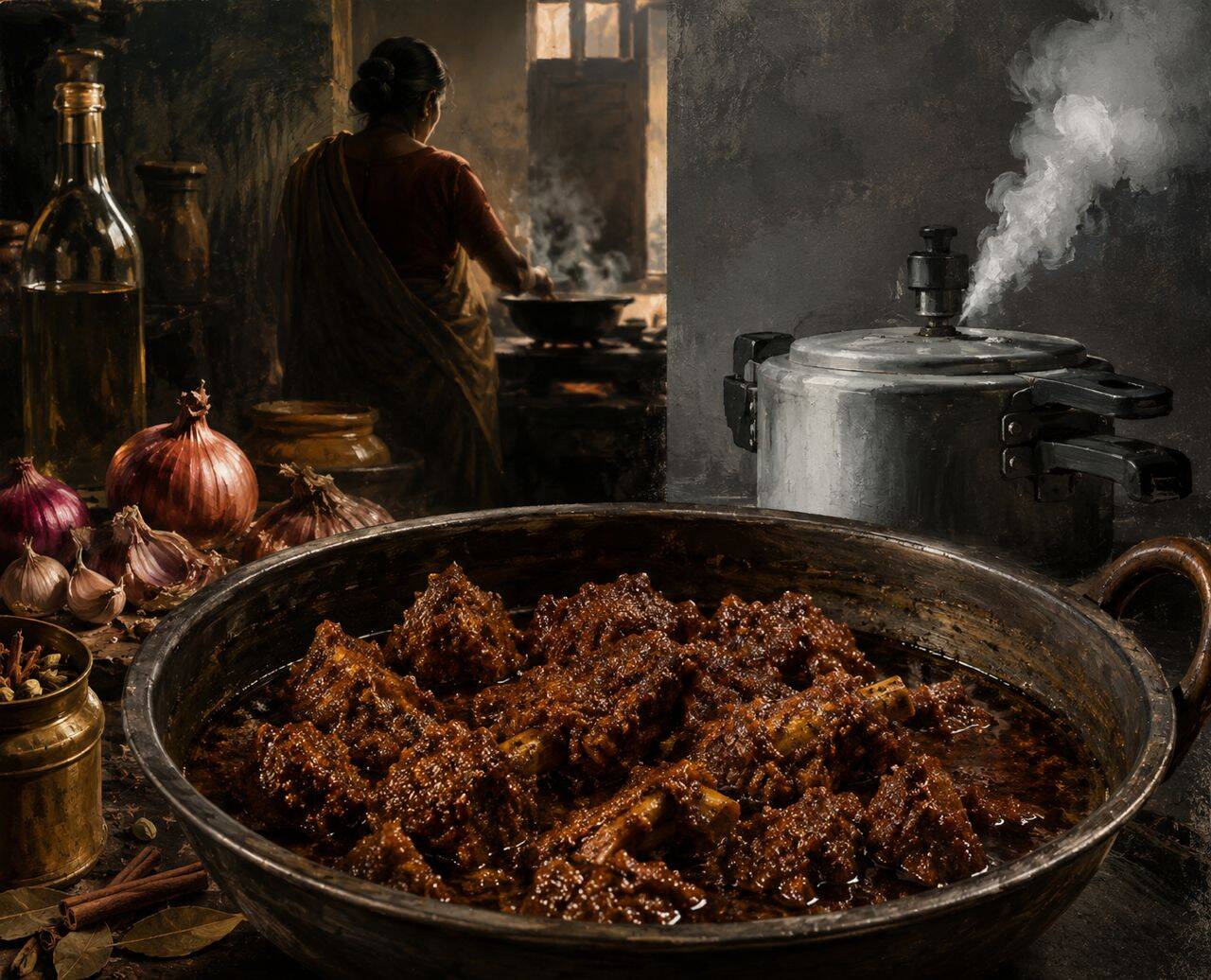

Now, before the internet food militias arrive waving potatoes like flags, let us clarify something. The older Bengali cookbooks, the real ones, written before food became “content” and grandmothers became “regional cuisine creators”, did not always treat potatoes as mandatory in Bengali mutton preparations.
In fact, if you wander through the smoky corridors of traditional Bengali culinary history, from Bipradas Mukhopadhyay’s পাকপ্রণালী (Pakpranali) to Leela Majumdar and Kamala Chattopadhyay’s sharply sensible রান্নার বই (Rannar Boi), and even the old Calcutta kitchen traditions that survived in crumbling North Kolkata mansions with Belgian mirrors, stained glass and unpaid electricity bills, kosha mangsho was fundamentally about the meat and potato was more married to jhol.
True kosha, or bhuna in Urdu, was always about the slow darkening of mutton itself. And darkening is the key word here because kosha mangsho is not really cooked. It evolves. The meat enters the dekchi arrogant, muscular and faintly suspicious. Meat should have character. If your mutton collapses emotionally after two whistles, you are either buying the wrong meat or living incorrectly, maybe both in equal measure.
This brings me to the great modern crime: overcooking. Overcooked mutton is a tragedy peculiar to the subcontinent. Somewhere between our fear of undercooking and our obsession with softness, we have normalised meat with the texture of regret. Proper kosha mangsho should resist slightly, al dente for you MasterChef connoisseur beings.
No, mutton mustn’t fight you. After all, it may be protein, but this is not gym equipment. But there must be integrity. A bite should feel like a conversation with an intelligent person, not a corporate town hall where everything dissolves into meaningless agreement. The pressure cooker destroys this integrity.
Of course, it tenderises. But kosha mangsho was never meant to be surrendered into existence. This is why mere enthusiasts should avoid attempting it. Enthusiasts are dangerous. They know just enough to be confident and too little to be humble. They will watch three YouTube videos, buy “authentic Bengali spice mix” online or from CR Park, and announce that they have “cracked the recipe”. They belong to the same ilk who discover Tagore through Instagram quotes and think Satyajit Ray is “slow but aesthetic”. Kosha mangsho does not reward enthusiasm. It rewards patience bordering on emotional damage.
You begin with mustard oil, enough to alarm your friendly neighbourhood cardiologist from South Delhi. The oil must smoke lightly first because mustard oil, much like Bengali intellectuals, requires its raw aggression to be calmed before becoming socially useful.
Then come the onions, not browned quickly, but slowly and with a steady gaze. This is where weak people fail. Onions take time, and modern attention spans cannot survive time without stimulation. Somewhere around minute fourteen, the enthusiast begins doubting himself. He increases the flame, and disaster begins.
Proper kosha lies precisely on this edge between caramelisation and catastrophe. The onions deepen gradually into a colour best described as “post-Emergency Calcutta sepia”. Then come ginger and garlic, followed by whole garam masala: cinnamon, black cardamom, cloves and bay leaves. And finally, the mutton, marinated overnight, preferably with yogurt, salt, turmeric and red chilli powder. Perhaps black pepper. Nothing theatrical. Kosha mangsho is not a TED Talk.
And now comes the bhuna. That ancient subcontinental process through which flavour, ego, moisture and human optimism are slowly beaten into submission together. The meat releases water. You stir till it dries. Then a little warm water. Then again. Stir. Scrape. MasterChef enthusiasts would call this deglazing. Wait. Repeat. The colour deepens slowly into that dark reddish-brown which every Bengali recognises instantly and every food photographer ruins by adding coriander leaves.
No coriander leaves, please. Kosha mangsho does not wear garnish like a startup founder wearing sneakers to appear disruptive. Somewhere during this long stirring emerges the truth hidden inside all good cooking: assumptions are easy. Understanding takes effort. And the metaphor can apply to almost anything in life.
Anybody can soften meat quickly. Understanding when the oil has separated correctly, when the onion has crossed into sweetness, when the spice has stopped smelling raw, and when the meat has yielded enough but not too much requires attention.
Attention is love’s most unfashionable form, which is why the people who truly understand kosha mangsho are usually suspicious of shortcuts elsewhere too. They know some things cannot be whistle-based. Though that may not hold true for Tamil Nadu anymore.
Not writing. Not grief. Not trust. Not marriage. And certainly not mutton.
I’m sharing how I do my kosha. This is my evolution in achieving a taste profile I like and one that comes closest to what I ate at family dinners.
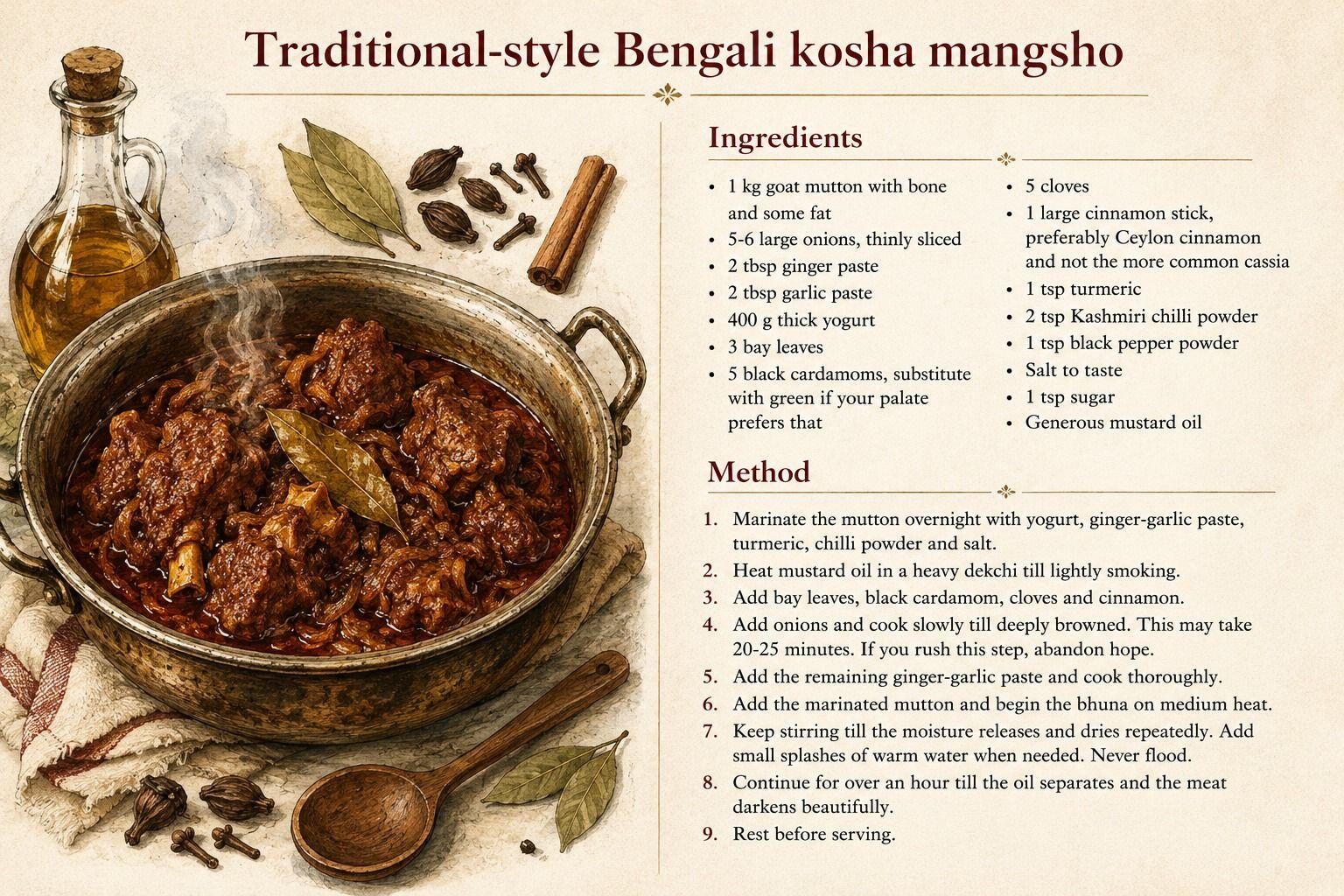

Traditional-style Bengali kosha mangsho
Ingredients
• 1 kg goat mutton with bone and some fat
• 5-6 large onions, thinly sliced
• 2 tbsp ginger paste
• 2 tbsp garlic paste
• 400 g thick yogurt
• 3 bay leaves
• 5 black cardamoms, substitute with green if your palate prefers that
• 5 cloves
• 1 large cinnamon stick, preferably Ceylon cinnamon and not the more common cassia
• 1 tsp turmeric
• 2 tsp Kashmiri chilli powder
• 1 tsp black pepper powder
• Salt to taste
• 1 tsp sugar
• Generous mustard oil
Method
- Marinate the mutton overnight with yogurt, ginger-garlic paste, turmeric, chilli powder and salt.
- Heat mustard oil in a heavy dekchi till lightly smoking.
- Add bay leaves, black cardamom, cloves and cinnamon.
- Add onions and cook slowly till deeply browned. This may take 20-25 minutes. If you rush this step, abandon hope.
- Add the remaining ginger-garlic paste and cook thoroughly.
- Add the marinated mutton and begin the bhuna on medium heat.
- Keep stirring till the moisture releases and dries repeatedly. Add small splashes of warm water when needed. Never flood.
- Continue for over an hour till the oil separates and the meat darkens beautifully.
- Rest before serving.
Serve this with luchi, porota or steamed rice. And if anyone asks why you didn’t use a pressure cooker, look at them gently, like a retired Bengali professor disappointed in the decline of civilisation.
Disclaimer
Views expressed above are the author’s own.
END OF ARTICLE