
Psychology explains why you randomly capitalise letters in words while writing |


Have you ever written a word randomly mixing capitalised letters without realising it initially? Such a minor quirk is actually quite common among people. According to psychologists and graphologists, such a behaviour can indicate one’s emotions, personality, or stress coping mechanisms.Integrating both uppercase and lowercase letters within the same word is rather typical for informal communication. Such cases usually occur when writing fast or informal messages, notes, etc. According to experts, this practice is not accidental but can be regarded as an involuntary method of communication. Another reason for integrating such a quirk into your writing is the need for self-expression. People who are frustrated with some limitations imposed on them may try to find different ways to express themselves. In such a way, the use of differently capitalised letters will become an alternative way of doing so.Suggested explanations from psychology and graphologyGraphology refers to the process of analysing handwriting to determine one’s personality traits and other characteristics. Although it is not recognised as an effective diagnostic technique, it is still widely employed in psychological and educational contexts.According to the journal Applied Sciences, handwriting features can be examined through machine learning to recognise personality traits quite accurately. Recognition ranges from 89 percent to 96 percent for handwriting features, and up to 91 percent for personality traits using artificial intelligence.Psychologists claim that inconsistent letter sizing, such as varying capitalisations, might indicate emotional depth or internal stress. Moreover, it could indicate that one is trying to convey some information visually rather than verbally.The study claims that aspects of handwriting, such as letter sizing, spacing, slant, and pressure, can shed light on one’s personality traits, temperament, and emotions.For instance, psychologists associate this handwriting style to impulsiveness and anxiety, particularly when the handwriting looks rushed. On the other hand, psychologists may associate this with creativity. In that case, the author experiments with their handwriting.The involvement of emotions and stressOften, emotions affect how one writes. Someone who is under pressure, highly stimulated, or in a hurry is unlikely to observe consistency in their writing. In those circumstances, alternating between upper-case and lower-case letters could be unconscious.Writing by hand itself is known to facilitate emotional expression. Studies referenced in the same Applied Sciences article point out that handwriting could help alleviate anxiety, enhance concentration, and arrange ideas. That may provide the reason why emotions could manifest themselves in the way one writes.For instance, hurried notes taken after an exhausting day may feature inconsistent letter sizes or abrupt capitalisation. Such modifications could function as a visible indication of urgency or significance.
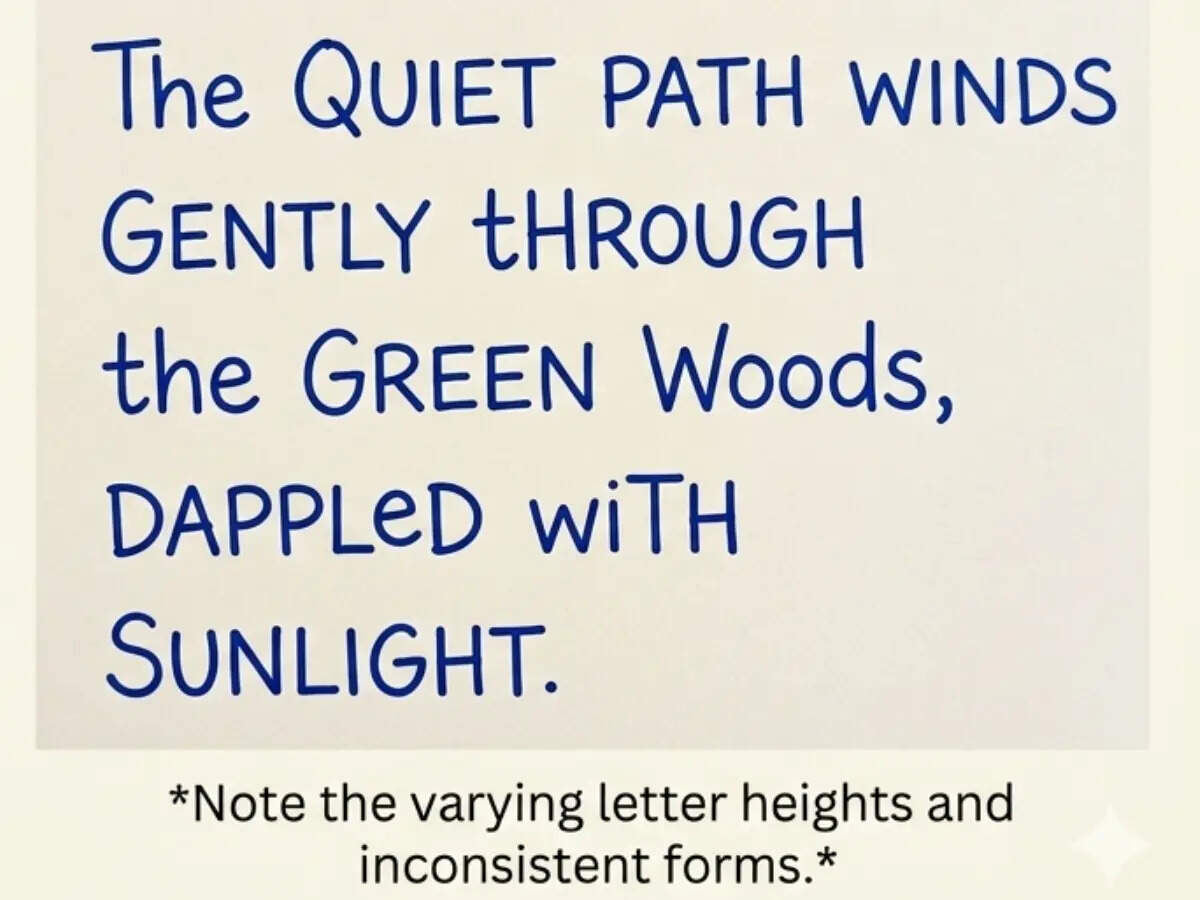
Do you write LiKe ThIs sometimes? Here is what psychology says. Image credit – Gemini
A creative and individualistic expressionMixed capitalisation does not always mean that someone feels anxious, pressured, or exhausted. In some instances, it could be an outcome of creativity or individualism. Those who are willing to explore new ideas or have artistic inclinations could try writing differently.Moreover, graphology considers the association between handwriting and personality types using models such as the Big Five or Myers–Briggs Type Indicator. Although the latter theories have a more rigorous approach, handwriting provides a more flexible insight into behaviour.It should be noted that handwriting analysis is applied in various fields, such as psychology, educational research and communications, and can provide insights about the way a person thinks, feels, and interacts with others.What makes understanding handwriting crucial?The usage of both lowercase and uppercase letters in one word does not mean there is something wrong with an individual’s personality or emotional state. There might be various reasons why a person uses a mixed case writing style. Mixed-case handwriting can be treated as a specific type of non-verbal communication, which reflects the process of visual adaptation of verbal language by people.