Government spends Rs 100 crore on Bengaluru daily, so why aren’t potholes being fixed? | Bengaluru News
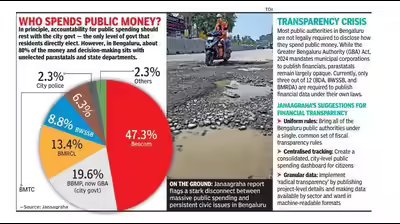
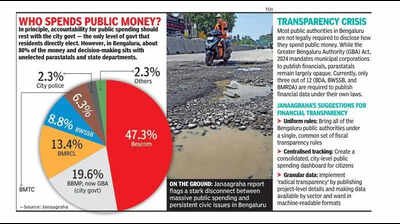
Bengaluru: Bengaluru is not just India’s tech capital; it is also a city where public money flows at a staggering pace, often beyond the direct gaze of its citizens.An eye-opening review by Janaagraha, a city-based not-for-profit focused on urban governance, has revealed that over Rs 100 crore is spent every single day on the city by the state govt and various public agencies. The estimate is based on an analysis of over 70 financial documents across 13 authorities for the financial year 2021-22.In total, public spending on Bengaluru stood at a massive Rs 38,455 crore for the year, according to the report.What stands out is not just the scale of spending, but how it is distributed. Only about 20% of the total expenditure is handled by the city’s municipal body, the erstwhile BBMP, now under the GBA framework. The remaining 80% is controlled by parastatal agencies such as Bangalore Electricity Supply Company (Bescom), Bangalore Metro Rail Corporation Ltd (BMRCL), Bangalore Water Supply and Sewerage Board (BWSSB), Bangalore Metropolitan Transport Corporation (BMTC), and city police.While these agencies account for the lion’s share of public spending, they often operate outside robust public scrutiny, leading to gaps in transparency.For residents, this disconnect is not abstract. It often translates into everyday civic issues, from potholed roads and traffic congestion to water shortages, even as thousands of crores are spent annually. Experts point out that without clear accountability, tracking outcomes on the ground becomes increasingly difficult.The issue is further compounded by the absence of elected representatives in city governance since 2020, weakening direct public oversight over a significant portion of civic spending. The report also highlights that Bengaluru lacks a single, consolidated view of its public finances, making it difficult for both citizens and policymakers to understand how funds are allocated across sectors.