
China: Your favourite internet story of 7 dogs returning home isn’t true – it’s not fake either | World News
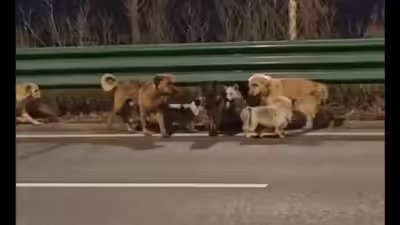
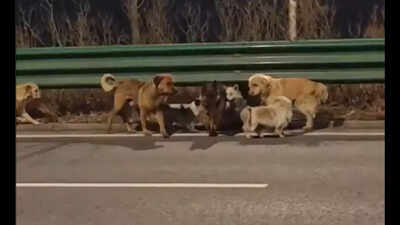
Yudhisthira, the eldest of the Pandavas in the Indian epic The Mahabharata, lived an almost sin-free life. After the battle, with old age approaching, he, along with his brothers, set off for heaven. En route, all others shuffled off their mortal coil except the eldest brother and one dog who accompanied him on the journey. At the gates of swarga, Indra, the king of gods, told him he could enter, but he would have to leave his stray companion behind. Yudhisthira, also called Dharmaputra, refused to abandon his canine companion. It turned out to be a test. The dog was Dharma (Yama), testing Yudhisthira’s moral resolve.The dog story is fascinating because it recalls the only time in life when the eldest Pandava prince was found morally wanting. That was on the battlefield, when he told a white lie by omission to Dronacharya: “Ashwatthama hata iti… narova kunjarova.” (Ashwatthama is dead… whether man or elephant, I do not know.) The smallest of lies changed the tide of battle and, as Dronacharya laid down his arms, Dhrishtadyumna, son of Drupad and brother of Draupadi, slew the warrior teacher. Much like Yudhisthira’s white lie, the tale of the seven dogs returning home — a viral video the internet fell in love with — is only partially true. The video is not AI; it is not fake, but the narrative is.The original video had millions of views at the time of writing. For those living under a rock, the clip shows a band of canine misfits — a golden retriever, an injured German shepherd, and a tiny corgi leading the line.According to a report in CNN, the original clip is authentic. There really are seven dogs wandering down the side of a highway in northeastern Jilin province. But they are not ‘homeward bound’.What the internet saw was a story. What the camera captured was behaviour.The dogs were not escaping anything. They were not marching towards anything. They belonged to nearby villagers. The German shepherd was in heat, which is why the others had gathered and followed. In villages, dogs wander. They drift. They return.There is no screenplay in that.Which is precisely why one was written.The moment the video left its original context, it entered a different economy. Not of facts, but of feeling. A corgi walking slightly ahead becomes leadership. A dog looking back becomes care. A cluster becomes loyalty. Meaning is not derived. It is assigned.And once assigned, it spreads.The first caption does not need to be entirely wrong. It only needs to be evocative. From there, the internet does the rest. Someone adds detail. Someone else adds motive. Soon there is a beginning, a middle, and an end. The dogs have escaped danger. They are protecting each other. They are on a journey home.The video has not changed, but the story has.This is how misinformation now travels. It does not arrive as a finished lie. It accumulates as a preferred interpretation. Each retelling smooths out ambiguity, sharpens intent, and removes the parts that feel inconveniently ordinary. By the time the story stabilises, it no longer feels like an embellishment. It feels like memory.And then comes the second wave. AI posters. Trailers. Imagined reunions. The internet does not just tell the story. It begins to produce it. A few seconds of footage become a universe that never existed.At that point, correction becomes irrelevant. Truth isn’t competing with a lie, just a version of it that sounds better.And perhaps that’s the irony, as Yudhisthira understood: a statement can be true and still mislead. Truth does not reside only in words. Beauty lies in the eyes of the beholder and, in our age of super-fast information, truth rests on the availability heuristic of the viewer.