How Iran targeted US, UK base Diego Garcia 4,000km away in Indian Ocean — Explained
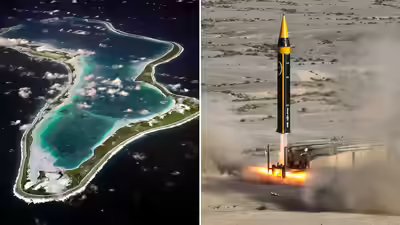
Iran’s attempted long-range strike on the US-UK military base at Diego Garcia has showcased a sharp escalation in both capability and intent, pushing the geography of the ongoing conflict far beyond the Middle East, as per a report by the Washington Post. The base, located roughly 4,000 kilometres from Iran’s coastline, was targeted with two intermediate-range ballistic missiles, according to US officials, in what appears to be one of Tehran’s longest-range strike attempts to date.Iran continues to strike Gulf nations — Follow live updatesNeither missile hit its target. One reportedly failed mid-flight, while the second was engaged by a US Navy destroyer using an SM-3 interceptor, though it remains unclear whether the interception was successful. Despite the lack of impact, the attempt itself has triggered alarm in Washington and allied capitals, as it suggests Iran may now possess or is willing to demonstrate strike capabilities far beyond its previously declared limits.
Also read: Iran fires 2 ballistic missiles towards US, UK military bases in Diego GarciaThe strike came amid intensifying hostilities between Iran and a US-Israel alliance, even as Donald Trump indicated that Washington was “very close” to achieving its military objectives and could consider winding down operations. Yet the attack on Diego Garcia, a remote but critical military hub, suggests Tehran is widening both the scope and signalling of its retaliation.
A strike across 4,000 kilometres
The attempted strike stands out primarily for its distance. Diego Garcia lies deep in the Indian Ocean, more than 3,800 kilometres from Iran, well beyond the 2,000-kilometre range Tehran has long claimed as the upper limit of its missile programme.US officials believe the missiles used were likely from the Khorramshahr-4 class, an intermediate-range ballistic missile that analysts had previously assessed to have a potential range exceeding 4,000 kilometres, though publicly demonstrated capabilities had remained lower. If confirmed, the strike would mark the first operational indication that Iran can hit targets at such distances.
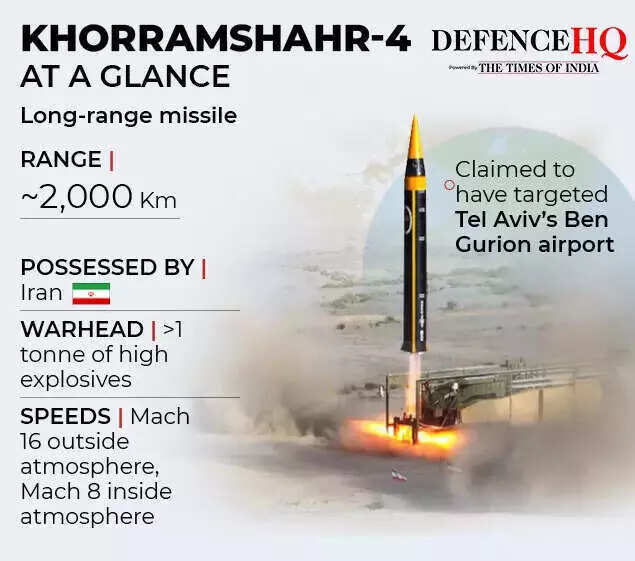
The implications extend far beyond this single incident. A 4,000-kilometre strike radius from Iran would place large parts of Europe including cities such as Paris and London within theoretical reach. For NATO countries that have largely viewed the conflict as regionally contained, the attempted strike alters that calculation significantly.The Khorramshahr-4 itself is a liquid-fuelled missile capable of carrying a warhead exceeding one tonne, with the option of deploying cluster munitions. Its design, derived in part from earlier North Korean and Soviet systems, combines relatively simple architecture with high payload capacity. The missile is also believed to feature manoeuvrable re-entry capabilities, making interception more difficult.
Why Diego Garcia matters
The choice of target is as significant as the distance. Diego Garcia is one of the most strategically important military installations operated jointly by the United States and the United Kingdom. Situated in the Chagos Archipelago, the base serves as a critical logistics and operations hub for long-range missions.It has historically supported US bombing campaigns in Afghanistan and Iraq, as well as more recent operations in the Middle East. Its airfield is capable of hosting heavy bombers, surveillance aircraft, and pre-positioned military equipment, allowing rapid deployment across Asia, Africa and the Gulf.The base’s isolation far from conventional conflict zones has long been considered one of its key advantages. Iran’s decision to target it challenges that assumption, demonstrating a willingness to strike even remote strategic assets.The attack also comes amid renewed scrutiny over the future of the base. The United Kingdom recently agreed to transfer sovereignty of the Chagos Islands to Mauritius while retaining long-term access to Diego Garcia under a lease arrangement, a move that has drawn political criticism in Washington.
Missile defence and widening conflict
The attempted interception reportedly using the SM-3 system highlights the growing importance of missile defence in the conflict. The SM-3, deployed on US Navy warships, uses a “hit-to-kill” approach relying on kinetic force rather than explosives to destroy incoming missiles. Its effectiveness against intermediate-range threats is well established, but the uncertainty around this interception underscores the challenges posed by advanced ballistic systems.At the same time, the strike on Diego Garcia fits into a broader pattern of Iranian escalation. Tehran has stepped up attacks on energy infrastructure across the Gulf, including reported drone strikes on Kuwait’s Mina Al-Ahmadi refinery, while issuing warnings to countries hosting US forces.Iranian officials have also expanded their rhetoric, warning that targets linked to their adversaries could extend beyond traditional battlefields. These signals point to a strategy that combines conventional missile strikes with the threat of asymmetric attacks.Meanwhile, the United States has reinforced its regional posture, deploying additional warships and thousands of Marines. Despite talk of winding down operations, Washington’s military build-up suggests preparations for a prolonged confrontation.