
Elon Musk shares update on Tesla’s Cybercab robotaxi and Optimus robot production: Initially, it will be…
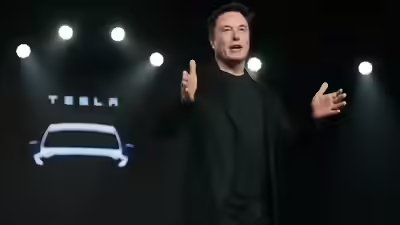

Elon Musk has shared an update on Tesla’s Cybercab robotaxi and Optimus robot production capabilities. In a post shared on X (formerly Twitter), the CEO of the electric vehicle-making company has warned that the production of Tesla’s Cybercab robotaxi and Optimus robot will initially be “agonisingly slow”. This suggests that Musk is bracing for another round of production challenges as the company prepares to begin manufacturing both products this year. Tesla is set to start production of the Cybercab, a sleek two-seater robotaxi that Musk has said will ship without a steering wheel or pedals, in April. Musk is targeting an eventual production goal of 2 million units a year. Meanwhile, Optimus, the company’s humanoid robot designed to help with everyday tasks, is set to enter production by the end of 2026, with Musk saying Tesla could eventually make one million a year.
What Elon Musk said about Tesla’s Cybercab and Optimus production capabilities
In his X post, Musk wrote: “With the important caveat that initial production is always very slow and follows an S-curve. The speed of the production ramp is inversely proportionate to how many new parts and steps there are. For Cybercab and Optimus, almost everything is new, so the early production rate will be agonisingly slow but eventually end up being insanely fast.”Musk’s explanation came as a reply to a post shared by another user who shared a video from a Cybercab production facility and wrote: “Tesla Cybercab production starts in less than 100 days from today, which will use Tesla’s revolutionary unboxed manufacturing process for the first time. One Cybercab will be able to roll off the production line in under 10 seconds versus 34 seconds for Model Y, with a long-term cycle time goal of ~5 seconds.”Musk’s comments match what Tesla may have been telling its employees. According to an earlier report by Business Insider, the company’s VP of AI software told staff on Tesla’s Autopilot and Optimus teams that 2026 would be the “hardest year” of their lives during an all-hands meeting in October 2025.At the same time, Musk also told investors that it would take a while to reach that goal, as the company was having to build almost the entire supply chain from scratch, with production moving at the speed of the “slowest, dumbest, least lucky thing out of 10,000 unique items.”This is not the first time Tesla has faced a difficult road as it planned on expanding an ambitious new product. The company went through a famously difficult period, which Musk called “production hell,” while building its Model 3 EV in 2017. Musk and other employees ended up sleeping on the factory floor as they struggled to expand production of the mass-market model.Tesla also faced production challenges with the Cybertruck, the company’s last new vehicle. The electric pickup’s unique design and stainless steel-clad structure made it highly challenging to produce at scale, and Musk acknowledged in 2023 that Tesla had “dug its own grave” with the Cybertruck’s design. The electric truck also serves as a warning for Musk’s ambitious production goals. Musk’s predictions that Tesla could produce 250,000 Cybertrucks a year eventually fell short, with industry data showing the company sold just over 20,000 Cybertrucks in the US last year.The company also launched an autonomous ride-hailing service in Austin in June 2025. Still, the fleet has only a small number of Model Y robotaxis on the road in the city and has yet to remove human safety monitors from its vehicles entirely.