
This remote Nagaland village sits on the India-Myanmar border, has a house that stretches across two countries

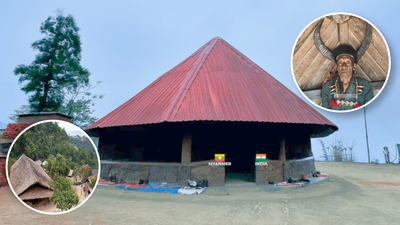
At first glance, this place looks like a remote village nestled amid the green hills of Northeast India, where traditional homes, forested slopes and a close-knit community define everyday life. But look a little closer, and its location begins to tell an extraordinary story. Here, an international boundary is not merely a line on a map. It passes through inhabited land, crosses the residence of the village chief and reflects a history in which communities existed long before modern borders divided them.Located in Mon district of Nagaland, Longwa is one of the region’s distinctive border villages. Yet the story of Longwa goes beyond a geographical curiosity. It is also about the Konyak Naga community, its cultural heritage and the relationship between traditional ways of life and modern national boundaries.
A house with rooms in two countries
The most widely discussed feature of Longwa is the residence of its traditional village chief, known as the Angh. According to the official Mon district administration website, the chief’s house lies partly in India and partly in Myanmar. The village itself is situated along the international boundary.The arrangement offers a striking illustration of how a national border can intersect with everyday spaces. A house, which ordinarily represents a single household and a place of belonging, becomes a physical reminder of two countries sharing the same landscape.The significance of Longwa is not limited to the house itself. Its location has shaped its identity, its social connections and the way residents relate to the land around them. The difference in time between the two countries adds another unusual detail. Myanmar is an hour and a half ahead of Indian Standard Time, making the house an especially striking example of how two countries can meet within a single geographical space.
Who are the people of Longwa?
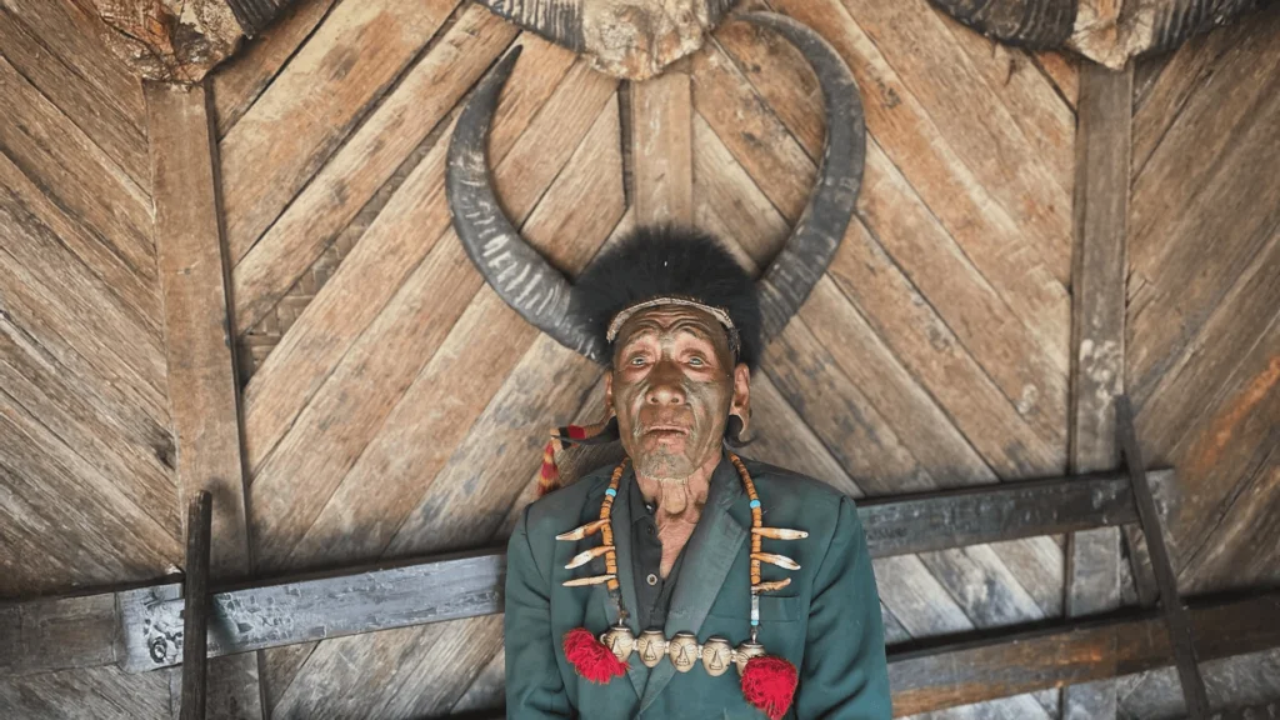
Photo courtesy: longwavillage.com
Longwa is home to the Konyak Nagas, one of Nagaland’s major Naga communities. The Konyaks have a distinctive cultural history, traditionally associated with elaborate facial tattoos, warrior traditions and intricate craftsmanship.Historical accounts of the community include the practice of headhunting, which was associated with warfare and traditional beliefs. The practice ended decades ago as social, religious and political changes transformed community life. Christianity is now an important part of the region’s religious landscape.Traces of the past remain visible in cultural expressions, traditional ornaments, tattoos among some older community members and stories passed down through generations. These are part of a wider heritage that cannot be understood simply through the village’s location on an international border.The Mon district administration’s tourism page introduces Longwa as a destination known for its location and cultural significance. For visitors, the village offers an opportunity to learn about Konyak traditions and the community’s history in its own geographical and cultural setting.Today, the Longwa community is shaped by contemporary life as much as by inherited traditions.
Why does the border pass through the village?
Longwa’s unusual position is rooted in the history of the India–Myanmar frontier. The Konyak Naga community and neighbouring groups have long maintained social, cultural and family connections across the hill region. These relationships predate the modern international boundary.When political boundaries were established and formalised, they divided territories that had previously been connected through community networks. In places such as Longwa, the border did not erase the older connections between people living on either side.The village’s location is therefore an example of how national boundaries can intersect with established cultural and social ties. Families and community networks have historically extended across what are now two countries, creating a reality that differs from the conventional idea of a border separating distinct communities.Longwa is not the only place in the world where modern boundaries divide older cultural networks. What makes it particularly striking is the visibility of that division: the international line passes through the village and the chief’s residence itself.
Does Longwa have dual citizenship?
Longwa is sometimes described in travel reports as a village where residents enjoy “dual citizenship”. The phrase can be misleading, however, because it suggests that people legally hold citizenship of both India and Myanmar.According to a previous TOI report, there is no automatic grant of dual citizenship simply because a village straddles an international boundary. India does not recognise dual citizenship in the conventional sense of a person simultaneously holding Indian citizenship and the citizenship of another country.What has historically made life in this region distinctive is the ability of communities living near the border to maintain cross-border social, cultural and economic ties.For years, the India–Myanmar Free Movement Regime (FMR) provided a framework for eligible residents of designated border areas to cross the international boundary under specified conditions without following the ordinary passport-and-visa process. The arrangement recognised the longstanding connections of communities living along the frontier.That policy changed in February 2024, when the Union Ministry of Home Affairs announced its decision to scrap the FMR and recommended its immediate suspension.
Four rivers and the natural landscape
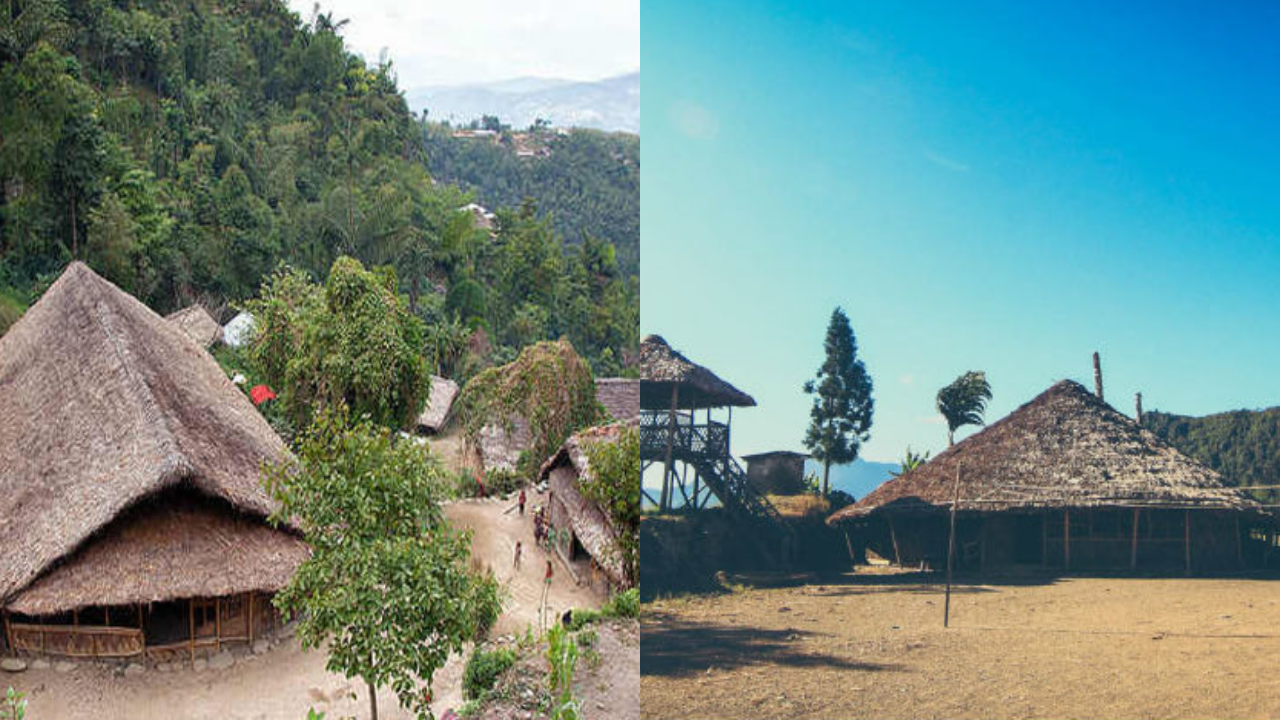
Photo courtesy: Official website of Government of Nagaland
Beyond its international-boundary distinction, Longwa is known for its natural setting. The official Mon district tourism page notes that four rivers flow through the village, with two on the Indian side and two on the Myanmar side.The surrounding hills and greenery form part of the wider landscape of Nagaland’s Mon district. For travellers interested in the Northeast beyond its better-known destinations, Longwa combines natural scenery with a distinctive cultural and geographical history.
More than a line on a map
Longwa’s appeal lies in the unusual meeting of geography, history and everyday life. The image of a house divided between India and Myanmar is an arresting introduction to the village, but it is only one part of a larger story.The Konyak community’s cultural heritage, its longstanding social connections across the frontier and the natural landscape of Mon district all contribute to Longwa’s identity. At the same time, changing rules governing cross-border movement show how modern national boundaries influence communities whose histories extend beyond them.In Longwa, the border is both a geographical fact and a reminder of a much older human story: people and their relationships often predate the lines that eventually divide the places they call home.


