
After 160 years of excavations, archaeologists find a 2,800-year-old bone flute at ancient Troy, offering the first direct evidence of music at the legendary city

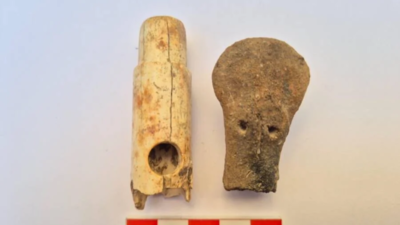
For the first time in 160 years of excavations, archaeologists unearthed a musical instrument at Troy, a flute made of bone that dates back about 2,800 years. Also discovered was a 4,500-year-old humanoid idol, which archaeologists hope will help shed light on the cultural traditions of the region.The bone flute was found in what’s known as the site’s Archaic layer, suggesting that the instrument dates back to about the eighth century B.C.E. This pivotal period in classical antiquity is roughly when the first Olympic Games took place and when legend says Romulus and Remus founded Rome. Also at this point in time, Troy was beginning to rise back into importance following centuries of decline.According to the announcement of the discovery made by the Turkish Ministry of Culture and Tourism, the bone flute’s head has been preserved while its body has been lost to history. Culture and Tourism Minister Mehmet Nuri Ersoy announced the discoveries from the 2026 excavation season, saying the flute provided direct archaeological evidence of musical culture at Troy.Dr Rustem Aslan, the director of the Troy excavations, emphasised the importance of the discovery. “We know about musical instruments from many depictions elsewhere. However, this is the first time a bone flute has been encountered in the history of Troy excavations,” Aslan said.Dating to approximately 750-480 B.C., the instrument provides evidence of music in a period when it played an important role in religious rituals as well as social and public life.Along with the bone flute, researchers found the head of a humanoid idol. The object was unearthed in a fire-damaged archaeological layer dating back to Troy II or the city’s Early Bronze Age phase of occupation. During this period, Troy was a fortified settlement, well-connected to other civilisations across western Anatolia due to its position near the Dardanelles Strait.A shocking entry in Troy’s archaeological record, the bone flute will hopefully serve as a window into the folkways and culture of everyday people living in Troy 2,800 years ago. Archaeologists noted that the age of the musical instrument is particularly relevant, as it dates back to the same period associated with the legendary Greek poet Homer.The composition of Homer’s epics, the Iliad and the Odyssey, is generally dated to the eighth century B.C.E. — just like the bone flute. However, the precise dating of Homer’s works remains under debate.The Iliad tells the tale of the legendary Trojan War, including the use of the famed Trojan Horse, which occurred (if it actually happened) in Troy. Meanwhile, the Odyssey narrates the story of how the Greek hero Odysseus journeyed home after the war. In Book 10 of the Iliad, Homer describes the Greek king Agamemnon standing over the Trojan plain, marvelling “at the many fires that burned before the face of Ilios, and at the sound of flutes and pipes, and the din of men.” Aslan himself drew the parallel, saying, according to AA, that Homer specialists accept that the poet lived in the eighth century, and that many researchers accept the epics were written down then. Finding such an object in an Archaic layer of the same century was, in his words, quite important for the excavation.If it in fact occurred at all, the Trojan War is usually thought to have taken place around 1200 B.C.E. When Homer was writing about it some four centuries later, he may have included flute-playing in the narrative because it was popular in his time, even if it may not have been popular 400 years earlier.While the coincidence of a flute being found at Troy and a flute at Troy being described by Homer is intriguing, archaeologists stressed that there is no concrete evidence that directly links the instrument to either Homer or his poems.Aslan also highlighted a different coincidence involving the recent film adaptation of the Odyssey. According to Aslan, in order to produce the song of the Sirens for the film, the producers made experimental music with a reconstruction of an eighth-century B.C.E. flute, not unlike the one that was just recently found.


