
The Weekly Vine, Edition 112: The Rang De Basanti syndrome

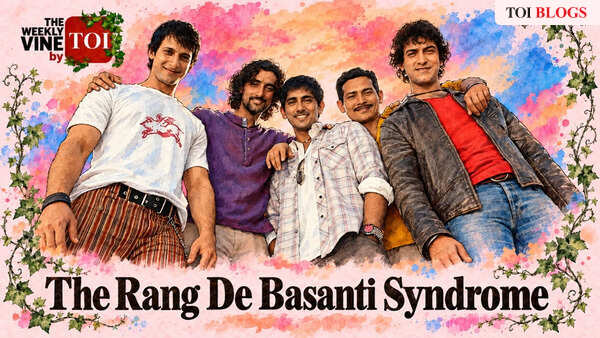
In my entire life, there has been one politician’s death that felt deeply personal, and it had nothing to do with ideology but hunger. You see, in the hellhole masquerading as a boarding school where I grew up, Founder’s Day is one day of the year when the mess chefs – showing they can make good food when they are not messing around – would create a veritable banquet that would be devoured by hungry school kids like those storming the Bastille during the French Revolution.Normally, the food served in the boarding school mess used to be so inedible that one wondered if it was a way to toughen up insouciant spoiled brats staying away from their well-to-do families.The chappatis would be tougher than leather and could double up as bulletproof vests, the dal was in a state of particulate matter where one could never surmise whether it was solid or liquid, and the noodles would stick to each other with such consistency that you would need to run them through a centrifuge to separate them. So we looked forward to Founder’s Day when we would finally give our digestive systems edible food fit for human consumption.Sadly, one year, a politician associated with the school passed away, which meant that Founder’s Day was cancelled and we missed the veritable feast that was promised, which remains to this day the only time I have felt an enormous amount of grief over a politician’s death.The memory of that cancelled banquet has stayed with me all these years – much like the Starks are haunted by the events of the Red Wedding – so it’s the perfect time to revisit the insouciance of youth with a topic that has been on my mind for a while: the Rang De Basanti Syndrome.Last week, my editor posted a simple question in his eminently readable newsletter: What makes a protest impactful – cause or coordinates? In this week’s Vine, I will take that political question to its ontological sequel: why are protests so sexy?The answer lies in a movie called Rang De Basanti – a supremely well-made anarcho-communist propaganda film wrapped in the fig leaf of patriotism with the leitmotif of AR Rahman’s music – which, for all intents and purposes, was for the Left what Dhurandhar is for the Right.I watched RDB in 2006 – the year my parents sent me to Kota to prepare for the IITs – and the movie seemed to have everything I wanted to do in life at the age of 18: drink beer, hang out with girls, protest and then send corrupt politicians to Elysium.Well, I didn’t actually want to do that, but RDB made it look rather cool, and it was only years later that I realised the power of subtle propaganda, something those who lean Right have to learn.RDB was the finest agitprop movie I’ve seen – and I use that term with absolutely no malice – that showed the romantic appeal of revolution without showing the harsh downsides.The Rang De Basanti Syndrome, shorn to its bare bones, is simply the romantic belief that protesting against the establishment makes one morally superior even though one has no idea what one is protesting, has no idea how things would get better after said protest, and just wants a symbolic removal.In RDB, that included a villain shuffling off this mortal coil, while in real life that can be the resignation of a minister that in no way changes the system. It is a peculiar human tendency to fall in love with the idea of revolution – while remaining blissfully uninterested in the responsibilities of governing or understanding how those systems operate – because usually what follows is far worse.The best example is the French, who have never needed an excuse – much like a Bollywood actor who was recently shot at – to protest something by taking their shirts off. Since taking offence at the idea of following a bread-free diet, the French have spent centuries trying to reconcile their revolutionary instincts with the inconvenient requirements of running a country, which has seen them come up with five different iterations.The Storming of the Bastille – perhaps it ought to be called a Mild Incursion into the Bastille – promised liberty, equality and fraternity, but instead led to the Reign of Terror under Robespierre and Napoleon Bonaparte, who managed to bring the terror to Europe as a whole and unite them, something no one has managed other than Adolf Hitler.The French tried again in 1848, overthrowing Louis-Philippe and establishing the Second Republic, only to elect Louis-Napoléon Bonaparte as president.Three years later, showing that the apple doesn’t fall very far from the tree, the OG Napoleon’s nephew staged a coup and became Napoleon III the following year to establish the Second Empire.The Third started in 1870 when the Prussians defeated Napoleon III and lasted until Hitler pulled a Napoleon in 1940 and decided that the French couldn’t be trusted to do their own thing. The Fourth lasted barely 12 years before Charles de Gaulle said enough is enough and started the Fifth Republic, during which he had the good sense not to arrest Jean-Paul Sartre because that would be unbearable for the other prisoners.In India, we have seen numerous student protest movements lead to political upheavals. What started as engineering students protesting increased hostel mess charges became the Navnirman movement, eventually forcing Chief Minister Chimanbhai Patel to resign, and helped inspire the JP Movement under Jayaprakash Narayan, who called for Sampoorna Kranti, or Total Revolution.Now, whether that was positive or negative depends upon your political worldview and the state you were born in, but at the Centre, post-Emergency, it facilitated such unstable coalitions that Indira Gandhi returned to the seat she had been dethroned from by 1980.Of course, there were several lasting institutional achievements, including constitutional amendments that made another Emergency almost impossible, but the grand promise of Total Revolution had culminated in a government that barely lasted a full parliamentary term, and things got so bad that the woman whose removal had united an extraordinary range of ideological adversaries was back in three years. And one could argue that the turbulence of the coalition years laid the foundation for the current regime.We have seen similar outcomes elsewhere.In the ancient land that was once called Persia, the ill-informed White Revolution by Shah Pahlavi to modernise the country instead sent it back to the Stone Age, literally and figuratively. The Arab Spring, on the other hand, ensured that chaos, like hummus, would always be part of the Middle East’s menu.Why do some revolutions work and others don’t?Hannah Arendt explored this problem in her 1963 book On Revolution, arguing that liberation from oppression was only part of the revolutionary undertaking. Establishing durable political freedom required the creation of institutions capable of sustaining it, a proposition that sounds considerably less exhilarating than overthrowing an unpopular government but has the advantage of addressing what happens the morning after the revolution.The RDB Syndrome, on the other hand, is particularly knee-jerk because all it does is create a vacuum that can be exploited by another individual and plunge countries into further chaos.Of course, it’s absurd to suggest that protests don’t achieve anything worthwhile. America is the perfect example where protests have led to civil rights, voting rights and even gay rights, though one might point out that pushing the boat out too far in the last case ended up helping MAGA cannibalise the Republican Party and condemned Democrats to lose.Last week on Vine, I explained the Toaster Lover Theory, the peculiar phenomenon where an individual with an absolutely absurd conviction can find enough people on the internet who share his beliefs and eventually convince himself that his lunacy is actually a righteous moral cause and anyone who doesn’t share that conviction is a bigot.The Rang De Basanti Syndrome is its logical extension, where the collective enthusiasm of protesters leads them to a mass delusion that whatever they are protesting is God’s own cause and makes them believe the Sith-like absolutist logic that anyone who doesn’t agree with them is a heretic.Bertrand Russell argued in his novel Power that most humans are either leaders or followers. Followers who become part of a tribe start believing in the infallibility of their own leader and cause. And that, one suspects, is what makes protests so magnetic, where ordinary individuals start experiencing the moral certainty normally reserved for prophets who found major religions. For a short time, till they splinter – much like organised religions – the protesters start believing in their own divinity.And God, after all, has demonstrated remarkable flexibility in choosing sides throughout human history, and people who think they are carrying out his wishes end up committing some fairly spectacular atrocities.The funny thing about Rang De Basanti is that almost everyone involved in the film follows an ideology that is antithetical to their character’s ideology. Just Google what they are doing right now. And there’s something fundamentally human about the journey from worshipping Marx, Lenin or Rand until age helps people discover that the only attraction that really matters is the attraction to Mammon. And that’s why capitalism, neo-liberalism, or whatever ideological epithet you have reserved for Mammon is the only one that endures while all others fall by the wayside. Unless one is an activist, but then again, one could argue that’s a different form of Mammon love.With age, people discover, like Voltaire’s protagonist Candide, that ideology doesn’t put bread on the table – unless one masters crowdfunding – and it’s much better to tend one’s own garden.And no one made this point better than the man the current CJP protesters venerate: BR Ambedkar. In his final address to the Constituent Assembly on November 25, 1949, Ambedkar argued that civil disobedience, non-cooperation and satyagraha were justified when constitutional methods were unavailable, but persisting with them would create what he called the Grammar of Anarchy.His second warning was even more prescient, particularly in a country where almost every popular figure – from actors to politicians – is beatified and elevated to a God-like status. Ambedkar warned that bhakti, or hero-worship, in politics would lead to dictatorship.Nearly six decades before AR Rahman made revolution sound cool, Ambedkar had identified the dangers of turning political figures into prophets. Sadly, almost all those who venerate him and use methods he would detest showcase that they didn’t understand – or willingly misunderstood – his point in the first place.As for those who take offence at Rang De Basanti being called ‘propaganda’, the simple truth is that one man’s propaganda is another one’s masterpiece. Just ask folks who love Dhurandhar. My real quibble, though, remains with those who continue to shove epithets on each other’s shelves: why can’t a propaganda movie also be a masterpiece?Also read
Disclaimer: Views expressed above are the author’s own.


