Australia planted African tulip trees for their bright orange flowers; the 24-metre trees now invade rainforests and threaten native bees |
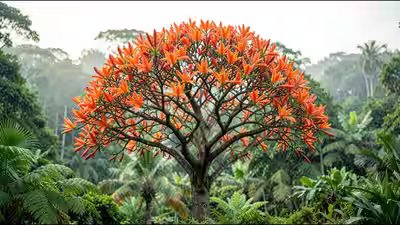
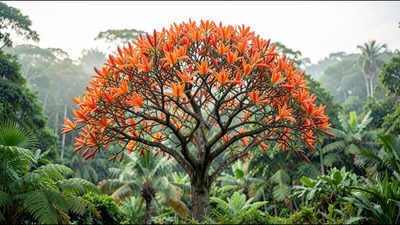
The African tulip tree was introduced to tropical and subtropical regions as an ornamental because of its showy orange-red flowers. In Queensland, Australia, the fast-growing tree, Spathodea campanulata, is now recognised as an invasive plant that can spread into disturbed rainforest and compete with native vegetation. Its flowers have also been associated with the deaths of stingless bees. Brazilian studies have recorded dead stingless bees in the flowers and found reduced survival in bees fed flower-bud mucilage, nectar or pollen. The studies examined different floral components, and their findings do not establish that all stingless bee species are affected equally. Queensland classifies the tree as a category 3 restricted invasive plant, placing restrictions on its sale and distribution. Replacing invasive African tulip trees with suitable native species could help protect Queensland’s rainforest ecosystems, reduce risks to native stingless bees and support biodiversity while maintaining attractive gardens and urban green spaces.
Why African tulip trees were planted in Queensland
Native to tropical Africa, the African tulip tree is an evergreen species that can grow up to 24 metres tall. Its large orange-red flowers, often edged with yellow, have made it a popular ornamental and street tree in tropical and subtropical parts of Queensland, according to Business Queensland. The tree also produces elongated seed capsules. Their reported maximum length varies between sources: Business Queensland gives up to 20 centimetres, while Brisbane City Council gives up to 30 centimetres. The Global Invasive Species Database reports a range of 17 to 25 centimetres. These measurements should not be treated as a single settled maximum.
How African tulip trees spread into rainforest and waterways
The tree can establish beyond gardens and streets. Business Queensland identifies disturbed rainforest, gullies and vegetation around waterways among the environments it can invade, where it competes with native vegetation. It reproduces through seeds and suckers, and its seeds can be carried by wind and water. Garden waste dumped in bushland can also contribute to its spread.The Global Invasive Species Database, maintained by the Invasive Species Specialist Group of the International Union for Conservation of Nature, records the species as invasive in several tropical locations, including Fiji, Hawaii, Guam, Vanuatu, the Cook Islands and Samoa. It describes the tree as capable of invading natural ecosystems, agricultural areas and forest plantations. Brisbane City Council regards African tulip tree as a significant environmental weed in Queensland, the Northern Territory and Christmas Island, and as a potential “sleeper weed” in northern New South Wales. The council also notes that the species is included among the world’s 100 worst invasive alien species in the Global Invasive Species Database.
African tulip tree flowers and stingless bees: what the evidence shows
Queensland’s biosecurity guidance states that African tulip tree flowers are toxic to native stingless bees. Research from Brazil provides more detail about the possible effects, but the studies investigated different parts of the flower and different bee species. In a research note published in Revista Brasileira de Biologia in 2000, José Roberto Trigo and Wagner F. dos Santos examined insect deaths associated with African tulip tree flowers. During March and April 1982, they examined 445 flowers across 5 trees in Ribeirão Preto, Brazil, and recorded 345 dead insects. About 97% were stingless bees, mostly Scaptotrigona postica. Most deaths occurred shortly after the flowers opened. The researchers also conducted a feeding bioassay using freshly emerged S. postica bees. They offered the bees sucrose diets containing mucilage collected from flower buds. A diet containing 25% mucilage reduced survival by 52.9% compared with the sucrose control. The result from pure mucilage was less conclusive because the bees might not have consumed it.The observations also suggested that the risk was not uniform across the flower’s development. The researchers reported no deaths or behavioural changes among bees collecting nectar from open flowers. They proposed that mucilage in the buds might serve as a chemical or mechanical defence against insects that rob nectar and pollen, and called for further investigation in the tree’s native range. A separate study by Ana Carolina Martins Queiroz, Felipe Andrés Leon Contrera and Giorgio Cristino Venturieri, published in Sociobiology in 2014, tested African tulip tree nectar and pollen on workers of 2 Amazonian stingless bee species, Melipona fasciculata and Melipona seminigra. The researchers found higher worker mortality in experimental groups exposed to the nectar or pollen than in the respective control groups. The studies therefore implicate different floral components: the 2000 note tested flower-bud mucilage, while the 2014 study tested nectar and pollen. Their results support concern about potential harm to the species examined, but do not establish that all stingless bees, including Australian species, respond in the same way. A University of Queensland School of the Environment project listing, posted in April 2025, proposes to investigate how African tulip tree flowers affect stingless bees. The listing describes a project opportunity; it does not establish that the work has been completed or is underway.
Queensland’s restrictions on African tulip trees
Under Queensland’s Biosecurity Act 2014, African tulip tree is classified as a category 3 restricted invasive plant. Business Queensland says it must not be given away, sold or released into the environment. The state’s general biosecurity obligation also requires people to take reasonable and practical steps to minimise biosecurity risks. Business Queensland recommends digging out or hand-pulling plants when the soil is moist and identifies herbicide use as an effective control method. Brisbane City Council lists cut-stump treatment, basal-bark application and stem injection. The appropriate method depends on the plant and site, and control work should follow relevant local guidance. For gardeners seeking alternatives, Business Queensland identifies native trees including black bean, wheel of fire and flame tree. Choosing suitable native species can help retain ornamental value while reducing the risk of introducing another invasive plant.