An underwater chimney collapsed at a Pacific hydrothermal vent; scientists discovered a ‘new one growing’ at its location |
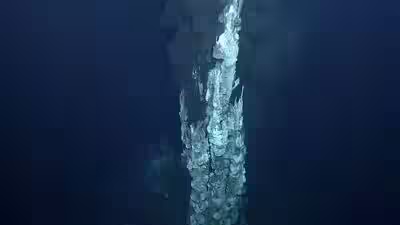
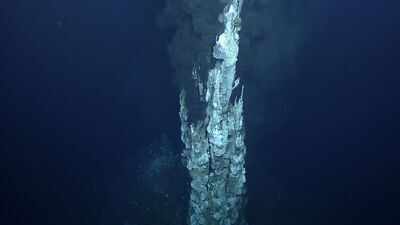
Since scientists first documented the Hafa Adai hydrothermal vent field in 2016, an underwater chimney has fallen over in the Pacific Ocean. When researchers returned in 2025, they discovered a smaller chimney growing in its place, a dramatic example of how rapidly the deep-sea landscape can shift. The discovery was made during an expedition led by the Ocean Exploration Trust aboard Exploration Vessel Nautilus, which surveyed volcanic features and deep-sea habitats around the Mariana Islands. The observations also revealed other towering chimneys at the vent field.
What happened to the underwater chimney at Hafa Adai in Pacific
The large chimney at Hafa Adai had collapsed sometime between its discovery in 2016 and the latest exploration in 2025. According to NOAA Ocean Exploration, the structure appeared to have toppled, while a new chimney was growing where it had stood.The finding came during the Mattingan: Mariana Arc Volcanic Exploration expedition, known as NA171. The Ocean Exploration Trust reported that its remotely operated vehicle, Hercules, visited the Hafa Adai vent field for the first time since the site was discovered.The expedition’s observations confirmed that the underwater landscape had changed considerably. Rather than finding the same arrangement of structures recorded nearly a decade earlier, scientists encountered evidence of continuing activity beneath the ocean.The new chimney was smaller than the one that had fallen. Its growth shows that the collapse of a structure does not necessarily mean the end of the hydrothermal activity that formed it. Instead, mineral-rich fluids can continue emerging from the seafloor and contribute to the development of new structures.NOAA Ocean Exploration’s account of the discovery identifies the replacement chimney as a new feature observed during the 2025 expedition.
How do black smokers form in the deep ocean
The Hafa Adai vent field lies in the Mariana back-arc, a region of the western Pacific where the ocean floor is slowly spreading apart. The Ocean Exploration Trust calls this movement in the Mariana region the ‘convergence of tectonic plates … that allows molten rock to rise up beneath the seafloor, creating conditions for hydrothermal vents.”These vents are formed when seawater seeps through cracks in the ocean crust, is heated by hot rocks and magma below, and then rises back up to the seafloor. When the hot fluid rises, it carries dissolved minerals and metals from the surrounding rocks.When the fluid meets cold seawater, some of these materials form solid deposits around the opening. With time, the deposits build up into chimney-like structures.Black smokers at Hafa Adai eject dark, mineral-rich fluids. The vent fluids are blackened by metals leached from the seafloor rocks, the Ocean Exploration Trust said in its June 2025 report. The chimneys can grow as minerals accumulate, but their structures can also change or collapse.
The Mariana back-arc supports extreme conditions
The Hafa Adai vent field is part of a geologically active area that differs from the volcanic arc farther east. In its May 2025 explainer, the Ocean Exploration Trust described the back-arc as a region where the seafloor spreads apart, creating deep basins and feeding magma towards the spreading centres.The volcanic arc, by contrast, consists of volcanoes formed above a zone where one tectonic plate moves beneath another. Although both regions contain hydrothermal vents, their geological settings and the chemistry of their fluids differ.According to the Ocean Exploration Trust, back-arc vents can produce impressive black smokers with temperatures exceeding 300 degrees Celsius. At Hafa Adai, measurements have reached as high as 350 degrees Celsius.Despite the heat and chemical conditions, these sites support specialised communities of marine life. The Nautilus Live report on the Hafa Adai black smokers identifies squat lobsters, anemones and shrimp among the animals found around the chimneys.Some species have adaptations that allow them to survive in these environments. The report also describes snails that rely on microscopic partners to produce food from chemicals released by the vents.
What else did the 2025 expedition discover
The collapse and regrowth of the Hafa Adai chimney formed part of a wider investigation of the Mariana region. According to the NA171 expedition summary, the research team carried out 9 successful remotely operated vehicle dives, spending 115 hours exploring underwater environments.The expedition also mapped 20,504 square kilometres of seafloor and collected 84 samples. These included biological material, rocks and hydrothermal fluids, which can help researchers investigate the region’s geology and the organisms living there.At Hafa Adai, the remotely operated vehicles documented several other chimneys, some reaching heights of up to 35 metres. The structures provided further evidence of the scale of hydrothermal activity at the site.The team also explored other volcanic features in the Mariana region. At Ahyi Seamount, researchers examined a recently formed lava cone and found extensive gas emissions. At Daikoku Seamount, they observed changes since an earlier survey, including the disappearance of a molten sulphur pond near the summit.
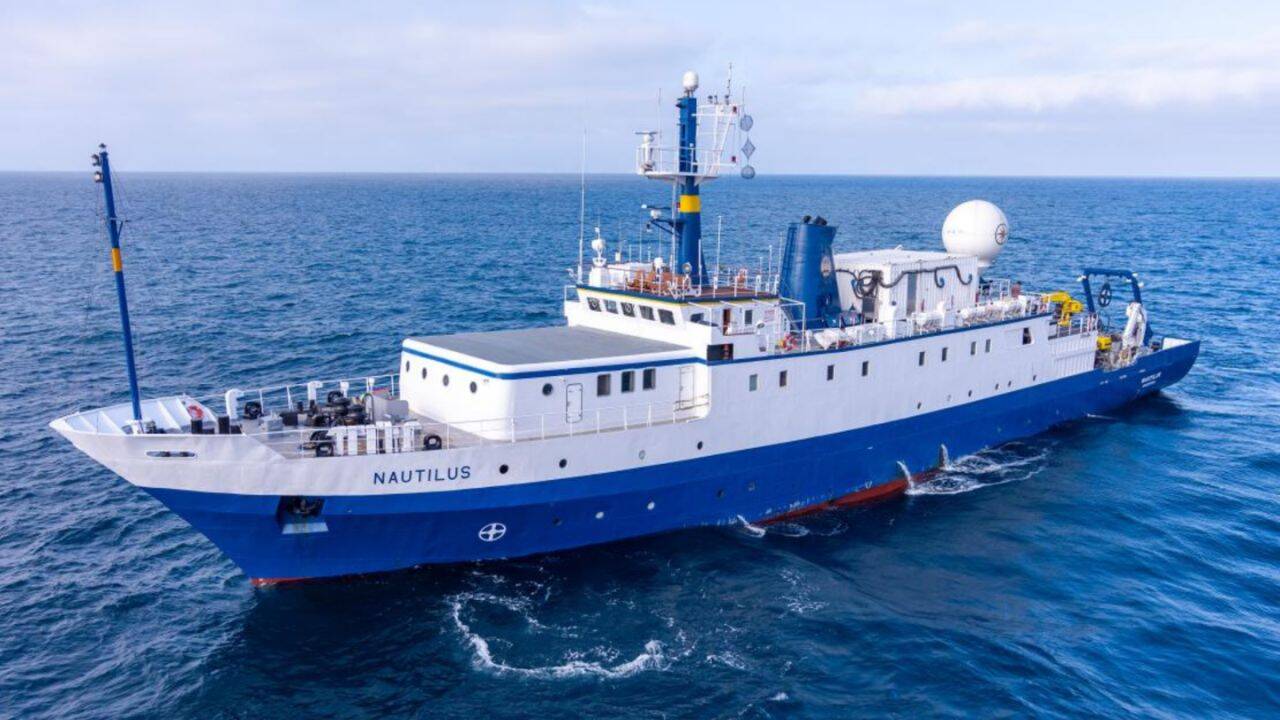
E/V Nautilus. Image Credit: Ocean Exploration Trust/Extreme Tech
Continued exploration will reveal how the seafloor changes
The 2025 expedition was conducted from 7 to 28 May, according to the Ocean Exploration Trust’s NA171 summary. It used the remotely operated vehicle Hercules, ship-based mapping systems and the Orpheus autonomous underwater vehicle to investigate areas around the Mariana Islands.The work was supported by NOAA Ocean Exploration and the Bureau of Ocean Energy Management through the Ocean Exploration Cooperative Institute, with scientific support from the US Geological Survey. For researchers, the site provides an opportunity to study how hydrothermal structures develop and how the animals living around them respond to a changing environment.