California’s Mendocino rivers witnessed a record 30,000 endangered coho salmon; a decade ago, some runs had fewer than 3,000 fish |
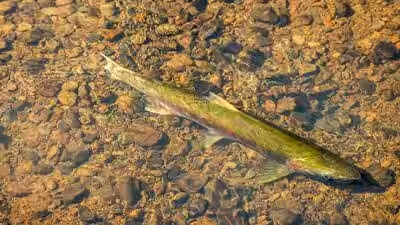
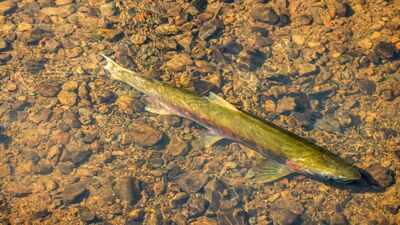
California’s Mendocino Coast rivers recorded an estimated 30,000 adult Central California Coast coho salmon during the 2024–25 spawning season, marking the largest return recorded there. The figure was twice the previous season’s record and far above the numbers seen during much of the past decade, when some annual runs were as low as 3,000 fish. According to NOAA Fisheries, the increase comes after years of habitat restoration, stream reconnection and monitoring, alongside favourable freshwater and ocean conditions that helped the endangered salmon complete more of their life cycle.
30,000 endangered coho salmon returned to Mendocino rivers
The 2024–25 season produced a return that surprised many of the people who had spent years watching these rivers. NOAA Fisheries reported that more than 30,000 adult coho salmon reached Mendocino Coast rivers, compared with about 15,000 during the previous record season.The change is particularly striking against the recent history of the population. During the past decade, annual returns in the region had fallen to as few as 3,000 fish. Central California Coast coho salmon are considered the most endangered subset of the coho salmon species, and their range stretches from Santa Cruz to Punta Gorda in Northern California, according to NOAA Fisheries.For biologists who had spent years surveying streams where salmon were scarce or absent, the sight of so many returning fish represented a major change. NOAA described the latest numbers as evidence that recovery can occur when habitat, management and environmental conditions work together.
Effects of restoration work on the salmon population across rivers
Much of the long-term work has focused on giving salmon access to places they could not previously reach. Since 2000, NOAA has supported more than 100 restoration projects across the Mendocino Coast.One important part of this work has involved removing barriers such as undersized road culverts. Replacing them with fish-friendly designs can reconnect sections of streams, allowing salmon to reach upstream areas suitable for spawning and for young fish to grow.A project at Neefus Gulch illustrates the effect. In 2024, Trout Unlimited restored 1,600 feet of stream channel and reopened spawning habitat above former barriers. NOAA Fisheries reported that surveys later found 10 coho salmon redds, or gravel nests, in the area, with 8 located in the newly restored habitat. Salmon had been unable to spawn there for more than 70 years.Other projects have focused on changing the shape and flow of rivers. Floodplains, side channels and engineered log jams can create slower areas where young and adult salmon have more shelter during periods of strong water flow.
Regions where salmon began appearing after a long time
The increase was not limited to rivers where coho had remained relatively common. NOAA Fisheries reported that salmon were also recorded in watersheds where they had not been seen for years.Coho were documented in Usal Creek for the first time since 2014. Restoration work there had increased access to spawning areas, according to NOAA. The fish also appeared in the Gualala River watershed for the first time in roughly two decades.The monitoring teams saw just how concentrated the returning fish had become. In previous years, survey teams working on the North Fork Navarro River could often cover two stream sections in a day. During the 2024–25 season, NOAA reported that some days they could barely cover half a section because of the number of salmon present.One surveyor reported seeing 50 to 100 fish a day during the height of the spawning season, compared with days in earlier years when no fish were seen.
Role of weather and ocean conditions in boosting salmon numbers
Restoration alone does not explain the record return. NOAA Fisheries stressed that salmon numbers are shaped by many factors, making it difficult to identify one cause.Coho salmon have a 3-year life cycle, spending roughly 18 months in freshwater and another 18 months in the ocean. The adults returning during the 2024–25 season were born to parents that spawned in the winter of 2021–22.Conditions during several stages of that life cycle were favourable. NOAA scientist Nate Mantua noted that fall rains in 2021 provided enough water for spawning adults to reach tributaries farther upstream. Stream flows were also favourable when juvenile salmon travelled towards the sea in 2023.Marine survival also improved. At a monitoring station on Pudding Creek, marine survival was around 8% during the latest period reported by NOAA, compared with a usual level of about 2% or lower. The agency said this points towards more favourable ocean conditions.
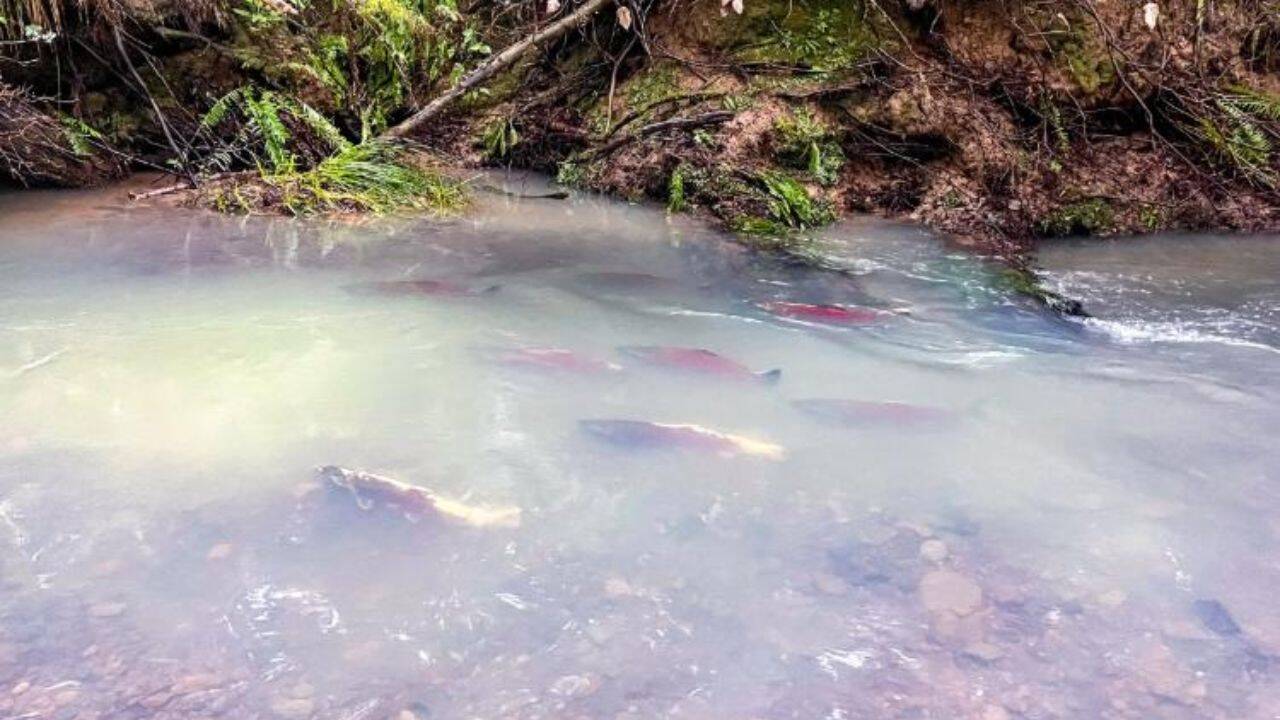
Adult coho making the final leg of their journey on Pudding Creek. Image Credit: Emily Lang/Redwood Timber Company/NOAA
The record does not mean recovery is complete
Despite the record, the Central California Coast coho salmon remains endangered. NOAA Fisheries said that two consecutive record seasons do not guarantee full recovery.The population still depends on suitable conditions in both rivers and the ocean, while increasingly erratic drought cycles and intense winter storms continue to create risks. Maintaining access to spawning habitat and protecting areas where young salmon grow remains important.Monitoring also continues. NOAA reported that surveys for the 2025–26 season were due to continue through May, with early observations suggesting another strong year. On the North Fork Navarro, surveyors had already counted around 400 coho by mid-February, a figure described as well above normal estimates.