‘Nightmare fuel’ from the deep: Scientists identify two bizarre new sea spider species in the Salish Sea; one has hairy legs and red eyes, while the other is often covered in debris
Two bizarre new sea spider species have been identified in the Salish Sea, including one with long, hair-like spines on its legs and striking red eyes, Science Daily has reported. The other species is often found with dirt, debris and tiny parasites attached to its body. Researchers from the University of British Columbia say the findings show how little is still known about the marine invertebrates living in the region.The two species are the first new sea spiders to be formally described from the Salish Sea in nearly 100 years. The study, published in Organisms Diversity & Evolution, used detailed observations of the animals along with DNA analysis to study the region’s sea spider diversity.The research began with Cormac Toler-Scott, the study’s lead author, trying to understand how sea spiders and other marine invertebrates could be affected by climate change and human disturbance. He found that there was a basic gap in scientific knowledge about the animals themselves.“I was interested in how sea spiders are impacted by climate change and human disturbance, because marine invertebrates in the Salish Sea are particularly at-risk, and I couldn’t find anything,” said Toler-Scott, who carried out the work during his master’s degree in zoology at UBC. “That’s largely because people don’t know much about what species exist here and what their lifestyle is,” he added.That lack of information is significant because scientists first need to know which species are present before they can properly study how environmental changes affect them. “In order to understand how marine invertebrates are being impacted by things like climate change and how we can better protect these key elements of the ecosystem, we have to be able to identify them,” Toler-Scott said.
Ancient animals with unusual biology
Sea spiders belong to an ancient lineage that appeared about 500 million years ago. Although their name and appearance link them to spiders, they are marine animals related to spiders, scorpions and horseshoe crabs. Unlike those land-dwelling relatives, sea spiders have remained entirely marine.Their bodies can look unusual. Some species can have as many as 12 legs and use a sucking proboscis to feed. Their size also varies widely. Some are less than a centimetre long, while others can grow to more than 70 cm in Antarctica.“They have retained some weird traits. A lot of the shallow water species are quite small, and so they will live as parasites on larger organisms, and they use this weird apparatus called a proboscis to suck the juices out of their host,” Toler-Scott said.Sea spiders also have unusual ways of breathing and reproducing. They breathe directly through their skin, while males are responsible for carrying and raising the young.In females, the ovaries extend into their limbs, where the eggs develop. The eggs then emerge through a special pore. During mating, males collect the eggs using specialised appendages near the base of their heads called ovigers.The males then coat the eggs with glue produced from their legs. They attach the resulting clusters of egg sacs to their own bodies and carry them as they develop.
One species has hairy legs and red eyes
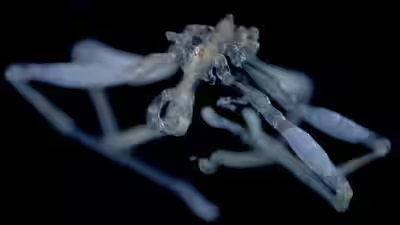
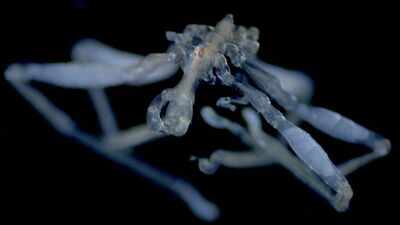
Researchers collected specimens of the two newly described species during dives between September 2023 and August 2024. The dives reached depths of up to 18 metres and took place in different marine habitats around Quadra Island, Bamfield and Victoria.One of the new species was named Callipallene pilosuspedes. Its name refers to the Latin words for ‘hairy feet’, based on the long, curved spines covering the lower parts of its legs.
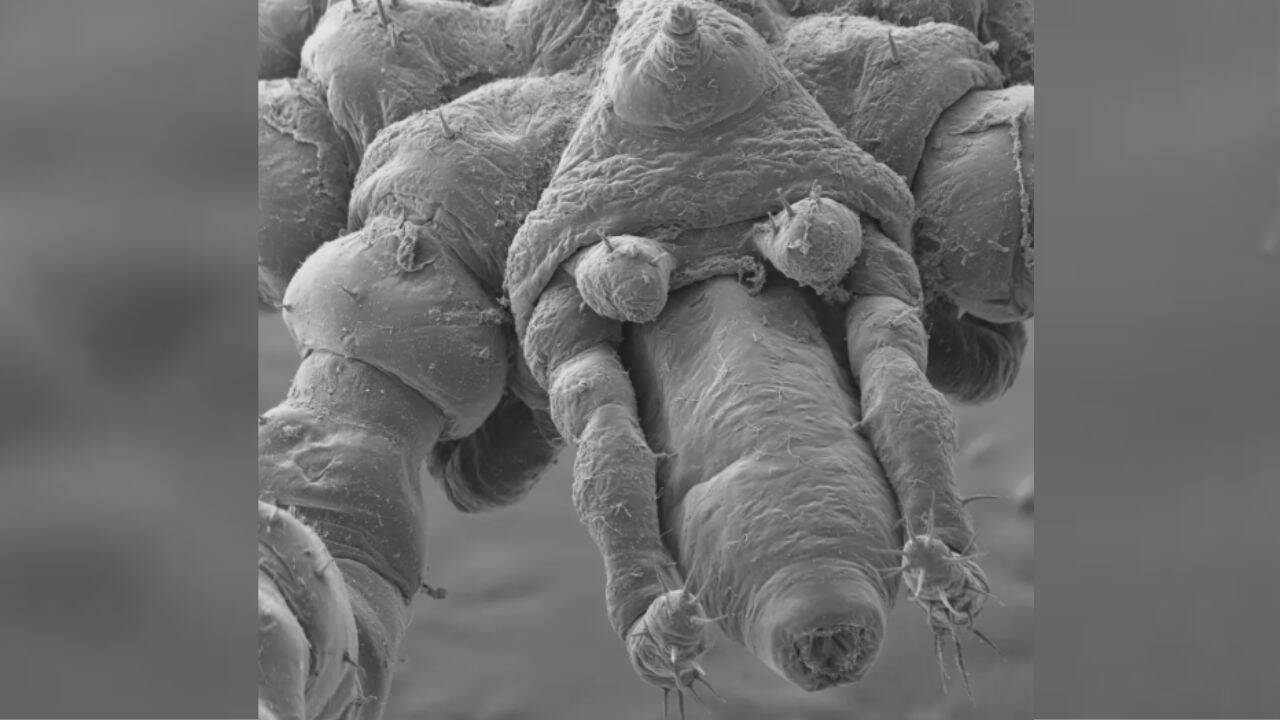
Tanystylum kiixin was named after an ancient Indigenous village site near where the species was first collected.
The animal also has red eyes and a short proboscis. Its proboscis has claws that help it hold food before biting. Its mouth is triangular and divided into three lips, with sensory tendrils around it.Researchers also observed an unusual use for its ovigers. These appendages are normally involved in carrying eggs, but this species can also use them for grooming.Under a microscope, the researchers watched the sea spider wrap its ovigers around its legs. Comb-like spines on the appendages helped it clean its body. Despite these distinctive features, researchers found only one specimen of Callipallene pilosuspedes.
The other sea spider carries debris and parasites
The second species was named Tanystylum kiixin. Its name comes from an ancient Indigenous village site near where the specimens were first collected. The name is pronounced ‘kee-hin’ and refers to the sound of waves crashing at the base of the village site.This species differs from Callipallene pilosuspedes in several ways. Its egg-carrying limbs are smaller and less flexible, which appears to limit how effectively it can groom itself.As a result, researchers often found dirt and debris attached to its body. Tiny parasites were also found living on the animals. Toler-Scott described the situation as “an ecosystem within an ecosystem within an ecosystem.”The two species therefore have very different appearances and features, but both add to scientists’ understanding of the sea spider diversity in the Salish Sea.
DNA study reveals more diversity
The research is the first comprehensive study of Salish Sea sea spiders to combine detailed physical observations with DNA analysis. Researchers generated genetic sequences for several species that had never been sequenced before.The team also created an identification guide to help scientists distinguish between sea spider species found across the region.Both newly described species have been registered in a global database. However, Toler-Scott believes the two discoveries are unlikely to represent all the sea spider diversity in the Salish Sea. “I only had one field season, but there’s definitely more diversity out there that we haven’t documented,” he said.The findings suggest that more sea spider species could still be identified in the region as researchers continue studying its marine life.