Borneo’s rainforest was selectively logged, but 22 years later it held only 60% of the carbon stored in primary forest | World News
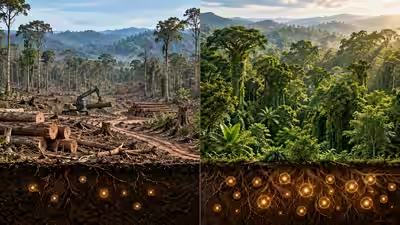
A rainforest in Borneo was still carrying the carbon legacy of selective logging more than two decades after the trees were cut. Researchers studying a selectively logged area in Sabah found that, 22 years after the disturbance, its above-ground biomass and carbon pools remained at only about 60 per cent of the levels measured in nearby primary forest. The difference was linked not to the number of trees, but to their size: the logged forest had similar stem density but far fewer large trees. The findings show that tropical rainforest recovery can take decades, with the loss of large, carbon-rich trees leaving a lasting mark.
Borneo’s logged forest still lacked large trees after 22 years
According to the study published in PubMed, titled ‘The Sabah Biodiversity Experiment: a long-term test of the role of tree diversity in restoring tropical forest structure and functioning’, one of the clearest differences was not the number of trees, but their size. The researchers recorded 410 stems per hectare in the unlogged forest and 417 in the selectively logged forest, meaning overall tree density was remarkably similar. Yet the logged forest had a total stand basal area of 25.0 square metres per hectare, compared with 29.9 square metres in the primary forest. Trees larger than 90 centimetres in diameter were absent from the logged transects, while such trees remained in the primary forest.The composition of the stands also reflected the history of logging. Dipterocarps accounted for about 60% of basal area in the unlogged forest but only around 30% in the logged forest. At the same time, the selectively logged forest contained more mid-sized trees, particularly those between 30 and 80 centimetres in diameter. The researchers said these changes showed that logging had produced a “deficit of large trees and a surfeit of saplings”, even after 22 years of recovery.
Logged forest stored only 60% as much carbon
Above-ground tree biomass was estimated at 272.1 tonnes per hectare in the selectively logged forest, compared with 468.6 tonnes per hectare in the primary forest. Because the researchers assumed that roughly half of wood biomass was carbon, the corresponding above-ground carbon estimates were 136 tonnes of carbon per hectare and 234.3 tonnes of carbon per hectare, respectively.The logged forest therefore held roughly 58% as much above-ground carbon as the primary forest, which is why the researchers described its above-ground biomass and carbon pools as being depressed by approximately 40%. Put another way, even after 22 years, the recovering forest had regained only about three-fifths of the above-ground carbon represented by the nearby primary forest. The study’s abstract accordingly states that above-ground biomass and carbon pools in selectively logged areas were “only 60 per cent” of those in primary forest after 22 years of recovery.
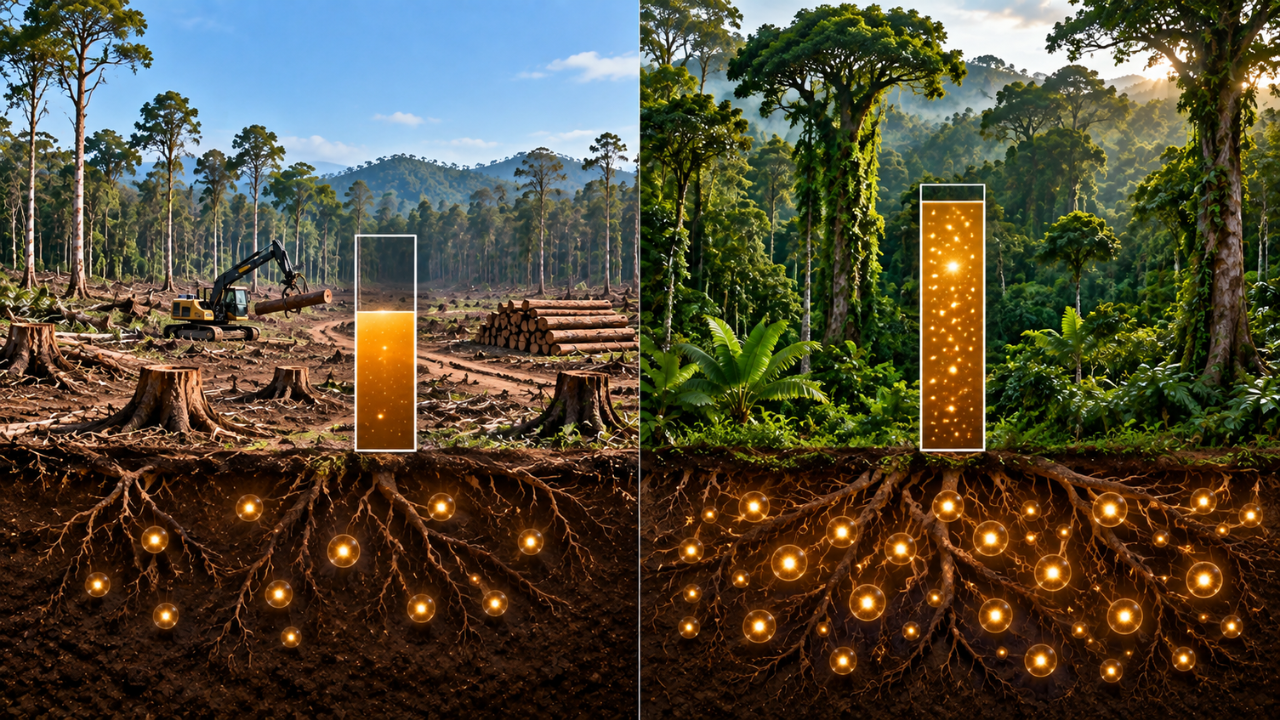
Image AI generated
Species diversity remained stable after logging
The researchers did not find evidence that every aspect of the forest remained severely impaired. Alpha and beta species diversity were not reduced in the selectively logged plots, which they suggested could partly reflect the selective nature of the logging and the release of surviving species from competition with large trees that had been removed. However, the species composition differed between logged and unlogged forests, and was accompanied by major changes in forest structure.The study also found that some measures linked to carbon and nutrient turnover, including dead standing wood, fine roots and litterfall, were not distinguishable from those in the neighbouring primary forest. Even so, the researchers argued that the persistent reduction in carbon stocks showed why restoration could matter.