Modi-Xi’s Ukraine offer to Putin, strong message to West & new Brics playbook: Key outcomes of summit | India News
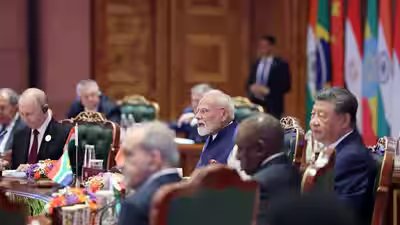
NEW DELHI: The 18th Brics Summit in New Delhi brought together leaders of the expanded 11-member grouping for two days of high-level diplomacy, with Prime Minister Narendra Modi holding key bilateral meetings with Chinese President Xi Jinping, Russian President Vladimir Putin and Iranian President Masoud Pezeshkian.The summit saw a renewed push to stabilise India-China ties, a reaffirmation of the India-Russia strategic partnership and discussions on the West Asia crisis, Ukraine, maritime security, trade and energy. Alongside formal negotiations, images of PM Modi with Xi, Putin and Pezeshkian projected a strong message of engagement and unity within the expanded grouping.The summit also featured informal diplomatic moments, including PM Modi and Putin travelling together by car inside the Bharat Mandapam complex, leaders attending a gala dinner featuring a specially curated Indian menu, and a symbolic Banyan tree plantation highlighting India’s emphasis on sustainability and interconnectedness.The two-day summit also produced a series of initiatives covering agriculture, health, technology, startups, energy, urban mobility, supply chains, skilling and global governance. The New Delhi Declaration, adopted after intensive negotiations, provided the summit’s principal political outcome, covering terrorism, conflicts, trade, sanctions, energy, finance and development.
PM Modi-Xi meeting signals push to stabilise ties
PM Modi and Xi Jinping held a bilateral meeting on the sidelines of the Brics Summit, with both leaders stressing the need to view India-China relations from a strategic and long-term perspective.The two sides expressed commitment to a fair, reasonable and mutually acceptable resolution of the boundary question. PM Modi stressed that differences should not become disputes and said the relationship should be guided by mutual respect, mutual sensitivity and mutual interest.The leaders also discussed maintaining peace and tranquillity along the border, economic and trade relations, trade imbalances, supply chains and people-to-people exchanges. Both sides underlined the need to address each other’s concerns and facilitate meaningful and predictable market access.PM Modi also thanked China for its support and cooperation during India’s Brics chairship and conveyed best wishes to China as it prepares to assume the Brics chairship next year.Xi said China and India should continue to approach their relationship from a strategic perspective and keep long-term bilateral development in mind. He also stressed the importance of cooperation between the two major Global South countries.
Modi-Putin talks focus on Ukraine, West Asia
PM Modi and Putin held an over 45-minute bilateral meeting on the sidelines of the summit, reviewing the India-Russia strategic partnership and discussing major regional and global developments.The two leaders discussed the impact of the Russia-Ukraine conflict and the West Asia crisis on maritime trade and the safety and security of Indian seafarers. PM Modi reiterated that dialogue and diplomacy remained the way forward in resolving conflicts and said India was ready to assist peace efforts.The discussions covered defence, energy, critical minerals, civil nuclear cooperation, fertilisers, infrastructure, technology and industrial cooperation. India and Russia also agreed to work towards increasing bilateral trade to $100 billion by 2030 and discussed implementation of the Programme for Economic Cooperation 2030.Putin invited PM Modi to Russia for the 24th India-Russia Annual Summit, with dates to be finalised through diplomatic channels.
Putin car ride becomes summit highlight
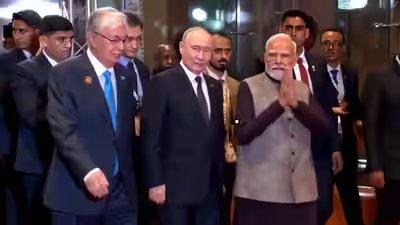
One of the most closely watched visual moments came after the Modi-Putin meeting, when the two leaders travelled together in the same car inside the Bharat Mandapam complex before attending the Brics Business Forum.The image underlined the longstanding India-Russia relationship at a time of continuing geopolitical tensions surrounding Moscow and highlighted India’s effort to maintain strategic autonomy.PM Modi also presented Putin with a Russian translation of the Thirukkural, the classical Tamil work attributed to poet-saint Thiruvalluvar.“Two thousand years ago, Thiruvalluvar wrote the Thirukkural. It includes the entire gamut of human life. It has been translated into the Russian language. I am confident that the people-to-people contact will increase with the translation of the Thirukkural into Russian, which will play a big role in strengthening our relations,” Modi told Putin.
Kremlin says PM Modi, Xi offered help on Ukraine
Russia said PM Modi and Xi offered their “good offices” to help find a solution to the Ukraine conflict during their separate interactions with Putin on the sidelines of the summit.Kremlin spokesperson Dmitry Peskov said Putin welcomed their readiness, saying: “During their bilateral meetings, Modi and Xi took a keen interest in the Ukraine settlement and actively offered their good offices to help find a solution,”.The development came amid continuing international efforts to find a settlement to the Russia-Ukraine war.
PM Modi-Pezeshkian talks centre on West Asia
PM Modi also met Iranian President Masoud Pezeshkian, with the discussions focusing on India-Iran ties, Brics cooperation and the escalating conflict in West Asia.PM Modi reiterated India’s consistent position that disputes should be resolved through dialogue and diplomacy and stressed the need for lasting peace and stability in the region. The two leaders also discussed freedom of navigation and commerce and the safety and well-being of seafarers amid disruptions to shipping routes.The meeting followed their earlier interaction on the sidelines of the Shanghai Cooperation Organisation Summit in Bishkek. India has also stressed the need to expand and diversify bilateral trade channels with Iran.
Iran-UAE engagement amid regional tensions
Pezeshkian also held talks with UAE President Sheikh Mohamed bin Zayed Al Nahyan on the sidelines of the summit.The meeting was significant as Iran and the UAE have had differences over regional security, while Gulf states maintain varying degrees of security cooperation with Western powers.Their interaction highlighted the diplomatic space created by Brics, which brings together countries with competing interests and positions on major geopolitical issues.
Modi-Xi-Putin-Pezeshkian project Brics unity
The summit was accompanied by a series of high-profile visuals involving PM Modi, Xi, Putin and Pezeshkian.PM Modi was seen greeting Putin and Xi together, holding their hands and sharing smiles. In another visual, PM Modi walked alongside Putin, Xi and Pezeshkian.PM Modi was also seen holding hands and walking alongside Pezeshkian and other leaders during the Brics Business Forum. The visuals projected unity among members despite differences over conflicts and other major geopolitical issues.The interactions were particularly significant for India as it sought to use its Brics chairship to build consensus among countries with sharply different political and strategic priorities.
Gala dinner adds cultural dimension
Brics leaders also attended a gala dinner during the summit, providing an informal setting for interaction among heads of state and government.The specially curated Indian menu showcased regional flavours, traditional recipes and contemporary interpretations of Indian cuisine. The menu included Khandvi Mille-Feuille, Khumb Galouti, Paneer Lababdar, Gucchi Marmik, Carrot Bean Poriyal, Thakkali Belle Saaru, Millet Pulao, Beetroot Raita and assorted Indian breads.Desserts included Old Delhi Fruit Cream with Jalebi and Shahtoot Phirni.The cultural evening added a softer dimension to a summit otherwise dominated by negotiations over conflicts, terrorism, trade, energy and global governance.
Banyan tree plantation highlights sustainability
A symbolic Banyan tree plantation ceremony was also held during the summit, with Brics leaders participating in the initiative.The Banyan tree, with its extensive roots and interconnected branches, was presented as a symbol of continuity, resilience and interconnectedness. The gesture complemented India’s 2026 Brics theme of “Building for Resilience, Innovation, Cooperation and Sustainability”.The plantation also reflected India’s effort to connect the diplomatic agenda with sustainability and environmental cooperation.
Brics Business Forum pushes trade, investment
The Brics Business Forum brought together heads of state, ministers and business leaders for discussions on trade, investment, finance, technology and development.PM Modi highlighted the economic weight of the expanded grouping, saying Brics countries account for 50 per cent of the world’s population, 40 per cent of global GDP and more than 25 per cent of global trade.“The growing scale, speed, and optimism of BRICS are clearly evident among us. This forum, hosted in India, is the largest BRICS Business Forum to date,” the Prime Minister said.Pezeshkian called for Brics to convert its economic potential into practical cooperation through trade, investment and joint financing. Putin stressed that business-to-business ties and economic partnerships could help build more resilient international economic relations.
PM Modi pushes people-centric Brics
India’s chairship sought to connect Brics cooperation more directly with ordinary citizens while focusing on resilience, innovation, cooperation and sustainability.Addressing the summit, PM Modi said, “It gives me immense pleasure to welcome and greet you all to India. India’s BRICS chairmanship is based on a people-centric and humanity-first approach.”He said resilience, innovation, cooperation and sustainability had remained India’s priorities, with special emphasis on connecting Brics cooperation with common people.“Alongside these priorities, we have placed special emphasis on connecting BRICS cooperation with the common people. With this vision in mind, more than 350 meetings were organised. We had the opportunity to welcome your teams to approximately 30 cities…”India organised more than 350 meetings and high-level engagements across around 30 cities during its 2026 chairship. The programme covered political and security cooperation, economic and financial cooperation, and cultural and people-to-people exchanges.
Agriculture and healthcare get major push
Brics countries advanced cooperation in sustainable agriculture through Centres of Excellence on agro-ecology, a Digital Agriculture Network and the Brics AGRIN framework covering agricultural inputs, genetic resources and information.The Digital Agriculture Network is intended to expand the use of AI, geospatial technology, Internet of Things-enabled monitoring and advanced data analytics to support farmers.In healthcare, the Brics Mission for Healthy Lifestyle and a roadmap for joint cooperation on healthy lifestyles were launched. Members also agreed to strengthen cooperation in traditional, complementary and integrative medicine.A greater focus was placed on mental health through the Brics Training Hub Network and Network of Centres of Excellence, with NIMHANS India serving as the coordinating centre.
Energy, climate and urban cooperation expanded
Brics adopted guiding principles on energy storage and smart grids and launched a Digital Centre of Excellence for Smart Grids and Energy Storage.The grouping also established a Brics Urban Mobility Hub to promote knowledge sharing and technical cooperation on sustainable urban transport. Members adopted voluntary principles on climate-resilient urban infrastructure and established an Urban Research and Knowledge Network.PM Modi also emphasised the importance of balancing development with environmental protection and said technology and critical minerals should not become instruments that hinder shared progress.
Startups, MSMEs and skilling receive boost
India advanced cooperation among small businesses and startups through a Brics MSME Cooperation Portal designed to connect MSMEs, financial institutions, technology centres, trade associations and policymakers.The Brics Incubator Network will connect startups and incubators across member countries, while the Brics Startup Innovation Fund is intended to support early and growth-stage startups.The Brics Science and Research Repository was also welcomed as a platform for scientific knowledge sharing.Through Brics CONNECT, members also advanced cooperation on skills, employability, women’s workforce participation, social security and digital public infrastructure.The Brics Youth Cooperation Framework 2026 was adopted to provide greater continuity and structure to youth cooperation, while sports technology cooperation was institutionalised through a dedicated working group.
Supply chains and global value chains strengthened
Brics members agreed on a Logistics Supply-Chain Cooperation Framework aimed at improving resilience, sustainability and connectivity.The grouping also advanced cooperation on global value chains through the GVC Action Plan 2026-2030, including a Technical Council and joint study.Members also gave in-principle approval to an agreement on cooperation and mutual administrative assistance in customs matters, aimed at facilitating trade, reducing transaction costs and improving border security and trade facilitation.
Global South gets stronger voice
PM Modi used the summit to push for greater representation of developing countries in global decision-making institutions.He argued that the Global South should move from being a rule-taker to a rule-shaper and called for reforms in global governance, including greater representation in the UN Security Council.Brics also reaffirmed support for comprehensive UN reform and a more democratic, representative and inclusive international system.China and Russia reiterated support for the aspirations of India and Brazil to play a greater role in the UN, including the Security Council.
New Delhi Declaration: 140 points, 45 pages
The Brics countries adopted the New Delhi Declaration 2026, a 45-page document containing 140 points, after intensive negotiations that continued into the early hours of Saturday.The declaration brings together the grouping’s positions on terrorism, unilateral military action, West Asia, global governance, trade, sanctions, energy, finance, development and the interests of the Global South.Its adoption was particularly significant because the expanded Brics includes countries with differing positions on major geopolitical conflicts, including Iran, Saudi Arabia and the UAE. India worked to bridge differences and secure consensus among members.
Pahalgam attack explicitly condemned
The declaration strongly condemned terrorism in all its forms and manifestations and called for “zero tolerance for terrorism”.It specifically condemned the April 22, 2025, Pahalgam terrorist attack, in which 26 people were killed. The declaration also condemned the cross-border movement of terrorists, terrorism financing and safe havens.Brics reaffirmed that terrorism cannot be associated with any religion, nationality, civilisation or ethnic group and called for those involved in terrorist activities and their support to be held accountable.The grouping also called for progress towards adopting the Comprehensive Convention on International Terrorism under the UN framework.
West Asia: Restraint, ceasefire and diplomacy
The declaration expressed deep concern over the continuing escalation in West Asia and called on all parties to exercise maximum restraint.It stressed dialogue, consultation and diplomacy as the means to address conflicts and called for the protection of civilians and humanitarian assistance.On Gaza, Brics called for upholding a ceasefire, ensuring unhindered humanitarian assistance and ending the forced displacement of Palestinians. It reaffirmed support for a two-state solution based on the internationally recognised 1967 borders.
Unilateral military action condemned
The declaration condemned unilateral military action without naming any country.The language assumes significance against the backdrop of ongoing conflicts in West Asia and the wider divisions within the expanded grouping.The consensus was reached after negotiations continued into the early hours of Saturday, with India working to reconcile competing positions and produce a common statement.
Trade, tariffs and sanctions
Brics expressed concern over unilateral tariff and non-tariff measures that distort international trade and create uncertainty for businesses and supply chains.The grouping reaffirmed support for a rules-based multilateral trading system centred on the World Trade Organization and called for restoration of a fully functioning two-tier binding WTO dispute settlement mechanism.Brics also voiced opposition to unilateral coercive measures that it considers inconsistent with international law and the principles of the UN Charter, calling for such measures to be eliminated.
Local currencies and financial resilience
The declaration backed efforts to promote cross-border payments and trade settlements using Brics members’ local currencies while respecting national priorities.Members acknowledged work on the interoperability of payment and messaging systems and discussions on facilitating trade settlements and investment using local currencies.The push forms part of a broader effort to strengthen financial resilience and reduce vulnerabilities in international economic relations.
Critical minerals and energy security
The declaration stressed the importance of reliable, diversified, resilient and sustainable supply chains for critical minerals.It called for benefit sharing, value addition and economic diversification in resource-rich countries while recognising their sovereign rights over mineral resources.Brics also stressed the importance of critical minerals for zero and low-emission technologies, energy security and resilient energy supply chains.On energy, the declaration called for diversified sources, resilient infrastructure and stable markets. It recognised that fossil fuels would continue to play an important role, particularly for emerging and developing economies, while backing equitable and inclusive energy transitions.
Health and universal health coverage
The declaration reaffirmed Brics’ commitment to universal health coverage and resilient, inclusive and people-centred health systems.Members emphasised the coordinating role of the World Health Organisation and backed continued multilateral cooperation on global health.The declaration also covered the Pandemic Agreement’s Pathogen Access and Benefit-Sharing negotiations, efforts to end tuberculosis, strengthening the health workforce, digital health and integration of traditional medicine.
Women, development and global governance
Brics recognised women as leaders, decision-makers and drivers of economic growth and social transformation.The declaration stressed women’s participation in governance and economic life, financial and digital inclusion, skill development, entrepreneurship and climate action.The grouping also reaffirmed the importance of reforming global institutions to reflect contemporary economic and political realities and strengthen the voice of developing countries.
Share your thoughts in the comments
Be respectful · TOI community guidelines
A wider Brics enters its third decade
The New Delhi Summit came as Brics entered its third decade with 11 full members: Brazil, China, Egypt, Ethiopia, India, Indonesia, Iran, Russia, Saudi Arabia, South Africa and the UAE.India’s 2026 chairship was its fourth after previous presidencies in 2012, 2016 and 2021. The latest chairship sought to build on those earlier efforts while adapting the grouping’s agenda to its expanded membership.In his concluding remarks, PM Modi said the discussions had strengthened the view that Brics had evolved beyond a traditional grouping and could function as an ecosystem for practical solutions.“Our discussions over the past two days have further strengthened our conviction that BRICS is not merely a grouping of nations, but an ecosystem of solutions. We hope that the New Delhi Declaration adopted at this summit will provide a clear direction for our shared vision and future cooperation. We must translate all outcomes into time-bound actions that deliver last-mile impact. We will work together to ensure that our framework moves beyond mere documentation and creates a tangible impact in real life,” he said.PM Modi also said the world now expected concrete results from Brics rather than only ideas and commitments, as the grouping prepares to enter its third decade.