
A Pennsylvania entomologist stripped alien plants from his abandoned 10-acre farm; 15 years later, 1,000 caterpillar species fed 50 breeding bird species |

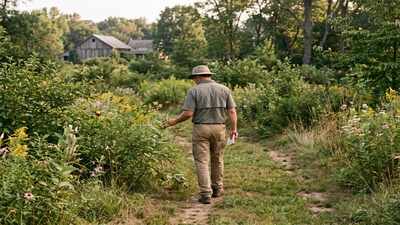
Most researchers who focus on insects for a living spend their fieldwork somewhere exotic, a rainforest canopy or a coral reef. Entomologist Doug Tallamy has done his most impactful work without ever leaving his garden. He and his wife, Cindy, bought a ten-acre tract in Oxford, southeast Pennsylvania, in 2000, expecting a quiet rural home. What they found when they arrived became the basis for a body of research that has since altered guidance on how regular landowners may help animals. Tallamy has maintained this work in his academic role, where his profile states he has spent decades studying how insects and the native plants they evolved with rely on one another, according to the University of Delaware.Tallamy’s subsequent study would give this idea a name: the keystone plant, a tiny percentage of native species that do most of the ecological work in a specific location. His nationwide investigations showed that about five per cent of native plant genera sustain about 75 per cent of caterpillar species, which feed local birds, with oaks alone hosting about a thousand caterpillar species nationwide, more than any other genus in North America. His results implied that if you remove those keystone plants from a landscape, the local food chain doesn’t simply decrease; it can collapse altogether, because the insects that depend on them have no other place to go.A hayfield overrun by imported plantsThe site had been part of a farm for close to three centuries, and its last use before the Tallamys arrived was as a hayfield that had gone unmowed for several years, according to Tallamy’s own account of the property. Left unmanaged, that abandoned ground quickly became easy territory for aggressive introduced plants, since their seeds are often spread by birds and their root systems can establish in disturbed, untended soil far more readily than many native seedlings can. When the couple moved in, their ten acres were infested with autumn olive, multiflora rose and Oriental bittersweet, all imported from Asia decades before for beautification or erosion control. As both an entomologist and a homeowner, Tallamy looked over his property, and he saw something telling. Native insects hardly grazed the leaves of these imported plants, as the two groups had never co-evolved and the insects could not identify the foliage as food.Replacing invaders brought the insects backRather than just eliminating the invasive foliage, Tallamy and his wife began to replace it with trees and shrubs native to the area, oaks, cherries and other plants on which local caterpillars had dined for thousands of years. Even if the task was not extensive, the rationale remained simple. Caterpillars are the major food for most breeding songbirds rearing their young, and a brood of chickadee chicks can eat thousands of caterpillars in a few weeks, so a landscape with few caterpillars will, sooner or later, have few birds. That link between the plants people choose and the survival of birds was tested directly nearly two decades later, in a 2018 study led by Tallamy’s former student Desirée Narango working with the Smithsonian Migratory Bird Centre, which found that Carolina chickadees breeding in yards filled with non-native plants raised significantly fewer young than those breeding in yards with more native plants, a finding published in the Proceedings of the National Academy of Sciences. Tallamy’s garden was still developing. He began to keep meticulous records to find out if his strategy was working and he photographed every moth species he found on the site and logged every bird species that he saw breeding there.
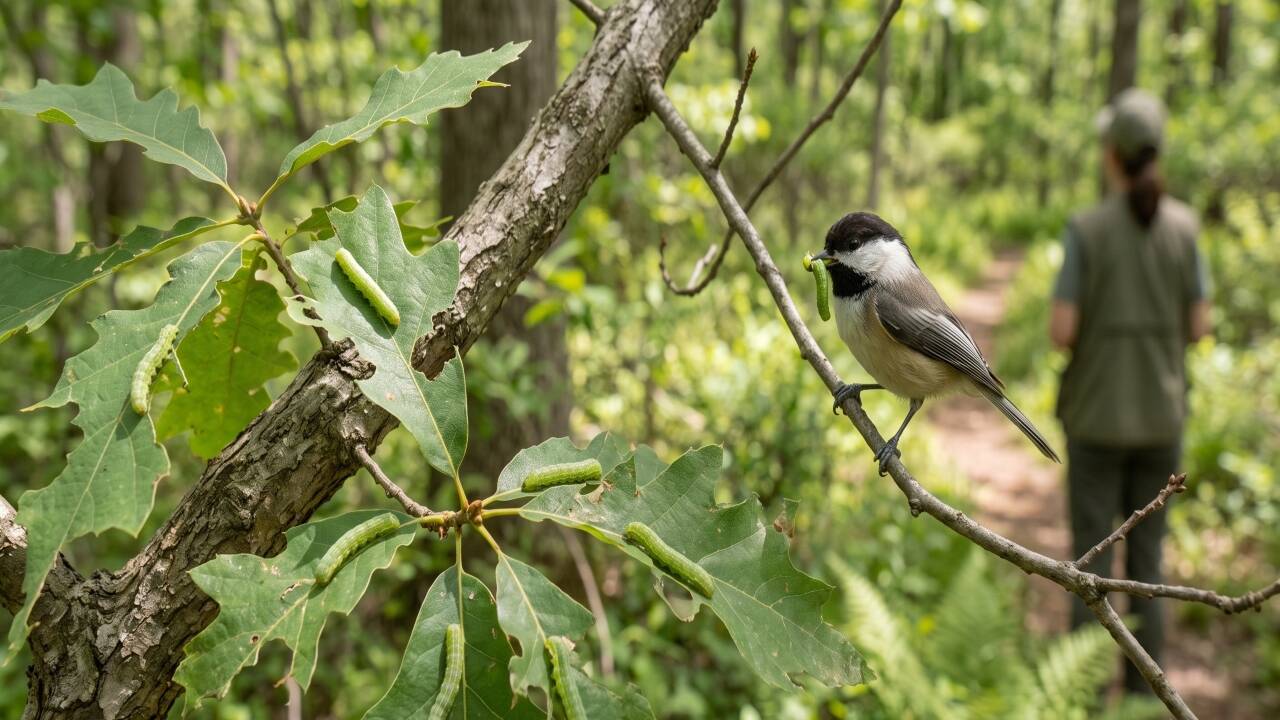
An AI-generated image showing how native plants such as oaks can support large numbers of caterpillars, which provide an important food source for breeding songbirds such as Carolina chickadees. Credits – Google Gemini
Fifteen years on, the food web rebuilt itselfThe outcomes were evident. Fifteen years after the restoration began, the native woody plants on the Tallamy property alone were supporting at least 1,000 caterpillar species, and more than 50 bird species had bred there, figures Tallamy recorded himself at the time. In the years since, as the restoration has continued for close to a quarter century, the property’s moth count alone has climbed past 1,300 species, a total the couple now tracks through the organisation Tallamy co-founded, Homegrown National Park. It has also helped inspire a larger movement encouraging homeowners nationwide to treat their gardens as habitat rather than just decoration.


