
Quote of the Day by Aristotle, “When you throw a stone, you cannot afterwards bring it back, but you’re responsible for…”

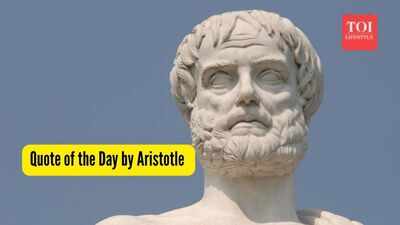
Aristotle is one of the most influential thinkers in human history. His ideas influenced philosophy, science, politics, ethics, logic, literature and the way people think about knowledge itself. Philosophers like Plato had restricted themselves to abstract questions, but Aristotle was fascinated by the world around him: by how people behave, how societies work, how governments should be organised, how animals live, how knowledge is acquired and, above all, what it means to live a good human life.Aristotle was born in 384 BC in Stagira, a Greek city in the Chalcidian region, at a time of rapid development of Greek philosophy. Aristotle’s father Nicomachus was a physician to the Macedonian court and Aristotle grew up in an atmosphere already attuned to the study of nature and living things. At the age of about 17 or 18 he went to Athens and became a member of Plato’s Academy, where he stayed for nearly 20 years. His relation with Plato was of the utmost importance for the development of Western philosophy. He was a student of Plato, but Aristotle didn’t just become a disciple. By degrees he developed doctrines quite different from those of his master. Whereas Plato often stressed a world of abstract, ideal forms, Aristotle much more stressed observing the actual world and studying things as they are.In so doing, he became astonishingly eclectic in his interests. He wrote on logic, metaphysics, ethics, politics, rhetoric, poetry, biology, physics, and psychology. His surviving works and the traditions of his teaching cover a vast range of subjects. He is often depicted as not just a philosopher but one of the first great polymaths.When Plato died Aristotle left Athens and travelled about in different parts of the Greek world. Finally, Philip II of Macedon invited him to tutor his son, the young Alexander, who would one day become Alexander the Great. Aristotle’s relationship with Alexander is one of the most famous teacher-student relationships in history.Around 335 BC Aristotle returned to Athens to found his own school, the Lyceum. There he taught and did research with his students. His method was general and systematic: observe, classify, question, compare and reason. The school became an important center of intellectual activity, and the philosophical tradition associated with it was called the Peripatetic school.Aristotle’s contribution to logic was especially important. He worked on reasoning and argument, and his framework influenced intellectual thought for centuries. He was also very interested in the natural world. He studied animals, their structures and behaviours and attempted to classify living things. Some of his scientific conclusions were later proved wrong, but his insistence on systematic observation and classification was enormously influential.But perhaps Aristotle’s greatest legacy is in his thinking about human beings and how they should live. His ethical philosophy is perhaps most famously set out in the Nicomachean Ethics, one of the founding texts of Western moral philosophy. Written in the fourth century B.C., the work asks a question that is still relevant today: What is the good life?For Aristotle happiness was not simply pleasure, wealth or fame. To him the good life was a good life of action. Human beings have special capacities, particularly the capacity to reason, and a good life requires the development of those capacities and the cultivation of virtue.His understanding of human beings went beyond the individual. In Politics, Aristotle famously called man a “political animal,” that is, humans are naturally inclined to live in communities. Society was not simply a convenience for Aristotle. People develop their capacities through relations, laws, institutions and shared life. Modern interpretations of his political philosophy also emphasise his belief that human flourishing is tied to life in an organised community.Aristotle died in 322 BC in Chalcis, but his intellectual influence continued to grow long after his death. His works became a central part of mediaeval Islamic, Jewish and Christian philosophy and later influenced European intellectual traditions. His ideas have been debated, challenged, modified and rejected at different times, but they have never ceased to be studied.Quote of the Day“When you have thrown a stone you cannot bring it back again, but nevertheless you are responsible for having taken up the stone and flung it, for the origin of the act was within you. “For men might originally have avoided being unjust and prodigal, and therefore they are unjust and prodigal voluntarily; although after they have become unjust and prodigal it is no longer possible for them not to be unjust and prodigal.”— Aristotle, Nicomachean Ethics, Book IIIThe image Aristotle uses here is so seemingly simple. Imagine you take a rock and throw it. If you drop the stone from your hand, you can’t call it back. You might regret chucking it. You might wish you’d shot differently. You may find the stone has fallen somewhere you didn’t intend. But that moment when you were in total control of the action is gone.For Aristotle human behaviour can work in much the same way.The important point of the metaphor is not simply that actions have consequences. That is that the responsibility comes before the consequence. The moment of choice is the moment of truth.This is especially the case regarding Aristotle’s discussion of character. A man does not acquire courage, dishonesty, generosity, cruelty, or injustice in a moment. Character is developed by choice and repeated behaviour. What we do today can be a slow-blooming thing to the person we will be tomorrow.Hence Aristotle’s argument is deeper than the familiar advice to “think before you act”. He is telling us that choices can eventually produce habits and habits can become a part of our character.We might have a choice at the start. A person can choose to tell a lie, act selfishly, lose temper, shirk responsibility or act generously. One isolated decision can seem meaningless. But repeated choices can make a certain behaviour easier and more automatic. Soon it might become much harder for that person to act any other way.This is what Aristotle means in his comparison with the stone. You are in charge of the action before the stone is thrown. Once you throw it you can’t undo that particular movement.The same is true of words. A harsh sentence spoken in anger can be apologised for, but it cannot be unsaid. A betrayal may be forgiven, but the act itself can never be undone. A quick choice can be reversed, but the repercussions can remain long after the original instant.The quote therefore invites us to think about the connection between freedom and responsibility.We like to think of freedom, often, as the ability to do what we want. Aristotle’s idea is more difficult. Freedom also involves being responsible for the choices we make. If an action originates from us, then we cannot always blame circumstances, other people or fate for the consequences.But there is an important warning about habit in the quotation. Aristotle is not claiming that people are stuck with one mistake forever. Instead, he is interested in what happens when choices are repeated until they become a part of a person’s character.That makes the message highly relevant today.There are little decisions every day that seem to be too little to matter: whether to answer with patience or anger, whether to keep a promise, whether to take responsibility for a mistake, whether to help someone when you have nothing to gain, whether to choose honesty when dishonesty would be easier.These individual choices may seem like small pebbles. But over time they can work out the direction of a person’s life.The larger message of Aristotle, then, is about the power of beginnings.We can’t always control what happens after an action. We cannot control the response of others, even if the situation changes or an unforeseen consequence ensues. But we can often control the first decision.Therein lies the beginning of accountability.And maybe that’s why this old metaphor is so potent: before the stone leaves your hand, you still have a choice. When it happens, you have a duty.


