
In 2024, scientists dyed Michigan’s Peter Lake blue to block sunlight, then added fertilizer; despite the dye, rain washed pigment out and algae turned it green |

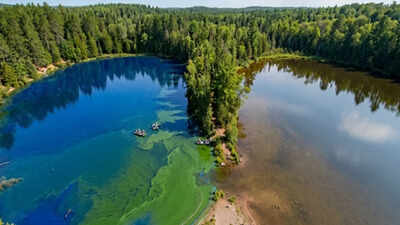
In the summer of 2024, researchers dyed the water of Peter Lake, located in Michigan’s Upper Peninsula, USA, with a non-toxic blue dye called Aquashade, then deliberately added fertilizer to the same lake. The experiment wasn’t done for beautification. Researchers wanted to understand how much stress a lake can absorb before it collapses into an algal bloom. It was also meant to test whether shading the water could help prevent one.Peter Lake was dyed blue, then fertilized, in summer 2024Peter Lake is located in Michigan’s Upper Peninsula, an area where the lakes tend to be clear or slightly brown. This lake sits beside its twin, Paul Lake, with only a thin strip of earth and gravel separating the two. That similarity is exactly why researchers have used the two lakes for ecology experiments since the 1980s, through an ongoing effort called the Cascade Project, which has manipulated one lake while leaving the other untouched as a control.In August 2024, the team of researchers headed by University of Wisconsin-Madison PhD candidate Danny Szydlowski dyed Peter Lake using a non-toxic dye, Aquashade, that decreases the amount of light getting to the lake while leaving Paul Lake intact. As all algae need light in order to grow, decreasing the amount of light available was a way of measuring the lake’s resilience by putting pressure on the lake in terms of light availability. The team followed the dye additions with fertilizer, mirroring the nutrient runoff that triggers real-world algal blooms. What happened next surprised the researchers themselves: repeated rain kept washing the blue pigment out of the lake and despite the dye, Peter Lake turned from blue to green as an algal bloom took hold.Peter and Paul lakes have been used for whole-lake experiments since the 1980sThe lakes of Peter and Paul have hosted whole-lake manipulation experiments for almost four decades and the present experiment with dyes and fertilization is based on already published research concerning so-called “early warning signals”, observable alterations of lake ecology that precede the appearance of a bloom. For instance, an exemplary study titled “Early Warnings of Regime Shifts: A Whole-Ecosystem Experiment” was performed on these lakes and published in the peer-reviewed scientific journal Science. For three years, the food chain of Peter Lake was gradually modified, while Paul Lake was left intact as a control. Warning signs of the statistical nature of the approaching regime change, which included increased variance in the data set, appeared more than a year before the actual transition.A subsequent study applied the reasoning to algal blooms. Early Warning Signals Precede Cyanobacterial Blooms in Multiple Whole-Lake Experiments, which appeared in the journal Ecological Monographs, performed six distinct whole-lake nutrient addition experiments on Peter and Paul Lakes. In each of the five out of the six lake years where blooms occurred, at least one early warning signal was raised in the statistical tests at 1 to 57 days before the bloom happened. That timeframe matters because it suggests the study’s early warning signals could, in principle, give managers enough lead time to act, such as cutting off a nutrient source or issuing a public warning, before a bloom fully develops.Rain washed out the dye before the fertilizer effect wore offThis 2024 dye experiment could therefore be described as a variation on the studies above: rather than measuring warning signs, it tested whether blocking sunlight could reduce a lake’s susceptibility to blooms. In theory, if the light received by the water is less, then algal growth should be slowed regardless of the presence of the fertilizer. However, the experiment suffered from uncontrolled conditions; repeated rainfall diluted the Aquashade solution and when sufficient light was regained, the nutrients behaved as in the previous experiments; they fueled a bloom.Szydlowski and his team were quick to note that failure itself was useful information in this case. They said whole-lake experiments are valuable precisely because they play out under real, unpredictable conditions, such as actual weather, rather than in a controlled laboratory tank. An experiment that couldn’t withstand natural weather, they added, still shows how difficult it is to meaningfully change light levels in an open lake, which is why the researchers openly acknowledged that dyeing lakes blue isn’t a practical fix.

Cyanobacterial Blooms. Image credits: Wikimedia Commons
Nutrient additions remain the main driver of blooms in these lakesThe 2024 finding is consistent with the one that has emerged repeatedly in many decades of studies into these two lakes: the amount of nutrients entering the water is the key determinant of the formation of algal blooms, and a solution that disregards this is bound to fail. The early warning indicators determined in these studies are some of the most valuable means of preparing managers for a bloom, but they cannot replace the more fundamental task of controlling the flow of fertilizers, sewage, and other sources of nutrients into the lake. Peter Lake is a clear example of this: the rain that diluted the dye was the uncontrolled factor here, not the fertilizer.


