
Liver damage without a drop of alcohol? The hidden causes doctor wants you to know

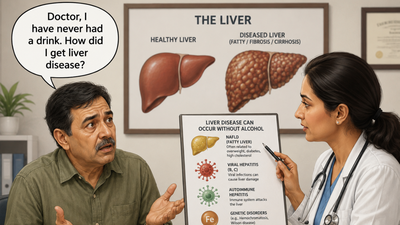
“Doctor, I have never had a drink in my entire life. How did I get liver disease?”It is one of the questions Dr. Suresh Raghavaiah, Senior Consultant, HPB and Multi-Organ Transplant at Apollo Hospitals, Bengaluru, says he hears routinely. For many people, liver disease still has one obvious explanation: alcohol. If they don’t drink, they assume their liver is safe. But that assumption is increasingly out of step with what doctors are seeing.Today, liver disease can develop in people who have never consumed alcohol. Obesity, diabetes, excess calories, physical inactivity and metabolic problems can quietly damage the liver, sometimes in people who appear perfectly fit. And by the time warning symptoms arrive, significant damage may already have occurred.Your liver can be badly damaged before you feel anythingOne of the most unsettling features of liver disease is how quietly it can progress.Unlike some illnesses that quickly produce obvious symptoms, liver damage can remain unnoticed for years. A person may continue working, exercising and eating normally while changes are taking place inside the liver.According to Dr. Raghavaiah, symptoms such as jaundice, fluid accumulation in the abdomen or internal bleeding are not usually early warning signs. They can indicate that the disease has already progressed to severe fibrosis or cirrhosis.This is why liver disease is often described as a “silent” condition. The absence of symptoms, therefore, should not automatically be interpreted as proof that the liver is healthy.The liver problem that has little to do with alcoholOne of the biggest changes in the way doctors understand liver disease is the growing importance of metabolic dysfunction-associated steatotic liver disease (MASLD), the condition previously known as non-alcoholic fatty liver disease.MASLD is associated with metabolic risk factors such as obesity, type 2 diabetes and excess body fat. Diet and physical inactivity can contribute to the metabolic problems that drive it.Dr. Raghavaiah says fatty liver disease has become a major reason patients in his practice eventually require liver transplantation, in some cases overtaking alcohol-related liver disease as a cause of liver failure.The change is particularly relevant in urban India, where sedentary work, long hours indoors and easy access to calorie-dense food can make metabolic risk surprisingly easy to overlook.And there is another complication: you don’t have to look overweight to have metabolic risk.A person can appear slim or physically active and still have diabetes, abnormal blood lipids, visceral fat or other metabolic abnormalities that increase the risk of fatty liver.A normal liver blood test doesn’t always tell the whole storyThis is where another common assumption can become dangerous.Dr. Raghavaiah points out that significant liver disease can sometimes exist without obvious abnormalities in routine blood tests. Conditions such as metabolic dysfunction-associated steatohepatitis can progress while laboratory results do not necessarily reflect the full extent of structural damage.That is why doctors may combine blood tests with a clinical assessment and imaging.An ultrasound can help detect fatty changes in the liver, while FibroScan can assess liver stiffness and provide information about fibrosis. Depending on an individual’s risk factors and medical history, doctors may recommend additional testing.The important distinction is this: a blood test can be reassuring, but it should not be treated as a complete liver health certificate.Then comes the “natural” remedy trapAs liver disease becomes more widely discussed online, another problem has grown alongside it: the belief that anything labelled “natural” must be safe for the liver.Herbal products, supplements and traditional remedies can contain biologically active substances, and some products may be poorly regulated or contain ingredients that are not obvious from the label. Certain supplements have been associated with drug-induced liver injury, which in severe cases can lead to liver failure.The phrase “herbal” therefore shouldn’t automatically translate to “harmless”.Dr. Raghavaiah cautions against self-medicating with supplements or remedies for suspected liver disease without professional advice.For someone already dealing with liver damage, adding an unverified product to the mix can create another problem rather than solve the first one.The liver can repair itself, if the damage is caught earlyThere is, however, a much more hopeful part of the story.A diagnosis of fatty liver does not automatically mean that a person is destined for cirrhosis or transplantation.The liver has a remarkable capacity for regeneration, and many early stages of liver disease can improve substantially when the underlying cause is addressed.For people with metabolic liver disease, that can involve weight management where appropriate, improving diet quality, increasing physical activity and controlling conditions such as diabetes and abnormal cholesterol. Some patients may also require medication, depending on their individual condition.But the window matters.Once liver disease has progressed to advanced fibrosis or cirrhosis, the situation becomes much more difficult. Established cirrhosis generally cannot simply be reversed by following a diet for a few weeks or taking a supplement.And when cirrhosis leads to serious complications or liver failure, transplantation may ultimately become necessary.That is why catching the disease earlier is so important.Your liver doesn’t need a “detox”Few liver-health trends have travelled faster on social media than detox diets and juice cleanses.The idea sounds appealing: eat or drink a particular combination of foods, “flush out” toxins and restore the liver.The problem is that the liver is already one of the body’s major organs for processing and metabolising substances. There is no good evidence that commercial detox diets or juice cleanses can “clean” a healthy liver or reverse established liver damage.Extreme approaches can also create their own nutritional problems.A healthy liver does not need a miracle cleanse. It needs the basics to be done consistently: a balanced diet, appropriate physical activity, management of metabolic conditions and avoidance of unnecessary medications and supplements.The question doctors want people to ask earlierPerhaps the most important change is not learning to recognise one particular symptom.It is changing the question.Instead of asking, “Do I drink alcohol?”, people at risk of liver disease may need to ask: Do I have diabetes? Is my weight or waist circumference increasing? Am I physically inactive? Do I have metabolic abnormalities? Am I taking supplements or medicines I don’t actually need? Have I ever been screened for viral hepatitis?Hepatitis B vaccination is also an important part of prevention, while appropriate testing and medical evaluation can identify people who need further assessment.The liver doesn’t always complain when it is in trouble. By the time it does, the disease may have been developing for years.That makes the original question: “I’ve never had a drink, so how did I get liver disease?” more important than it first appears.The answer is that alcohol is only one piece of the liver-disease story. Metabolic health, infections, medications, supplements, genetics and lifestyle can all matter.And perhaps the most reassuring discovery is that catching the problem early can change that story entirely.


