Railway Station Modernization: From E coli to amenity gaps: What CAG found beyond the railway makeover | India News
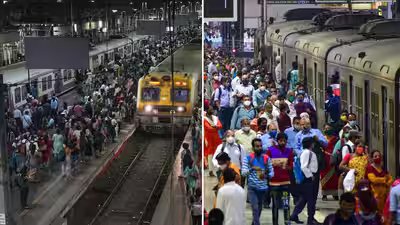
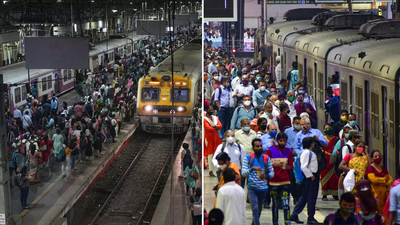
NEW DELHI: Indian Railways is in the middle of one of its biggest modernisation drives, spanning station redevelopment, new trains, electrification and record capital investment. A recent CAG audit, however, shows that alongside this expansion, gaps remain in some of the most basic passenger amenities at stations.For years now, the story of Indian Railways has been told through images of transformation.There are sleek Vande Bharat trains gliding out of revamped stations, glossy artist’s impressions of redeveloped railway hubs, new concourses, lifts, escalators and futuristic terminals. The government has steadily raised capital expenditure on the national transporter, presenting the Railways as one of the central pillars of country’s infrastructure push.The makeover is visible. But the latest audit findings of the Comptroller and Auditor General of India show that ensuring basic passenger amenities remain available and functional across the network continues to be an important part of that transformation.In a report tabled in Parliament on August 12, the CAG examined passenger amenities and sanitation at non-suburban railway stations and found significant gaps in the basics. Of 512 stations covered by the audit, 458 had deficiencies in one or more essential passenger amenities. Water samples collected from coolers at eight stations were found contaminated with E. coli, a marker that raises serious concerns about faecal contamination and water safety.
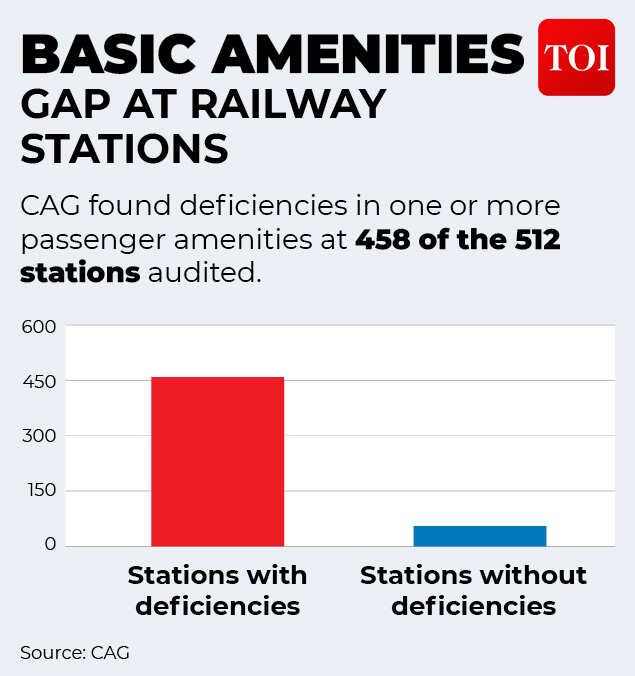
Amenities gap at railway stations (Source: CAG)
The latest CAG reports, including those on passenger amenities, railway finances and compliance, raise a larger question about the makeover that we keep talking about: Is the transformation merely about building new assets, or is it also about making the everyday railway experience safer, cleaner, more reliable and financially sustainable?
What the CAG found at railway stations
Indian Railways is not a conventional transport system. It is the daily infrastructure of a country on the move.Millions pass through its stations not as occasional tourists but as workers, students, migrants, families and small traders. For many, the railway journey begins long before boarding a train. It begins with finding the platform, locating a toilet, getting drinking water, sitting in a waiting area and navigating a crowded station.That is precisely where the latest audit becomes very important.The CAG’s Report No. 31 of 2026, focused on passenger amenities and sanitation at non-suburban railway stations, was tabled on August 12.The findings suggest that while major infrastructure projects may dominate the narrative around railway modernisation, there continues to be significant variation in the availability of basic passenger amenities across the stations examined.The audit found deficiencies at nearly nine out of every 10 stations examined.The gaps ranged across basic amenities such as toilets, urinals and drinking-water facilities. In other words, the issue was not necessarily the absence of a grand redevelopment plan. It was ensuring that facilities passengers encounter every day are available and functional consistently.The audit underlines that station modernisation has two components: creating new infrastructure and ensuring that routine passenger amenities remain available and functional.
Water quality emerges as a key concern
Perhaps the most striking finding in the audit concerns drinking water.The CAG found E. coli contamination in samples collected from water coolers at eight locations. The presence of such bacteria raises concerns because contaminated drinking water can pose a serious public-health risk.The finding was particularly important because access to safe water is among the most basic services expected at a railway station.The finding has now prompted a special response from Indian Railways.The Railways has launched a special drive to clean and disinfect drinking-water tanks and filters. Zonal Railways have also been advised to undertake comprehensive inspections of drinking-water infrastructure and rectify deficiencies wherever they are found.Importantly, the exercise is not being limited to a one-time cleaning drive. The Railways has directed that station-wise deficiencies and the action taken to address them be monitored.That changes the nature of the response.The issue is no longer simply whether a station has a drinking-water facility. The bigger question is whether the entire system behind that facility, tanks, filters, pipelines, coolers and monitoring, is functioning properly and delivering safe water consistently.It is a crucial distinction.A water cooler installed at a station is an infrastructure achievement. Ensuring that the water remains safe every day is a maintenance and governance challenge.The new cleaning and inspection drive also underlines the broader problem identified by the CAG.Modernisation is not simply about creating infrastructure. It is about maintaining it.A water cooler installed at a station is only as useful as the quality of the water flowing through it. A new toilet is only as useful as its cleanliness and upkeep. An escalator that frequently stops working or a waiting hall that is not maintained does not become useful merely because the infrastructure exists.The challenge for Indian Railways is increasingly shifting from construction to maintenance.
The missing link in the makeover
India’s railway modernisation programme has been built around large numbers.New lines, doubling and electrification projects, station redevelopment, signalling upgrades and new rolling stock have become the visible markers of the transformation.The latest financial audit, Report No. 30 of 2026, was also tabled on August 12 and examines the finances of the ministry of Railways for the year ended March 2025. Its significance lies in placing the makeover against the larger question of financial capacity and the resources available to sustain such an ambitious transformation.The numbers show the scale of the continuing investment push. For 2026-27, railway capital expenditure is budgeted at Rs 2.93 lakh crore, with budgetary support from the Centre expected to finance around 95% of that spending.This represents a fundamental shift in how railway modernisation is being financed.The network is no longer relying only on internally generated resources to fund its massive expansion and upgrade plans. Government support has become the financial backbone of the capital programme.That has enabled Indian Railways to build faster. At the same time, the growing asset base makes maintenance, upgrade and efficient operation increasingly important.
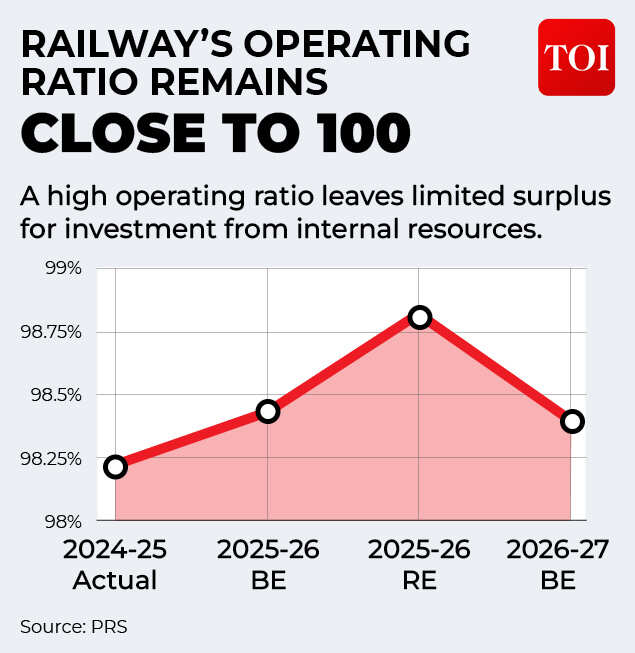
Record spending, 98.4% operating ratio
The answer lies partly in the operating ratio, a measure of how much of every rupee earned is consumed by working expenses. A lower operating ratio leaves more room for investment and financial flexibility.For 2026-27, the operating ratio is budgeted at 98.4%, after a revised estimate of 98.8% for 2025-26, as reported by Parliament and PRS Legislative Research.The margin remains narrow.The modernisation drive is also being supported by a substantial increase in central budgetary support. Government support is expected to finance around 95% of railway capital expenditure in 2026-27, while the operating ratio remains above 98%.
Building big, maintaining better
The CAG’s findings bring an old problem into a new context.The audit places renewed focus on maintenance, an increasingly important issue as the Railways adds and upgrades infrastructure across a very large network.The transformation of Indian Railways will not be judged only by whether a station redevelopment project is completed on schedule. It will also be judged years later by whether the facilities created continue to work as intended.The CAG examined precisely these everyday indicators — drinking water, toilets and urinals, seating, platform shelters, accessibility and sanitation — making the report as much about service quality as infrastructure availability.The findings highlight the importance of pairing asset creation with regular maintenance, inspection and service monitoring.The former is visible. It can be photographed, inaugurated and counted.The latter is harder. It requires regular inspection, accountability, maintenance contracts, quality checks and systems that continue to work long after the inaugural ceremony.The Railways’ latest drinking-water drive points in that direction. The focus on comprehensive inspection, rectification and station-wise monitoring suggests an attempt to make maintenance more systematic rather than waiting for individual problems to surface.The real test will be whether that monitoring continues after the immediate response to the audit findings.The challenge of maintaining standards across a vast networkThe latest findings also underline the challenge of ensuring uniform service standards across a railway network of India’s scale.At one level are the flagship projects: High-profile trains, major stations and corridors receiving substantial investment. These are the symbols that shape public perception of a changing railway system.At another level are hundreds of ordinary stations where the provision and upkeep of basic amenities remain equally important.The CAG’s examination of 512 stations and its finding of deficiencies at 458 suggests that ensuring minimum standards consistently across the network remains a work in progress.That is where the true test of the makeover lies.Indian Railways is too large and too geographically diverse for transformation to be measured only through a handful of showcase projects. The success of the modernisation programme will depend on whether improvements can eventually become the standard across the network rather than remain concentrated at major stations.The passenger boarding from a smaller city experiences the Railways through the condition of the local station.That station is where the promise of transformation ultimately becomes visible.
A financial makeover still in progress
The railway modernisation programme is also taking place against a difficult financial backdrop.Passenger and freight revenues remain central to the financial health of the system. Yet recent budget analysis has pointed to revenue estimates falling short of targets, even as the Railways continues to undertake large capital investments.According to the 2026-27 analysis by PRS Legislative Research, freight revenue in 2025-26 was estimated to be 5.1% below the budget estimate, while passenger revenue was expected to fall short by 13.8%.
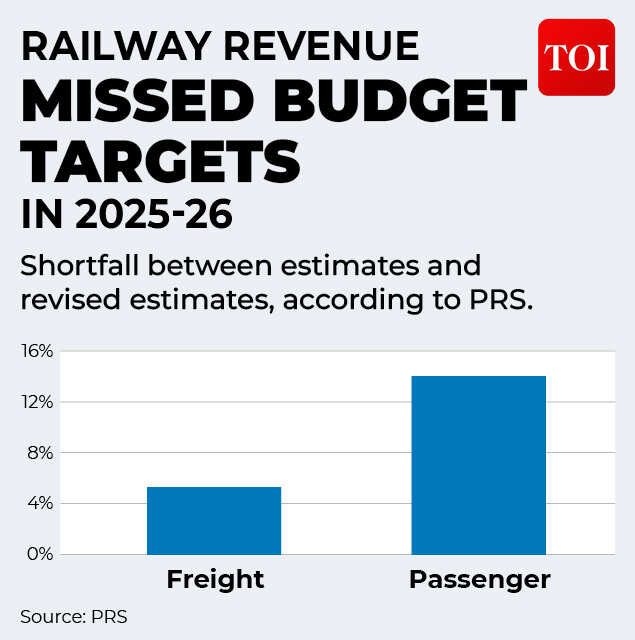
Freight down, passenger revenue misses target
This does not mean that the railway transformation has stalled. Far from it. The scale of capital expenditure remains historically high.It does mean, however, that central budgetary support remains a major pillar of the current modernisation programme.The question is whether the investments being made today will eventually create a more efficient railway system, one that can carry more freight, attract more passengers, reduce congestion and improve revenue generation.That is the economic logic behind modernisation.The CAG’s latest findings add another dimension: modernisation must also ensure that spending translates into reliable passenger amenities and services.
The real makeover begins after inauguration
There is another lesson in the CAG audit.One of the most important parts of railway transformation is creating systems capable of looking after the infrastructure once it is built.A station redevelopment project has a beginning and an end. A maintenance programme does not.It requires continuous supervision.The Railways’ decision to launch a special drive for cleaning and disinfecting drinking-water tanks and filters, inspect infrastructure and monitor station-wise deficiencies is therefore significant.The Railways will now have to ensure that the response goes beyond corrective action after contamination is detected. The larger goal is preventive systems, regular water testing, routine cleaning and disinfection, replacement of ageing infrastructure, clear responsibility for sanitation, and stronger monitoring of passenger amenities.The same principle applies across the network.Modernisation must become a process rather than an event.The CAG’s findings have arrived at an important moment because Indian Railways is entering a phase where the story can no longer be told only through the scale of capital expenditure. The network has already seen major investments and ambitious announcements.The next question is whether these investments are producing a railway that works better every day.
From showcase projects to everyday reliability
There is no doubt that Indian Railways is changing.The infrastructure pipeline is enormous. Capital spending remains high. Stations and trains look different from what they did a decade ago. Electrification, new corridors and capacity expansion are reshaping the network.The CAG audit does not erase those changes.Instead, it adds another dimension to the modernisation story: the importance of ensuring that basic passenger services improve alongside major infrastructure creation.A transformed railway will ultimately be judged both by its new assets and by the consistency with which its everyday facilities work.It must be judged by outcomes.The latest audit reports offer precisely that reminder.The CAG’s passenger amenities report was tabled in Parliament on August 12, alongside the latest reports on railway finances and compliance. Together, they offer a snapshot of a system undergoing one of its most ambitious periods of investment while still grappling with persistent questions of service delivery, maintenance and financial sustainability.
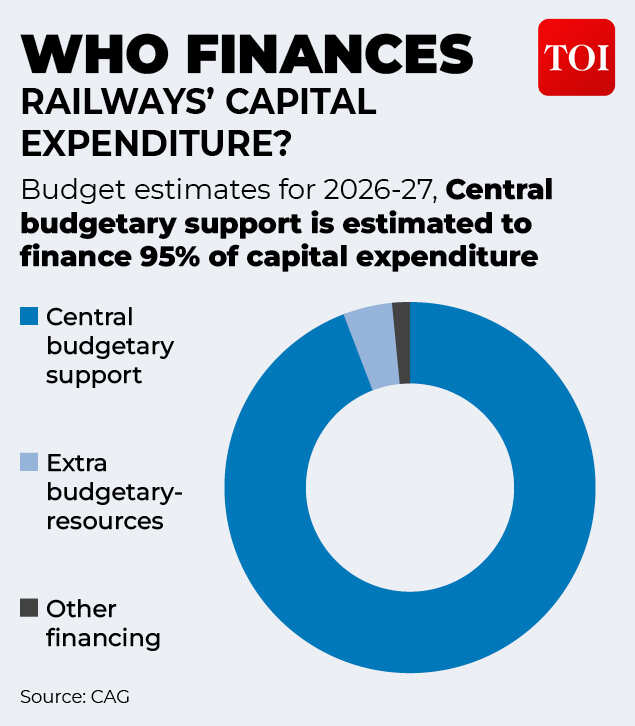
Record capex, heavy government support: The financial reality behind Railways’ makeover
The new drinking-water drive shows that the Railways is responding to at least one of those concerns. But whether the effort translates into consistently safer and better-maintained facilities across stations will determine its real impact.
Share your thoughts in the comments
Be respectful · TOI community guidelines
The railway makeover, in other words, is real. But seems unfinished.The CAG report does not negate the scale of the transformation underway in Indian Railways. Capital investment remains at record levels, stations are being redeveloped and capacity is expanding. What the audit adds to that picture is a reminder that the next phase of modernisation will also depend on maintenance, consistency and ensuring that facilities already created remain functional, accessible and safe.The Railways’ response to the water-quality findings, including inspections, filtration upgrades and station-wise monitoring, shows that corrective action has begun. The larger test will be whether these systems can help close the remaining amenity gaps across a network that serves millions of passengers every day.For millions of passengers, transformation will ultimately mean something simple: a clean station, a functioning toilet, safe drinking water and a journey in which the infrastructure created for them continues to work as intended.