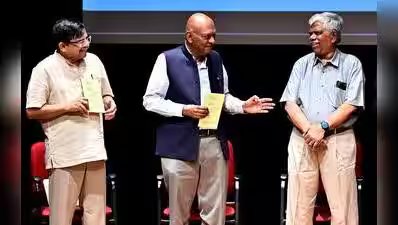
I have friends and enemies in every camp. If I have a stand, I take it: Srijit Mukherji | Bengali Movie News


On a rain-drenched set at the Freemason’s Club with Jisshu U Sengupta for Queen Victoria Aar Goyenda Kanaichawron, Srijit Mukherji spilled the tea on his latest creative leap: turning music composer. Excerpts:How much of this career turn is born from a desire to control the sonic architecture of your films? And how much of it is a natural expression of the kind of upbringing that you had, growing up with music and musicians?It’s a mixture of both. Music has always been the backbone of my existence. My earliest memory involves listening to my father’s huge collection of records. The variety was mind-boggling.On one hand we had old Bengali songs by SD Burman, Manna Dey, Shyamal Mitra, and then you would also have Bob Dylan, Joan Baez, Harry Belafonte. And you would also have Bade Ghulam Ali Khan, Begum Akhtar and also film songs.The most interesting bits were the Ramayan and the Mahabharat. My grandparents, especially my grandmom, used to read out the stories, but I first heard them as audio stories or audio books in those times. And there were fairy tales and everything else.From these epics to independent Bengali music to Hindi music, to pop, country, jazz, my childhood was steeped in music. The versatility of musical influences, spearheaded by my father, formed the musical backbone of my growth.
If I had my own band, I’d probably write, harmonise, and play the harmonica or percussions. It would definitely be a band that captures the essence of a world I sometimes miss a lot
And that has obviously shaped you as a filmmaker. I subscribe heavily to the subcontinental tradition of narrative storytelling through songs, which the Western cinematic world often views skeptically. Western philosophy categorises song-led narratives separately as musicals, whereas our tradition is intrinsically entwined with music.Whenever I submit films to festivals, programmers frequently ask me to remove the songs. I consistently refuse because the music forms an integral part of the narrative – a stance that has cost me selections at major festivals. Instead of writing explicit scenes, I often express crucial narrative realities through songs or background scores, choosing to strictly hold my ground on musical storytelling.Through this uncompromising journey, I have had the privilege to collaborate with and learn from a wonderful array of musicians and composers who have deeply enriched my craft.Growing up in a rich musical environment, singer Aarti Mukherjee was my aunt, my father studied under Sudhin Dasgupta, and my mother trained under sitar maestro Kalyani Roy. Surrounded by music and playing various instruments from childhood, I developed a deep passion for musical expression.I entered the industry as a lyricist before transitioning into music composition, production, and arrangement. My journey as a composer truly began around 2009-2010 through my long-standing collaboration with director Indraadip Dasgupta (ID). I wrote and composed the song Ador for his project – featuring vocals by Subhodeep and Lagnajita.Since then, I have composed two tracks for my film Emperor vs Sharatchandra, worked on Suman Ghosh’s project Serampore Diaries, and written and composed the title track for my current film, Queen Victoria Aar Goyenda Kanaichawron.Taking on the composer role allows me to precisely articulate the exact emotional brief, musical sensibility, and lyrical nuance I envision for my films.You deliberately start with period dramas rooted in history rather than modern, slick genres like your Ray short? Does your musical sensibility lean toward traditional Bengali music for these period settings? My personal favorite musical eras are the ’60s-’70s and ’90s-mid-2000s across Hindi, Bengali, and Western music like Dylan and Cohen. However, as a composer, I serve the film’s brief. For Goenda Kanai, I wanted a funky, K-pop-inspired mix of hip-hop and Bangla folk for the title track.We only released the “making-of” footage because the song deserves a proper music video release. It sets up a fun, lighthearted detective franchise – more of a food-filled caper than a gory, sociopathic thriller. Lines like “Happy foodie…” reflect this, fitting our protagonist’s love for food.We even shot during peak office hours at Dacres Lane and included references to iconic Kolkata eateries like India Restaurant and Aminia. The film spans two timelines: modern-day 2026 and 1910, making it a true detective treasure hunt combined with a rich culinary exploration.How do dynamics shift when working with Anirban Bhattacharya as a composer/director versus an actor? The dynamic doesn’t shift – it just pivots from histrionic instructions to musical briefs, detailing specific notes, lines, and subtle variations.Anirban is an exceptionally versatile artist whose theatrical discipline allows him to modulate his voice masterfully; he sang nearly every line as a different persona. I wanted to tap into that distinct “X factor.”After a frustrating deadlock kept him unfairly incapacitated, I felt claustrophobic waiting to collaborate with him. As soon as the situation cleared, I wanted to work together immediately. Casting him for this track was the perfect restart – he hit it out of the park.Given your passion for food, have you considered dedicated food projects? Absolutely. I’ve pitched a food chat show and explored scripts like a food thriller. At a film festival, Nagesh Kukunoor and I jammed on a food rom-com about a Telugu guy and a Bengali guy competing for a girl’s heart through Hyderabadi versus Kolkata biryani.While food-relationship films exist, genres like food thrillers or treasure hunts remain untapped. Beyond Pratim D Gupta’s brilliant Maacher Jhol, there is a real dearth of food cinema. Exploring regional recipes, exotic culinary histories, and historic food trails is an avenue waiting to be explored.Beyond your online posts, how does your political stance translate into your films? My politics are strictly issue-based rather than party-aligned, which inevitably offends people across the spectrum.This philosophy carries directly into my filmmaking. I refuse to present a one-sided narrative – every story demands the opposing perspective. Because I choose to highlight these dualities rather than toe a party line, I end up with friends and enemies in every camp.
I take issue-based stances and don’t balance them for optics. Inevitably, someone gets offended – I have friends and enemies in every camp. If I have a stand, I take it
Srijit on his actors
About Jisshu U Sengupta, Srijit says, “Jisshu’s cinematic revival began when I cast him in Jaatishwarpost-Rituparno Ghosh. I then convinced him to step into villainous territory with Rajkahiniand Zulfiqar, which unlocked national opportunities for him as an antagonist. Roles in Umaand Ek Je Chhilo Rajafurther showcased his complete emotional range, giving him the sky to truly explore his craft”

Jisshu U Sengupta in Ek Je Chhilo Raja
According to Srijit, directing Anirban Bhattacharya across seven consecutive projects through Byomkesh was pure joy. “He arrives on set thoroughly prepared with characterisations and improvisations, masterfully modulating his voice to give each line a distinct persona. That rare, versatile ‘X factor’ makes collaborating with him immensely fulfilling, which is why I was desperate to work with him again the moment industry deadlocks cleared,” he says
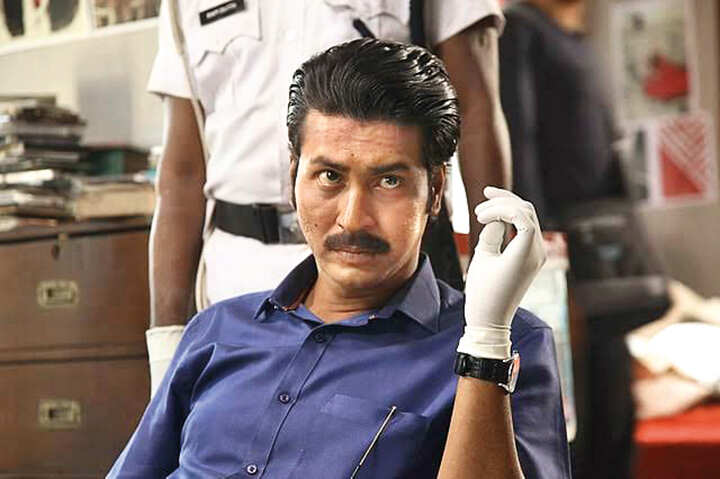
Anirban Bhattacharya in Vinci Da
According to the filmmaker, his and Tota Roy Choudhury‘s partnership was a successful one. “Despite initial public skepticism, I cast Tota as Feluda, staying strictly faithful to Satyajit Ray’s original books. Through diligent research and subtle tonality refinements, he became accepted as the third-best Feluda after Soumitra Chatterjee and Sabyasachi Chakraborty. That breakthrough opened massive national doors for him, sparking a second innings that led to major Mumbai projects and has kept him supremely busy ever since,” Srijit told us
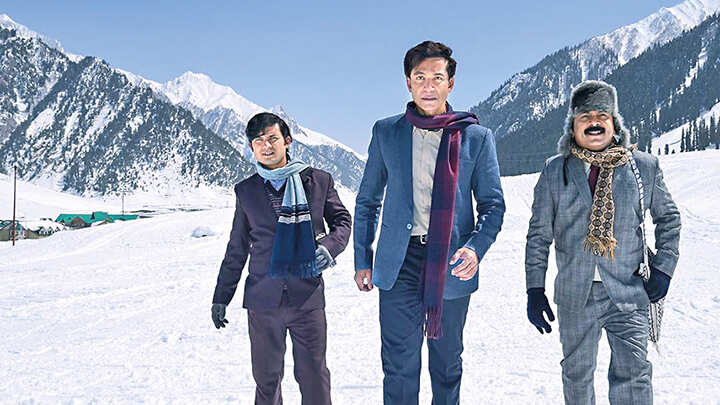
Tota Roy Choudhury in Feludar Goyendagiri
Do we need another goenda? Adapted from director Rajorshi Das Bhowmik’s original literary creation, Goenda Kanai fills a unique void in Bengali detective fiction by offering a quirky, lighthearted armchair sleuth, says Srijit, reminiscent of Agatha Christie’s Hercule Poirot. “He relies on keen deduction while sending his assistant to do the legwork. Unlike traditional, health-conscious Bengali detectives like Feluda, Kanai is an unapologetic, food-loving detective whose cases double as a rich culinary and geographic exploration of Kolkata,” he adds.