Mexico City planted thousands of plants on highway pillars to fight pollution and heat, turning its busy roads into vertical gardens | World News
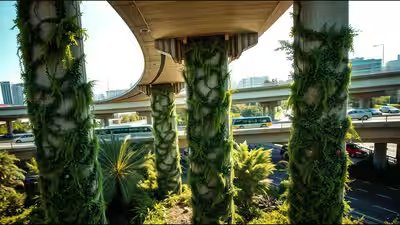
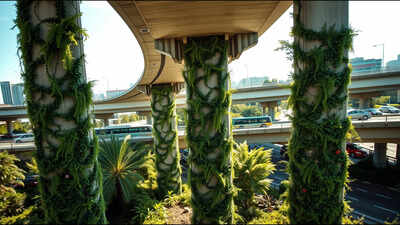
Mexico City’s Anillo Periférico, the major ring road that carries traffic around the capital, was never designed to be a garden. For years, its concrete support columns stood bare above some of the city’s busiest and most polluted roads, forming a vast grey landscape through densely populated parts of the capital. Architect Fernando Ortiz Monasterio saw an opportunity to change that. In 2016, he launched Via Verde, a project designed to transform highway infrastructure into vertical gardens by covering concrete columns with living plants. The idea was to combine urban greening with infrastructure that already existed, rather than requiring large amounts of additional land. What began as a public campaign eventually developed into a large-scale urban landscaping project, with thousands of plants installed along sections of the city’s road network. The result is a striking transformation: columns that once contributed little beyond supporting the highway now form stretches of greenery through one of the world’s largest cities.
How a public campaign helped bring Via Verde to Mexico City
Ortiz Monasterio promoted Via Verde as a way to address several of Mexico City’s environmental problems at once, including air pollution, rising temperatures and a shortage of accessible green space. The project attracted considerable public attention after its proposal was circulated online, helping demonstrate that there was strong public interest in adding vegetation to the city’s heavily built-up road corridors. The basic idea was relatively simple: use the enormous amount of existing concrete infrastructure along the Periférico as a framework for planting vegetation. Instead of removing roads or acquiring new land, the project could place greenery directly onto structures that were already occupying space. That approach also gave the project an immediate visual impact. As the plants grew across the columns, sections of the previously grey roadway began to resemble a continuous vertical landscape.
How the vertical gardens are designed to survive beside a highway
Via Verde’s planting system was developed specifically for the difficult conditions surrounding major roads. The plants have to tolerate heat, pollution, limited space and exposure to traffic while growing vertically on structures that were never intended to support vegetation. The system incorporates irrigation and monitoring technology to help maintain the plants, while the gardens are designed to require considerably less conventional ground space than a traditional urban park. The project has also incorporated private-sector financing, including advertising, allowing the gardens to be installed without relying entirely on public funding. That financing model has been an important part of Via Verde’s expansion. Instead of treating every column as a conventional municipal landscaping project, the initiative created a mechanism through which private companies could contribute to the cost of installation and maintenance.
What Mexico City’s highway gardens can and cannot solve
The project has become an example of how existing infrastructure can be adapted to provide environmental benefits in densely populated cities. Vegetation can help provide shade, capture some airborne pollutants, store carbon and reduce the amount of exposed concrete contributing to the urban heat-island effect. But Via Verde is not a substitute for conventional urban forests or parks. Critics have argued that money spent covering elevated highway columns could potentially produce greater benefits if directed toward planting trees at street level, where people can directly access their shade and cooling effects. That distinction is important because Mexico City’s shortage of accessible green space cannot be solved simply by covering infrastructure with plants. Yet the project demonstrates a different possibility: infrastructure that normally consumes urban space can sometimes be made to perform additional environmental functions.For Ortiz Monasterio, that is the larger idea behind Via Verde. The project turns structures that residents normally experience as symbols of traffic and concrete into something visibly alive, showing how even some of a city’s least attractive spaces can be redesigned rather than simply accepted as permanent parts of the urban landscape.