‘Judges are not gods, won’t get every judgment right’: Outgoing SC Judge Sanjay Karol in farewell speech | India News
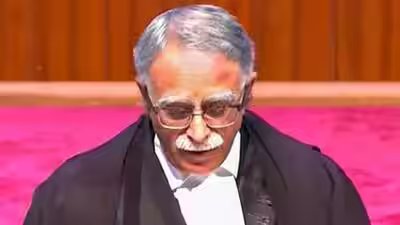
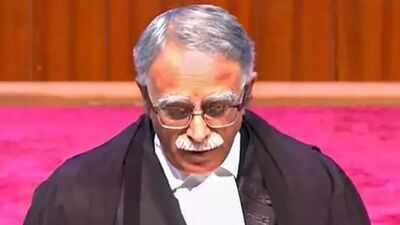
NEW DELHI: Retiring Supreme Court judge Justice Sanjay Karol in his farewell address on Saturday, said judges “are not gods and they will not get every judgment right.” He also urged other judges to look beyond the facts of a case and see the person behind every litigant.The Supreme Court bid farewell to Justice Karol on his last working day, with Chief Justice of India Surya Kant and senior members of the Bar, including Solicitor General Tushar Mehta and Supreme Court Bar Association president Pradeep Rai paying tribute to the outgoing judge.“We, as judges, are not gods. We will not get every judgment right. What was always in our hands was simple: to see the person, not just the petitioner. A petition can only tell you the facts of a case, but it cannot tell you what the person has already lost or what he is hoping to seek from the courts. And perhaps that is why I have always said that judging requires a certain level of humility,” Justice Karol said.“The Constitution does not ask us merely to apply the law correctly. It asks us to apply it justly. That is perhaps why the responsibility of judging has always seemed larger to me than simply deciding who is legally correct,” he added.Justice Karol, who was elevated to the Supreme Court on February 6, 2023, reflected on his nearly four-decade journey in the legal profession. He said the courtroom had never been merely a workplace for him, but a vehicle for something “greater and more important” than himself.“I will not pretend that this journey has been mine alone. This courtroom has not left me; it has supported me,” he said.Karol spent 40 years in courtrooms, initially as an advocate and later, for 19 years, as a judge. He said judges must learn to listen not only to arguments but also to the “eloquent silences” in courtrooms.“In the silence of the Bar, there is a way of listening,” he said, stressing that the judicial process was also about understanding what people were seeking “in the spaces between the words”.Recalling his first visit to Courtroom No. 1 of the Supreme Court in 1996, Justice Karol said the Bench appeared to him to be almost six feet above the ground.“Judging from there has taught me something about this courtroom’s symbolism. From below, the height of the bench can appear to signify authority. From the comfort zone, it signifies something quite different, and that is responsibility with dignity and honesty,” he said.Justice Karol said the Supreme Court’s true significance lay in the faith of ordinary citizens who approach it believing that someone would listen.“But we must also remember those who never reach those doors because justice is too distant, too expensive, too intimidating,” he said.Reflecting on constitutionalism and justice, Karol said concepts such as law, due process and constitutional legality could be understood through the idea of “dharma”, which he described not as ritual but as duty.“The duty of a judge is to respect justice and see that the person standing before the court, however small, however wretched, is seen and heard,” he said.Addressing the Bar, he said the principles of judging extended beyond courtrooms and judicial robes, with every individual responsible for judging their own choices, conduct and use of power.“There may be no courtrooms, no robes, no technical grounds, but in these small choices, each of us dispenses the measure of justice that we take,” he said.“A judge is a judge before he dons and after he takes off the robes,” he added.Referring to a point made by CJI Surya Kant a day earlier, Justice Karol said India had not only a living Constitution but also had to “live the Constitution”.“The greatness of our Constitution is tested not only in great cases. It is tested in ordinary conduct,” he said. Concluding his farewell address, Justice Karol said he was returning to “the most distinguished constitutional office,” that of the ordinary citizen.
Share your thoughts in the comments
Be respectful · TOI community guidelines
Born on August 23, 1961, Karol studied in Shimla and obtained his law degree from Himachal Pradesh University. He became advocate general of Himachal Pradesh in 1998 and served until 2003, and was designated a senior advocate in 1999.He was appointed a judge of the Himachal Pradesh high court in March 2007 and became chief justice of the Tripura high court in November 2018. He was later transferred as chief justice of the Patna high court in November 2019 before being elevated to the Supreme Court in February 2023.