
SC upholds broad definition of industry, only for pending cases | India News
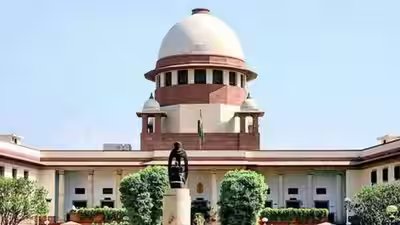
NEW DELHI: A nine-judge Supreme Court bench on Thursday settled a decades-old debate over the appropriateness of its 1978 ruling giving an expansive definition to “industry” to protect workmen against arbitrary retrenchment, and said it would apply to all organisations, including govt public works agencies, temples, hospitals and NGOs, if there existed an employee-employer relationship under Industrial Disputes Act, 1947.A 9-judge bench of CJI Surya Kant, and Justices B V Nagarathna, P S Narasimha, D Datta, U Bhuyan, S C Sharma, J Bagchi, A Aradhe and V M Pancholi unanimously said that given the socio-economic condition of yester decades, the triple test laid down by a 7-judge bench in Bangalore Water Supply case – systematic activity, functional relationship between employer and employees and engagement of the enterprise in production or distribution of goods or services to satisfy human wants, needs and wishes, excluding purely spiritual or religious activities – for determination of ‘industry’ is valid.Importantly, it said that the triple test for determination of industry character of an enterprise employing workmen would cover temples, charitable organisations and even NGOs provided there is a distinct and discernible employee-employer relationship.However, it clarified that since Industrial Relations Code (IRC), 2020, has come into effect from Nov 21, 2025, the bench’s ruling would apply only to the pending cases under the ID Act.
SC: 9-J bench ruling won’t be regarded as ‘sheet anchor’
Referring to the pending petitions challenging the validity of certain provisions of IRC, the bench said the 9-judge bench ruling would not be “regarded as a sheet anchor” by SC or the petitioners during the adjudication of the validity of provisions of the 2020 Code.The bench said the triple test in 1978 judgement carefully carved out just and proper exceptions in cases of casual and non-systematic activities like domestic service, individual professionals, and small and unorganised clubs and associations. On March 19, when the 9-judge bench reserved verdict after three-day-long arguments, the states governed by opposition parties had pleaded in unison for circumscribing the SC-framed expansive definition of ‘industry’ to exclude activities that are ‘sovereign functions’, charitable in nature, or unrelated to business, trade or commerce.Attorney general R Venkataramani had pleaded that SC cannot shut its eyes and ears to the prevailing industrial climate of the country altered by liberalisation and globalisation. “Court should not misunderstand the Centre’s argument as anti-labour. Govt is committed to go to any length to ensure labour welfare. But the definition of ‘industry’ cannot mean to include the irrigation department or research institutions.
Share your thoughts in the comments
Be respectful · TOI community guidelines
”“In a constitutional democracy, the concept of sovereignty has undergone a jurisprudential contraction and is restricted to core and inalienable duties for which the govts are answerable not to the courts of law but to the people in a political democratic discourse,” Justice Bagchi on behalf of the bench said. “Viewed from this perspective, welfare activities of a state, schemes undertaken by govt depts, and their instrumentalities do not by their public charitable character escape the scrutiny under Section 2(j) of ID Act (that defines industry). Mere vesting of duties on a state by statute or Constitution, even a duty undertaken to fulfil the lofty mandate of Part IV (fundamental duties), does not clothe it with sovereign immunity from industrial law,” he said. “From the lens of the industrial law, charitable undertakings, temples and educational institutions are all viewed from the character of employee-employer relationships through which they function.”