Wyoming’s Casper landfill buried 1,124 turbine blades after each was cut into three pieces; a Missouri plant offers another route by turning old blades into cement feedstock
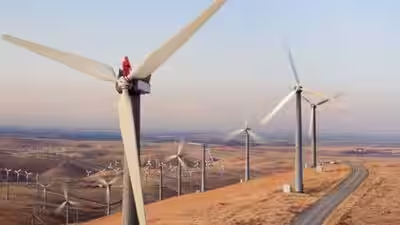
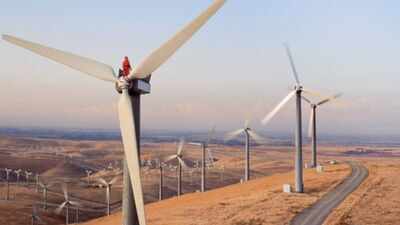
Outside Casper, pieces of turbine blades cut through were lowered by a loader into a trench for years. Now, what they are being used for instead of being buried under the ground, is to make cement powder. And this transition is worth noting.The Casper Regional Landfill took its first decommissioned blades in the spring of 2019. By the following September the running total stood at 1,124 blades, arriving from three wind farms in the surrounding country.Each one came in at roughly 120 feet and was cut into three 40-foot lengths before it could be moved or stacked. The smaller sections were then nested inside the larger ones, which is the only way to stop a single blade swallowing an unreasonable share of the trench. Even nested, one blade fills about 44 cubic yards, or roughly three cement mixer trucks worth of space.Why do the blades have to be cut at all? Well, a blade is fibreglass bonded with epoxy, engineered to flex through decades of storm loading without cracking. That is precisely the property that defeats a landfill, because everything on a tip works by crushing, compacting or shredding whatever arrives. Steel gets melted down and copper gets stripped out, but a cured composite cannot be unmade by heat in any economic way at all.So the cutting happens out where the turbine stood, usually with a diamond wire saw dragged slowly through the shell. A 150-foot blade weighs about 20,000 pounds even after it has been sectioned, which is why the trench comes before the recycling plant.
The river town where they go instead
About 90 miles north of St Louis there is an old Mississippi River town called Louisiana and blades arrive there daily. They come in from nearly every state, get shredded down to fragments, and go into cement. The plant has run close to 2,000 blades through since the late summer of 2020, and takes in roughly 250 more every month.The reason it works is purely chemistry. More than 70 per cent of a blade is silica, which happens to be what cement is made from anyway. Thus, about three-quarters of each blade becomes raw material, and the remainder burns in the kiln in place of coal.
A bridge of blades
From being buried in landfill, mixed in cement and now used as a bridge, these blades have had quite the journey. On a greenway in County Cork, laid along an old railway bed, two decommissioned blades were installed as a pedestrian bridge, as the bridge project recorded. The span is modest, around 16 feet, and the blades came off small older machines rather than the giants going up today. It was the second in the world, the first having gone in on a site in Poland a few months earlier.A blade is already a long hollow beam built to carry bending loads, which is most of what a footbridge has to do, as the plant reporting on the wider problem sets out.
Yet to arrive
Even with these uses, it is yet to be seen how the blades that will be arriving in the future will be handled. Researchers put the worldwide total at roughly 43 million tons of blade material discarded by the middle of this century. Against that, a few thousand blades in a trench and a few thousand more through a kiln is a start rather than a solution.Interestingly, the newest blades are being designed for the end of their working life rather than only for the wind. Blades built to come apart chemically are already turning on real machines, which changes the arithmetic thirty years out. Until then, trenches, kilns and bridges are where the blades will be cutting through.