
‘US has similar laws’: Indian envoy Vinay Kwatra clarifies FCRA Bill, shares ‘myth vs reality’ check | India News
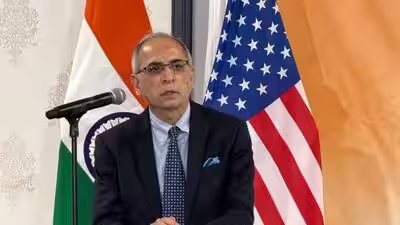
NEW DELHI: India’s Ambassador to the US Vinay Mohan Kwatra on Monday defended the proposed amendments to the Foreign Contribution (Regulation) Act (FCRA), saying the changes are aimed at improving transparency, governance and oversight of foreign funds.In a series of posts on X on Monday, Kwatra issued a “Myth vs. Reality check” on the proposed FCRA Amendment Bill, 2026, amid concerns raised by sections of civil society and a US lawmaker over the legislation.Kwatra said regulating foreign financial flows in public and political spaces was a sovereign measure driven by national security concerns and was common in several democracies.“Truth: Regulation of foreign financial flows in public and political spaces is a sovereign step driven by national security concerns. It is an accepted feature of modern governance in many democracies around the world,” he said.Responding to the claim that India was framing a new law to cut off foreign aid to civil society, Kwatra said the proposed legislation did not prohibit Indians from receiving foreign donations or seek to shut down law-abiding organisations.“The fact is that the law does not forbid Indians from receiving foreign donations or shut down law abiding civil society. Tens of thousands of associations are registered under FCRA and routinely receive foreign funds for health, education, disaster relief, research and humanitarian work,” he said.Kwatra said the FCRA was first enacted in India in 1976 and replaced by a new framework in 2010. It was subsequently strengthened through amendments in 2016, 2018 and 2020.“The 2026 Bill and Rules are the next step in the same direction: more transparency, better governance, clearer rules,” he said.‘FCRA does not target any religion’Kwatra also rejected allegations that the FCRA amendments “specifically target a particular religion or community.”“Truth: Nothing could be farther from it. The Act applies uniformly to all organisations regardless of religion, community or ideology,” he said.He added that faith-based welfare activities, including religious education, maintenance of places of worship and charitable work by organisations of all faiths, would continue to be eligible for foreign funding.‘Foreign money inflows have been rising’Kwatra also rejected claims that the FCRA had adversely affected NGOs and charitable organisations or that the proposed amendments would further restrict their operations.“Truth: In reality, foreign money inflows into India have been rising, not falling. Foreign contributions to registered organisations grew from roughly $1.2 billion in 2010–11 to $2.67 billion in 2024–25,” he said.He said India has more than 3 million NGOs, while only 14,450 have FCRA registration, arguing that the overwhelming majority of civil society organisations fall outside the ambit of the Act.“FCRA does not stop anyone from accepting foreign charity, research grants or humanitarian aid. It asks three things — register, receive the money through laid down process, report what you did with it,” Kwatra said.Addressing concerns that the proposed law would allow the government to seize assets of NGOs, religious charities, places of worship, hospitals and schools dependent on foreign donations, Kwatra said the provision regarding assets was not new.“When a registration is cancelled or surrendered, foreign contributions and the assets created from them already vest in a State Government authority. This has been in force since 2010. It is not new,” he said.According to Kwatra, the 2026 Bill proposes to create a designated authority to safeguard such assets and also provides a mechanism for their return if an organisation restores its FCRA registration.“What the 2026 Bill adds is a designated authority to safeguard those assets — and a way back. If the organisation restores its registration, all assets and unused funds are returned in full,” he said.He also said the proposed legislation contains specific provisions for places of worship.“Places of worship carry their own protection. Where a cancelled association has created property connected to a place of worship, that property goes to another FCRA-registered association of the same faith to ensure continuity of worship,” Kwatra said.‘US has FARA, FATCA’Kwatra also dismissed the argument that India was an outlier in regulating foreign funding, pointing to similar laws in other countries.“Truth: The US has had FARA since 1938 and FATCA since 2010. Australia legislated in 2018, Canada in 2024. The UK’s scheme came into force in July 2025. The EU is legislating now,” he posted on X.
Share your thoughts in the comments
Be respectful · TOI community guidelines
His comments came days after a US lawmaker raised concerns over the proposed FCRA amendments, claiming that the legislation could allow the Indian government to take control of churches and charities.The FCRA Bill, 2026 proposes to empower the government to create a “Designated Authority” to take over the management of foreign contributions and assets created using such contributions when an organisation’s FCRA registration is cancelled, surrendered or ceases because it is not renewed.The Bill also states that where such assets constitute a place of worship, the Designated Authority must ensure that its religious character is maintained.